The picture for today’s door of the CS4FN Christmas Computing Advent Calendar is a snowflake and, inspired by its six-sides, this post is celebrating the similarly six-sided (and six-faced) HexaHexaFlexagon.
A snowflake in a blue circle. Image drawn and digitised by Jo Brodie.
A hexahexaflexagon is a strip of paper cleverly folded to hide and then reveal six hexagonal faces within it. You pinch and flex them to reveal another face, as shown in the video below. It’s effectively a Möbius strip.
Looping gif created by Jo Brodie.
The name references a hexagonal shape which is flexed to show a new face (‘flexagon’) and the hexa-hexa bit just means each face has six sides and there are six faces.
An unfolded hexahexaflexagon design. Image(s) by Jo Brodie.
Flexagons were discovered in the late 1930s by a British maths student (Arthur Stone) who’d arrived at Princeton University with a binder / folder from home and discovered that American paper was too large to fit in. He cut off the excess strips and ‘doodled’ with them by folding them into different shapes, then involving his classmates in developing them.
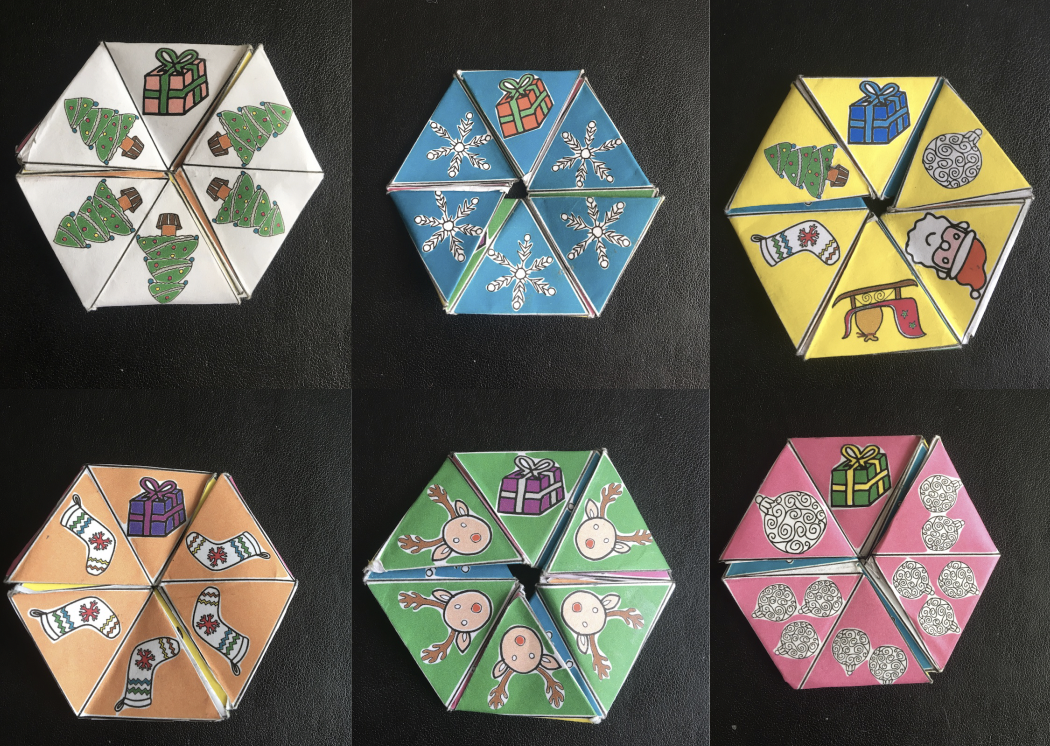
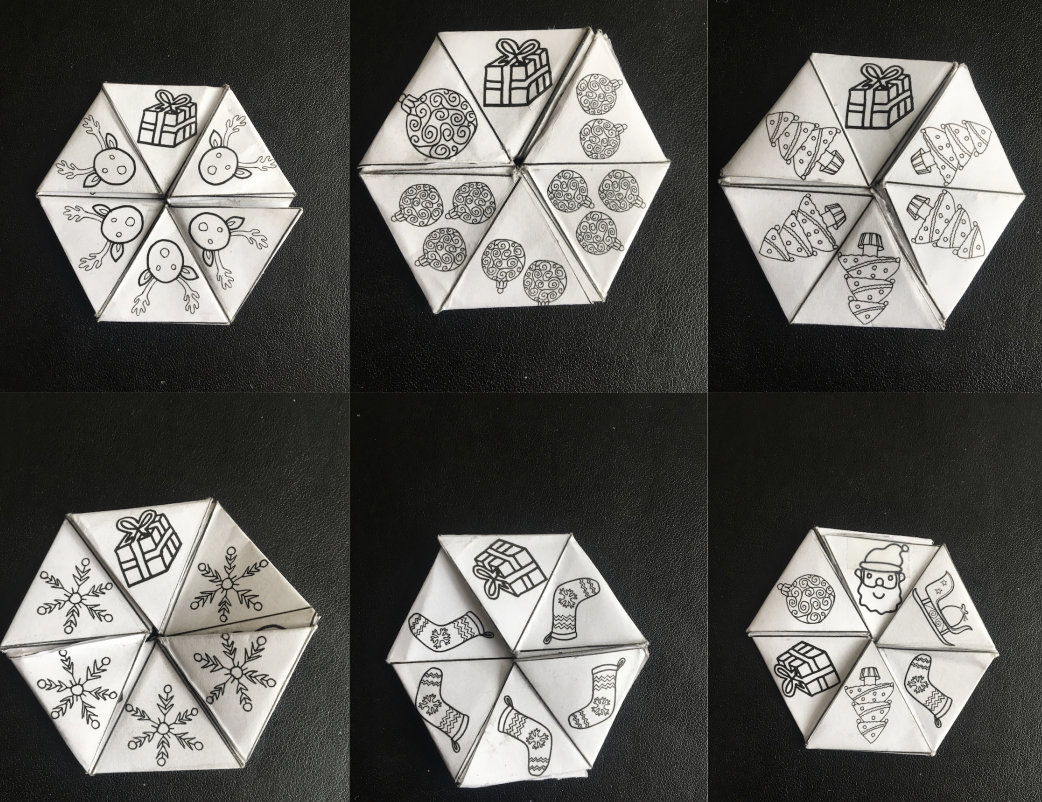
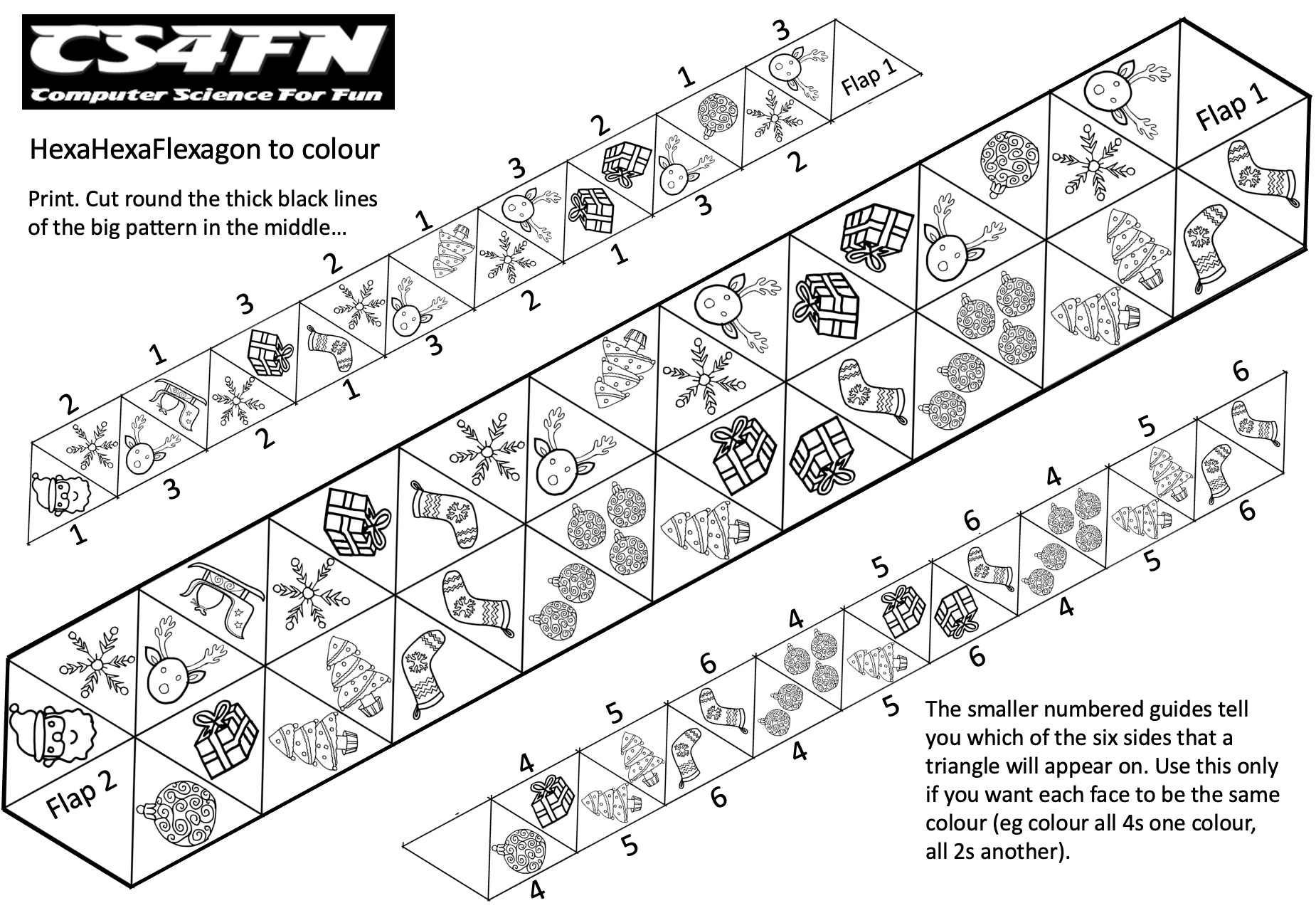
There are lots of ways to make them but we’ve created some templates to help. You can print our HexaHexaFlexagons or make and decorate your own from scratch. Ours depict Father Christmas looking for the six presents he’s lost among the different faces but there’s a blank template if you’d like to design your own.
Click here to download the patterns for printing. There are black and white ones for you to colour in yourself as well as an already-coloured one. There are also blank templates for you to make your own.
The six faces of our ready-to-print hexahexaflexagon. Image(s) by Jo Brodie.
There’s a gift on side one, and another if you turn the hexahexaflexagon over. Another 4 to find inside the flexagon. Image by Jo Brodie
Image by Jo Brodie
(Updated for 2023, now with US Letter size files in addition to A4 files)
Father Christmas has lost six of his presents inside this flexagon. The first two are easy to find but can you uncover the other four?
By folding and unfolding the flexagon, perhaps you can find them for him
Print and make your own hexahexaflexagon and help Father Christmas find the missing gifts.
Print (or draw) your flexagon
Cut it out, then fold it following the instructions
Find all of Father Christmas’ lost gifts by pinching and folding the flexagon to reveal the hidden faces
A hexahexaflexagon is a six sided shape (hexagon) which also has six faces in total (hexa-hexa) and which can flex and fold to show a new face (flexagon). They are fun to make and play with but can also be used to learn some computational thinking. To get to each face or side you may need to follow a variety of paths, you can’t always get to every face from every other face. The sides you can reach depend on the sides you currently have visible – it’s a ‘finite state machine’ and you can create a map to describe how you navigate around your hexahexaflexagon. See our page on Computational Thinking: HexaHexaFlexagon Automata and download our free booklet (PDF) to find out more. We definitely recommend this as an end-of-term classroom activity.
Table of Contents A. For people who want a ready-coloured hexahexaflexagon – print and go B. For people who want to colour in their own hexahexaflexagon – print & colour in C. For people who want to design their own hexahexaflexagon on a computer D. For people who don’t have a printer or want to design a hexahexaflexagon from scratch E. Useful videos
A. For people who want a ready-coloured hexahexaflexagon
It may be easier to make the flexagon first then colour it in, then it’s easier to see which triangle is on which face, but the printable does have instructions in if you want to make one that will ‘work’ once folded.
D. For people who don’t have a printer or who want to create one from scratch
Above: CS4FN’s Paul Curzon demonstrates how to fold one (note that the direction of the first round of folding is different from the written instructions above, though it doesn’t matter if you go from A to B or B to A).








 cs4fn
cs4fn 