Musical Algorithms

How can a machine generate music? It needs an algorithm to follow: instructions to tell it what to do, step by step. Here are two simple games to play that compose a random tune by algorithm.

Writing Notes

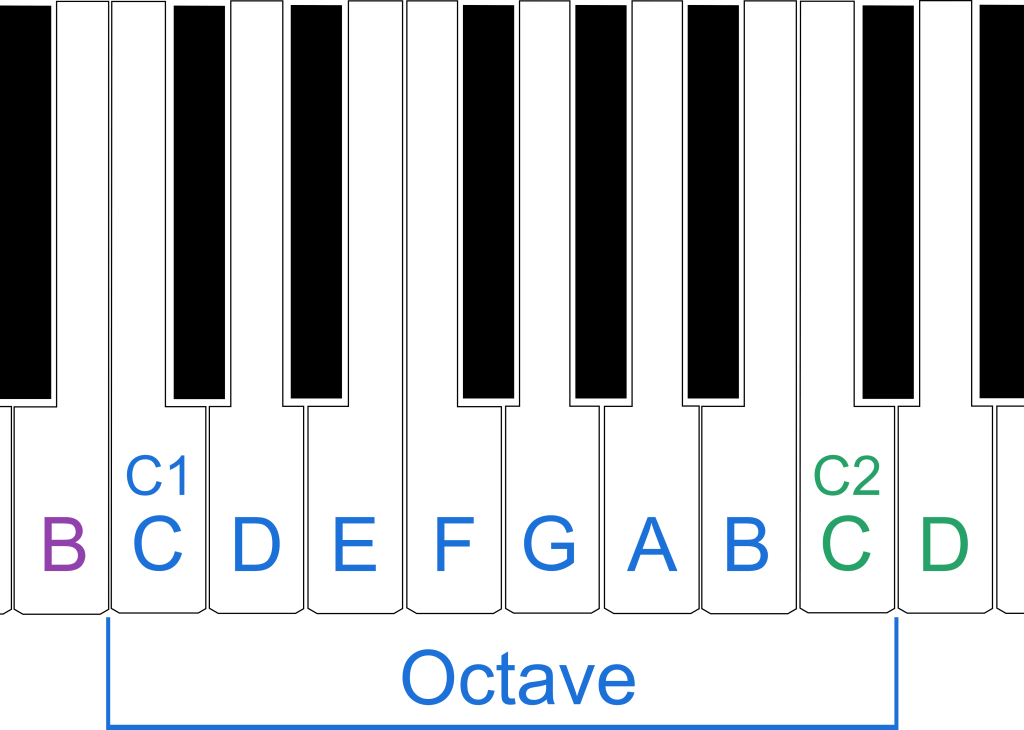
We need a way to write notes. We use letters A to G as on a piano. They repeat all the way up the white keys, so after G comes different higher versions of A, B, C again. We will use notes running from what is called Middle C in the middle of the piano to the next C up. This is called an octave. We will call the two Cs, C1 and C2.

Piano keys

Image (edited) by OpenClipart-Vectors from Pixabay

Game 1: Random Jumps

Roll two dice and add the numbers. Write down the note given in the table for Game 1, so if they add to 2 or 3 write down C1, if 4 write down D…If 7 then you get to roll again, and so on. Keep going until you have written 15 notes to make a tune of 15 notes.
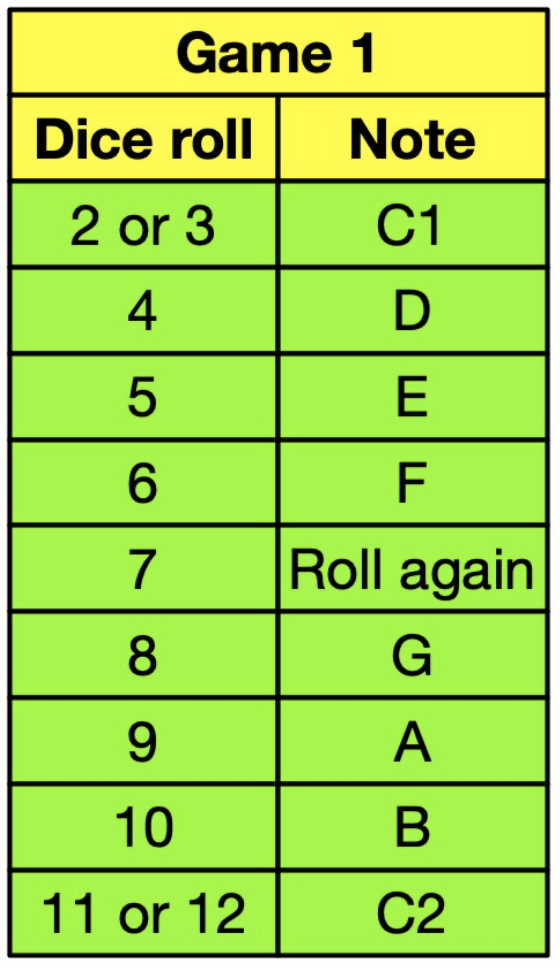
Game 1 by CS4FN

Game 2: Up and Down

The second algorithm uses one die. First write down C1 then roll the die and do what it says in the Game 2 table. Each new note is based on the last note. If you roll a 1 then write down D (the next note UP from C1). Rolling a 6 means add a pause in the tune (write a dash). If the roll takes you beyond either C then you bounce back: so rolling a 4 when you last wrote C1 means you write C1 again. Rolling 5 from C1 bounces you up to E. Continue until you have 15 notes.
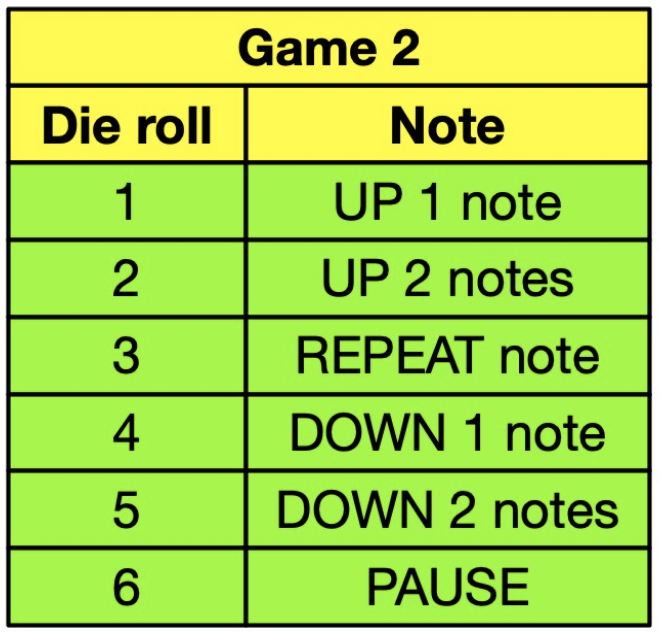
Game 2 by CS4FN

Play your tunes

Play your tunes on any instrument or use a free online piano (see https://bit.ly/pianoCS4FN).

Are they any good? Does either game give better tunes? 

Good music isn’t just random notes. That is why we pay composers to come up with the really good stuff! Both human and machine composers learn more complicated patterns of what makes good music.

What do you think of our musical masterpiece?

On Game 1 we rolled 6 4 8 8 8 | 5 9 4 9 6 | 5 6 9 9 10 so our tune is F D G G G | E A D A F | E F A A B

Make your tunes special!

See how on the Bach Google Doodle page.

Starburst by CS4FN

Here’s what our tune sounds like once harmonies have been added.

Could you improve your tunes by tweaking the notes? Some people use simple algorithms to spark human creativity like that. Rock legend David Bowie helped write a program he then used to write songs. It took random sentences from different places, split them in half and swapped the parts over to give him ideas for interesting lyrics. It was possibly the first algorithm to help write hit songs.

A ‘note’ on bias

Think about the numbers that are rolled and the number of different ways that each number can be produced. For example with two dice (let’s call them ‘left’ and ‘right’) you can make the number 9 twice by rolling a 5 with the left and 4 with the right, or 4 with the left and 5 with the right. Same with 6 and 3. There are only two ways to roll a 2 (both dice have to show 1) or a 3 (a 1 and a 2 or a 2 and a 1). This is baked in to the process and so will affect the notes that appear most often.

By Jo Brodie and Paul Curzon, Queen Mary University of London


More on…

We have LOTS of articles about music, audio and computer science. Have a look in these themed portals for more:


The Music and AI pages are sponsored by the EPSRC (UKRI3024: DA EPSRC university doctoral landscape award additional funding 2025 – Queen Mary University of London).

Subscribe to be notified whenever we publish a new post to the CS4FN blog.


The robot always wins

Children playing Rock Paper Scissors (Janken)
image by HeungSoon from Pixabay

Researchers in Japan made a robot arm that always wins at rock, paper, scissors (a game completely of chance). Not with ultra-clever psychology, which is the way that the best humans play, but with old-fashioned cheating. The robot uses high-speed motors and precise computer vision systems to recognise whether its human opponent is making the sign for rock, paper or scissors. One millisecond later, it can play the sign that beats whatever the human chooses. Because the whole process is so quick, it looks to humans like the robot is playing at the same time. See for yourself by following the link below to watch the video of this amazing cheating robot.

Watch …

Paul Curzon, Queen Mary University of London

Did you know?

The word ‘robot’ came to the English language over 100 years ago in the early 1920s. Before that the words ‘automaton’ or ‘android’ were used. In 1920 Czech playwright Karel Čapek published his play “R.U.R.” (Rossum’s Universal Robots, or Rossumovi Univerzální Roboti) and his brother Josef suggested using ‘roboti’, from the Slavic / Czech word meaning ‘forced labour’. In the late 1930s there was a performance of the play at the People’s Palace in London’s Stepney Green / Mile End – this building is now part of Queen Mary University of London (some of our computer science lectures take place there) and, one hundred years on, QMUL also has a Centre for Advanced Robotics.

More on …


Related Magazine …


Subscribe to be notified whenever we publish a new post to the CS4FN blog.


This blog is funded by EPSRC on research agreement EP/W033615/1.

QMUL CS4FN EPSRC logos

Kakuro, Logic and Computer Science

Kakuro Fragment
Part of a Kakuro puzzle. Image by PC

To be a good computer scientist you have to enjoy problem solving. That is what it’s all about: working out the best way to do things. You also have to be able to think in a logical way: be a bit of a Vulcan. But what does that mean? It just means being able to think precisely, extracting all the knowledge possible from a situation just by pure reasoning. It’s about being able to say what is definitely the case given what is already known…and it’s fun to do. That’s why there is a Suduko craze going on as I write. Suduko are just pure logical thinking puzzles. Personally I like Kakuro better. They are similar to Soduko, but with a crossword format.

What is a Kakuro?

A Kakuro is a crossword-like grid, but where each square has to be filled in with a digit from 1-9 not a letter. Each horizontal or vertical block of digits must add up to the number given to the left or above, respectively. All the digits in each such block must be different. That part is similar to Soduko, though unlike Soduko, numbers can be repeated on a line as long as they are in different blocks. Also, unlike Soduko, you aren’t given any starting numbers, just a blank grid.

Where does logic come into it? Take the following fragment:

Kakuro Start - part of a Kakuro puzzle
Part of a Kakuro Puzzle. Image by PC

There is a horizontal block of two cells that must add up to 16. Ways that could be done using digits 1-9 are 9+7, 8+8 or 7+9. But it can’t be 8+8 as that needs two 8s in a block which is not allowed so we are left with just two possibilities: 9+7 or 7+9. Now look at the vertical blocks. One of them consists of two cells that add up to 17. That can only be 9+8 or 8+9. That doesn’t seem to have got us very far as we still don’t know any numbers for sure. But now think about the top corner. We know from across that it is definiteley 9 or 7 and from down that it is definitely 9 or 8. That means it must be 9 as that is the only way to satisfy both restrictions.

A Kakuro for you to try

A Kakuro puzzle for you to try. Image by PC

Here is a full Kakuro to try. There is also a printer friendly pdf version. Check your answer at the very end of this post when you are done.

Being able to think logically is important because computer programming is about coming up with precise solutions that even a dumb computer can follow. To do that you have to make sure all the possibilities have been covered. Reasoning very much like in a Kakuro is needed to convince yourself and others that a program does do what it is supposed to.

– Paul Curzon, Queen Mary University of London


More on …


Related Magazine …

This article was included on Day 11 (The proof of the pudding… mathematical proof) of the CS4FN Advent Calendar in December 2021. Before that it was originally published on CS4FN and can also be found on page 16 of CS4FN Issue 3, which you can download as a PDF below. All of our free material can be downloaded here: https://cs4fndownloads.wordpress.com/

Subscribe to be notified whenever we publish a new post to the CS4FN blog.


This blog is funded by EPSRC on research agreement EP/W033615/1.

QMUL CS4FN EPSRC logos

The answer to the kakuro above

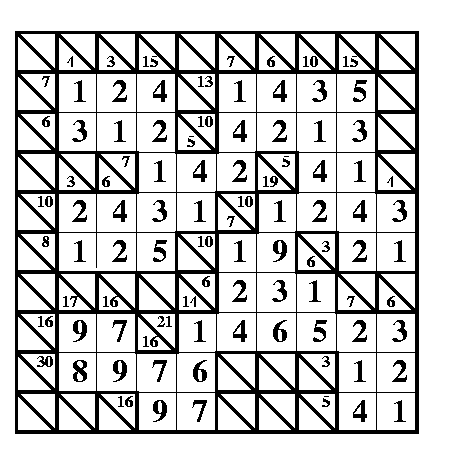
Answer for the kakuro
A correctly filled in answer for the kakuro puzzle: Image by PC