Bank holiday bunting!

Chain of bunting flags
Image adapted by PC based on one by Clker-Free-Vector-Images from Pixabay

Bank holiday bunting appears automatically on the GOV.UK website thanks to a little program! If you’re reading this post today (Monday 21 April 2025) it’s Easter Monday which is a Bank Holiday in England & Wales and in Northern Ireland you have a chance to see it.

The UK Government’s website has a UK Bank Holidays page which lists all the upcoming dates for the next two years’ worth of bank holidays (so people can put them in the diaries) for England & Wales, Northern Ireland and Scotland (the different UK nations share many but not all bank holidays).

Bunting on the UK bank holidays page – appears whenever there’s an appropriate bank holiday.
Screenshot taken today (Monday 21st April 2025) – the bunting won’t be there tomorrow.

But… if you visit the page on a Bank Holiday then you may be met with some bunting, which doesn’t appear if you visit the page on a non-bank holiday day. People who look after the website added in this little Easter egg* over a decade ago and people have been discovering it ever since. They use an Application Program Interface (API) which connects the bank holiday website to a database which lets the website check, whenever there’s a bank holiday, whether it should display bunting. For example Easter Monday is a celebratory day in the Christian calendar but Good Friday isn’t. Both are holidays but it wouldn’t be appropriate for bunting on Good Friday so it gets the instruction “bunting: false” whereas Easter Monday is “bunting: true”. You can see the API’s instructions here.

If you’re reading this post after Easter Monday 2025 you’ll still have a few more chances to catch the bunting on 5 May (Early May bank holiday) and 26 May (Spring bank holiday) then you’ll need to wait until August for the Summer bank holiday then a few more weeks before Christmas Day, Boxing Day and New Year’s Day and New Year’s Day – on those days the bunting changes to tinsel!

*it’s not called an Easter egg because it’s there at Easter, the bunting is there at other times too but because it’s something to discover (like Easter Egg Hunts – find ours at The CS4FN Easter Egg Hunt).


10 Downing Street has a bunting competition to celebrate VE Day

10 Downing Street VE Day Children’s Bunting Competition – closes 23 April 2025

VE Day commemorates ‘Victory in Europe’ which was declared on 8th May 1945, at the end of the second world war. The celebration in 2025 is the 80th anniversary of the event . Children around the UK have been invited to draw some celebratory bunting to decorate 10 Downing Street (the home of the UK Prime Minister) and the competition closes on Wednesday 23rd April 2025.

Find out more, download the triangular bunting template and enter the competition.

We want to see bunting designs that are colourful, patriotic, and full of creativity and heart.

Designs should look back on years of tradition, commemorate the fallen, and recognise the sacrifices made by communities across the UK during the war.

We also encourage a message of thanks and hope for the future.

There are several street parties and other events taking place across the UK to celebrate VE day including, on Monday 5th May in London, a televised event that includes a flypast of old and new military aircraft.

Jo Brodie, Queen Mary University of London

This is an updated version of a snippet that appeared previously on this blog.


Part of a series of ‘whimsical fun in computing’ to celebrate April Fool’s (all month long!).
Find out about some of the rather surprising things computer scientists have got up to when they're in a playful mood.

Subscribe to be notified whenever we publish a new post to the CS4FN blog.


This page is funded by EPSRC on research agreement EP/W033615/1.

QMUL CS4FN EPSRC logos

Bank holiday fun: website whimsy, and try your hand at making 3D pictures

Website whimsy 1 – the UK Government (surprisingly)!

If you’re reading this post today (Monday 26th August 2024) it’s a Bank Holiday in England & Wales and in Northern Ireland. The UK Government’s website has a page https://www.gov.uk/bank-holidays which lists all the upcoming dates for the next two years’ worth of bank holidays (so people can put them in the diaries). But… if you visit the page on a Bank Holiday then you’ll be met with some bunting, which isn’t there on the other days. If you’re reading this post tomorrow then you’ll have to wait until the next Bank Holidays, which are Christmas, Boxing Day then New Year’s Day. On those days the bunting changes to tinsel!

Website whimsy 2 – Wikipedia

Throughout history people have tried to make money and sometimes they do so rather dishonestly. Occasionally people claim that they have a qualification in a subject – in the hope that this will make people trust them, and give them money.

Normally it takes time and effort to get a genuine qualification (and for some qualifications it costs money too). A qualification that is suspiciously easy to get (just make a payment and then get a certificate) raises red flags and if someone thinks someone else’s qualification might be fraudulent there’s a fun way they can draw attention to this.

There’s a page on Wikipedia currently called “List of animals awarded human credentials” (but it used to have the even better name “List of animals with fraudulent diplomas” (and before that it was “List of cats with fraudulent diplomas” until people started adding more animals!)). It’s full of examples where people filled in an online form and paid a fee, using their pet’s name as the ‘person’ to be awarded. If someone claims a particular credential but someone else was able to get the same credential for their dog by paying $50 and filling in a form… well, don’t give them any money!

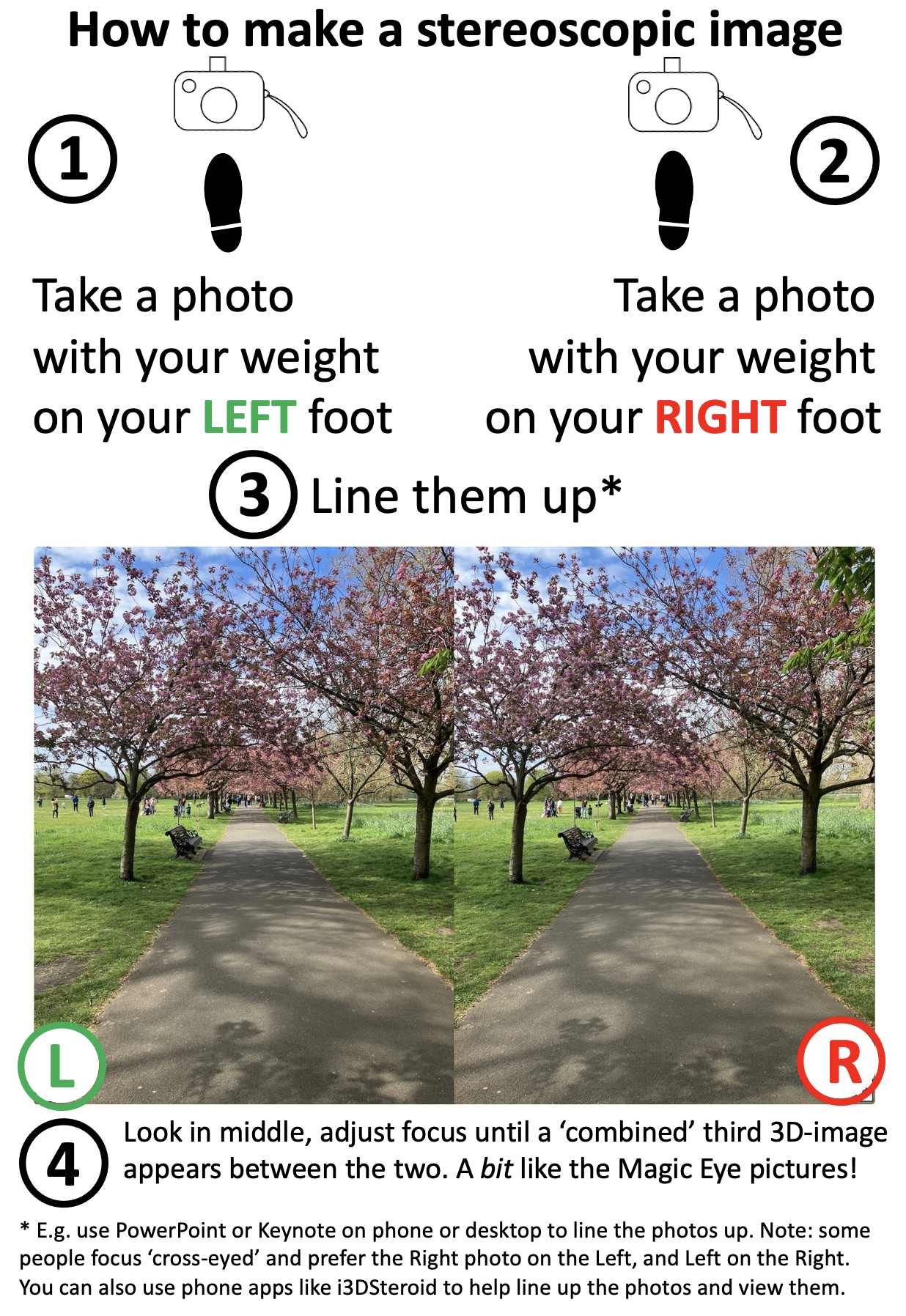
Try your hand at making 3D pictures with stereoscopy

Bank Holiday weather is famous for being inconveniently changeable but if the rain holds off and you’re out and about with a smartphone camera (or any camera) then you can quite easily create some 3D images with them (you can do this indoors too of course). We’ve put together some basic instructions (below) and some more detailed information, in case teachers might also like to try this in class some time. (If the weather is off-putting there are also some ready-to-use images in that link).

Basic instructions: take two photos a few inches apart, line them up, gaze between them and adjust your focus until a third image appears between them which combines the two images into one that has depth perception. This is just recreating what your eyes do naturally every day – combining what your left eye and your right eye see separately into one view of the world around you.

Photographs and icons created by Jo Brodie for CS4FN.

Subscribe to be notified whenever we publish a new post to the CS4FN blog.


This page is funded by EPSRC on research agreement EP/W033615/1.
QMUL CS4FN EPSRC logos