North America is now a powerhouse of Computer Science and technology but, Latin America, South America and indigenous American populations across the continent are all part of the story too. Here we focus on those lesser told stories of research from or inspired by the Americas.
“Tlahcuilo”, a visual composer
A main goal of computational creativity research is to help us better understand how this essential human characteristic, creativity, works. By building computer models of the processes we think are behind creativity, we can start to probe how creativity really works. … (read on)
Can a computer tell a good story?

What’s your favourite story? Perhaps it’s from a brilliant book you’ve read: a classic like Pride and Prejudice or maybe Twilight, His Dark Materials or a Percy Jackson story? Maybe it’s a creepy tale, or a favourite bedtime story from when you were a toddler? Could your favourite story have been written by a machine? … (read on)
Navajo Code Talkers
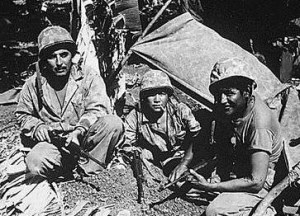
One if the most successful code-creating teams of World War II were Navajo. The Navajo “Code Talkers” as they were called, could encode, transmit and decode messages in minutes when it would take hours using conventional codes and ciphers. … (read on)
Quipu: tie a knot in it

Quipu (the Quechua word for ‘knot’), used by the Incas, are knotted, and sometimes differently coloured, strings, made from the hair fibres of llamas or alpacas. They were an early number representation and many of them formed a simple kind of database …. (read on)
Reclaim your name

In 2021 the Canadian government announced that Indigenous people could use their ancestral family names on identity documents. Because of computers, it wasn’t quite as easy as that though … (read on)
A Godlike Heart

A short story that is a Computer Science folk tale by Rafael Pérez y Pérez of the Universidad Autónoma Metropolitana, México set in ancient México… (read on)
The last speaker

The languages of the world are going extinct at a rapid rate. As the numbers of people who still speak a language dwindle, the chance of it surviving dwindles too. As the last person dies, the language is gone forever. Could AI chatbots help preserve spoken languages ... (read on).
Turn Right in Tenejapa

Designing software that is inclusive for global markets is easy. All you have to do is get an AI to translate everything in the interface into multiple languages…or perhaps to do it properly it is harder than that! Not everyone thinks like you do… (read on)
More to come (of course)
Find more diverse diversity on our diversity pages here.
Subscribe to be notified whenever we publish a new post to the CS4FN blog.
This blog is funded by EPSRC on research agreement EP/W033615/1.

 cs4fn
cs4fn 