Table of Contents
Articles about health & computing
In this portal you can read articles about how computer scientists’ research contributes to improvements in the diagnosis and treatment of disease. You can also find out about some computing-related jobs and careers in health.
This portal was inspired by the Barts & Queen Mary Science Festival, an annual online event for older secondary school pupils who might be thinking about a career in medicine or STEM. Paul Curzon will be giving a talk at the 2024 festival on “The illusion of good medical device design“. You can also read about the 2021, 2022 and 2023 festivals.
Machines making medicine safer

We have an entire CS4FN magazine, issue 17, dedicated to computing and human-computer interaction in medicine with a particular focus on making medical devices safer through better design, and understanding the people who use them. Click here or the picture of the magazine on the left to download the issue as a free PDF. Some of the articles from the magazine are available below as articles too. This magazine is particularly relevant to Paul Curzon’s talk.
- Nurses in the Mist – to design a really good medical device you have to really understand how various people will use or interact with it and design with them in mind. This article is about a team of medical device system engineers spending time in a hospital acting as anthropologists: shadowing nurses, talking to patients and the porters who help them get from one place to another to understand how to make better medical devices.
- Pit-stop heart surgery – the collaborative teamwork in complex surgery has some parallels with the collaborative teamwork found in Formula 1 racing where wheels are changed at lightning speeds but a co-ordinated effort makes sure the car doesn’t move until everyone’s safely out of the way. Find out about how learning from the pit-stop can be applied to heart surgery.
Smart Health – the Pambayesian project
Issue 27 of the CS4FN magazine is about the use of decision-making tools in healthcare. Find out about the modern use of Bayes’ Theorem to help doctors and patients decide how best to treat long-term conditions. Click the picture or this link to download a free PDF copy of the magazine.
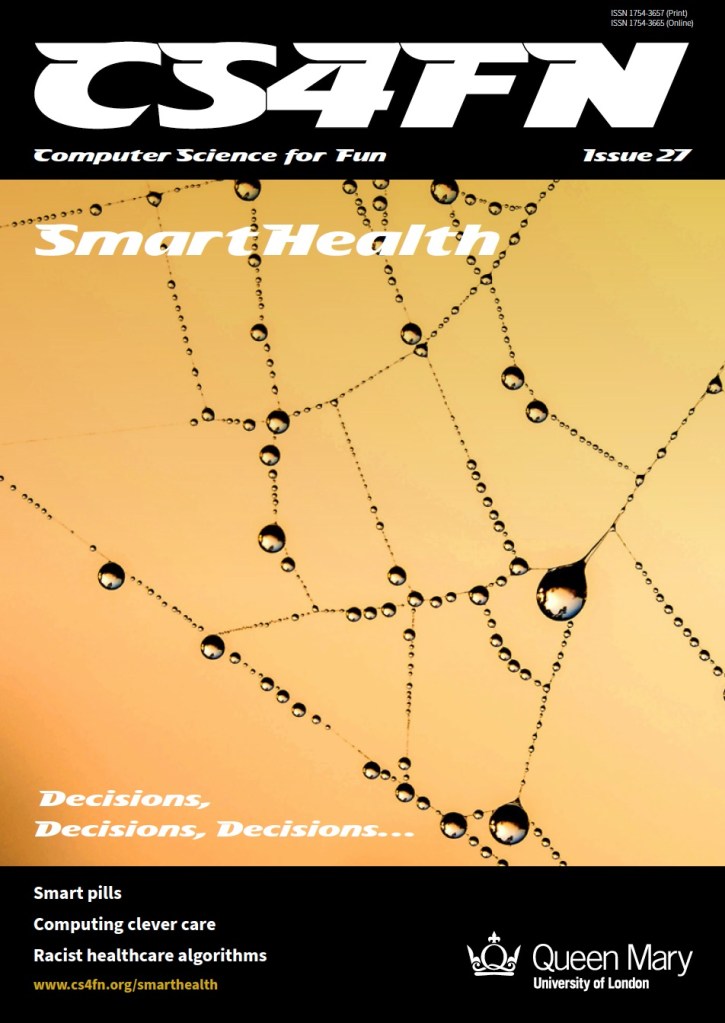
- How do you solve a problem like arthritis? – investigating a way to make a smarter app that monitors a patient’s changes in their symptoms and which could help them find the best time to make a doctor’s appointment to adjust their medication.
- Is your healthcare algorithm racist? – to prevent bias, treatment decisions based on lots of previous patient data will only be valid if the full range of patients is included.
- Here – an app to help reduce anxiety by helping the user focus on the here and now, by looking for coloured objects in the real world.
AMPER: AI helping future you remember past you

As we get older we create more memories but we might start to forget too. Sometimes a prompt can remind us of something that we thought we’d forgotten. The researchers behind ‘AMPER’ are creating an AI-based reminiscence prompting device to help people with dementia remember better. [Read the article]
Computer modelling
- Executable Biology – computing cancer using computational modelling – simulating human cells and experimenting on them, in a computer
- Understanding matters of the heart – creating accurate computer models of human organs – using computer science to knit together MRI scans to produce a 3D model of the heart.
More computer science in health articles
Archived jobs in health & computing
Below are job adverts and descriptions for a variety of jobs that are closed, but which give useful information about the sort of roles that are available for people interested in computer science and health. These jobs are archived at our sister site TechDev Jobs – there are over 60 archived jobs in computer science (and related roles) there.
Jobs that were advertised here at QMUL
- AI Researcher: Researcher in Machine Learning /AI (this job closed in September 2023) – QMUL’s William Harvey Research Institute were looking for someone with data science and statistical analysis skills to work on a project to spot patterns in data that might help in preventing heart disease.
- Junior Software Developer / Data Scientist (closed in February 2023) – Barts and The London School of Medicine and Dentistry were looking for someone with Python skills and a familiarity with medical terminology to work in the Bioinformatics team on a project to annotate variations in the human genome with a focus on cancer research.
- Post-Doc Data Scientist (closed October 2022) – this role advertised for a data scientist working in breast cancer research who would develop an AI algorithm based on digital mammograms to try and predict the long-term future risk of developing the disease in someone whose mammogram is currently clear.
- Data Scientist & Science Communicator (closed April 2022) – a mixed data science role on a Healthy Aging project involving the use of machine learning techniques to analyse large data sets relating to metabolic ageing and also communicating the results of their research to colleagues at QMUL, other scientists and the public.
- Senior Research Application Programmer (closed 2019) – Barts Cancer Institute sought a candidate to develop applications for cancer-related clinical trials (the way new medicines and other treatments are tested) who was familiar with the importance of data protection in clinical trial design.
Jobs that were advertised elsewhere
- Four research jobs (for people wishing to gain a PhD qualification) on the ‘Dramaturgy for Devices’ project in the Netherlands (these jobs closed in January 2024) – robotic devices are already in use as companions, for example reducing loneliness in older people. This project draws on dramaturgy (the study of theatre and performance) to learn how robots can be designed to better interact with people.
- Four jobs in patient charities / medical research charities
- Duchenne UK, Head of Patient Data (closed January 2024) – the charity was looking for someone who has expertise in health data collection and in designing systems to house that data safely and logically.
- Asthma UK, Health Data Analyst (closed August 2022) – they wanted someone to analyse data to find new insights on the impact of lung conditions. The person also needed to be able to communicate their findings to a variety of audiences, from experts to people with asthma and other lung conditions.
- Cancer Research UK, Senior Software Engineer (closed January 2021) – the charity wanted someone who could provide the infrastructure for their website, fundraising platforms, payments, events etc. This role wasn’t directly related to health (in terms of diagnosis or treatment) but helped to provide the underlying online support for people with cancer to be able to access information.
- Brain Tumour Charity, Data Scientist (closed in November 2020) – this charity wanted someone who understands how to analyse data from databases and is also able to communicate that with a wide range of audiences, particularly in raising awareness of brain tumours.
- Bennett Institute for Applied Data Science, Software developers x2 (closed January 2021) – two posts (one for a Python expert, the other for an expert in HTML and JavaScript) to analyse NHS data, advocate for better use of software in the NHS and campaign for researchers to make their code open source.
Click the Portals image below to uncover our other themed pages.

EPSRC supports this blog through research grant EP/W033615/1.
 cs4fn
cs4fn 