Film Futures: The Lord of the Rings

Image by Ondřej Neduchal from Pixabay

What if there was Computer Science in Middle Earth?…Computer Scientists and digital artists are behind the fabulous special effects and computer generated imagery we see in today’s movies, but for a bit of fun, in this series, we look at how movie plots could change if they involved Computer Scientists. Here we look at an alternative version of the film series (and of course book trilogy): The Lord of the Rings.

***SPOILER ALERT***

The Lord of the Rings is an Oscar winning film series by Peter Jackson. It follows the story of Frodo as he tries to destroy the darkly magical, controlling One Ring of Power, by throwing it in to the fires of Mount Doom at Mordor. This involves a three film epic journey across Middle Earth where he and “the company of the Ring” are chased by the Nazgûl, the Ringwraiths of the evil Sauron. Their aim is to get to Mordor, without being killed and the Ring taken from them and returned to Sauron who created it, or it being stolen by Golem who once owned it.

The Lord of the Rings: with computer science

In our computer science film future version, Frodo discovers there is a better way than setting out on a long and dangerous quest. Aragorn, has been tinkering with drones in his spare time, and so builds a drone to carry the Ring to Mount Doom controlled remotely. Frodo pilots it from the safety of Rivendell. However, on its first test flight, its radio signal is jammed by the magic of Saruman from his tower. The drone crashes and is lost. It looks like a the company must set off on a quest after all.

However, the wise Elf, the Lady Galadriel suggests that they control the drone by impossible-to-jam fibre optic cable. The Elves are experts at creating such cables using them in their highly sophisticated communication networks that span Middle Earth (unknown to the other peoples of Middle Earth), sending messages encoded in light down the cables.

They create a huge spool containing the hundreds of miles needed. Having also learnt from their first attempt, they build a new drone that uses stealth technology devised by Gandalf to make it invisible to the magic of Wizards, bouncing magical signals off it in a way that means even the ever watchful Eye of Sauron does not detect it until it is too late. The new drone sets off trailing a fine strand of silk-like cable behind, with the One Ring within. At its destination, the drone is piloted into the lava of Mount Doom, destroying the ring forever. Sauron’s power collapses, and peace returns to Middle Earth. Frodo does not suffer from post-traumatic stress disorder, and lives happily ever after, though what becomes of Golem is unknown (he was last seen on Mount Doom through the Drones camera, chasing after it, as the drone was piloted into the crater).

In real life…

Drones are being touted for lots of roles, from delivering packages to people’s doors to helping in disaster emergency areas. They have most quickly found their place as a weapon, however. At regular intervals a new technology changes war forever, whether it is the long bow, the musket, the cannon, the tank, the plane… The most recent technology to change warfare on the battlefield has been the introduction of drone technology. It is essentially the use of robots in warfare, just remote controlled, flying ones rather than autonomous humanoid ones, Terminator style (but watch this space – the military are not ones to hold back on a ‘good’ idea). The vast majority of deaths in the Russia-Ukraine war on both sides have been caused by drone strikes. Now countries around the world are scrambling to update their battle readiness, adding drones into their defence plans.

The earliest drones to be used on the battlefield were remote controlled by radio, The trouble with anything controlled that way is it is very easy to jam – either sending your own signals at higher power to take over control, or more easily to just swamp the airwaves with signal so the one controlling the drone does not get through. The need to avoid weapons being jammed is not a new problem. In World War II, some early torpedoes were radio controlled to their target, but that became ineffectual as jamming technology was introduced. Movie star Hedy Lamar is famous for patenting a mechanism whereby a torpedo could be controlled by radio signals that jumped from frequency to frequency, making it harder to jam (without knowing the exact sequence and timing of the frequency jumps). In London, torpedo stations protecting the Thames from enemy shipping had torpedoes controlled by wire so they could be guided all the way to the target. Unfortunately though it was not a great success, the only time one was used in a test it blew up a harmless fishing boat passing by (luckily no-one died).

And that is the solution adopted by both sides in the Ukraine war to overcome jamming. Drones flying across the front lines are controlled by miles of fibre optic cable that is run out on spools (tens of miles rather than the hundreds we suggested above). The light signals controlling the drone, pass down the glass fibre so cannot be jammed or interfered with. As a result the front lines in the Ukraine are now criss-crossed with gossamer thin fibres, left behind once the drones hit their target or are taken out by the opposing side. It looks as though the war is being fought by robotic spiders (which one day may be the case but not yet). With this advent of fibre-optic drone control, the war has changed again and new defences against this new technology are needed. By the time they are effective, likely the technology will have morphed into something new once more.

– Paul Curzon, Queen Mary University of London

More on …

Subscribe to be notified whenever we publish a new post to the CS4FN blog.


This page is funded by EPSRC on research agreement EP/W033615/1.

QMUL CS4FN EPSRC logos

Shirts that keep score

Basketball player with shirt in mouth
Image by 愚木混株 Cdd20 from Pixabay 

When you are watching a sport in person, a quick glance at the scoreboard should tell you everything you need to know about what’s going on. But why not try to put that information right in the action? How much better would it be if all the players’ shirts could display not just the score, but how well each individual is doing?

Light up, light up

An Australian research group from the University of Sydney has made it happen. They rigged up two basketball teams’ shirts with displays that showed instant information as they played one another. The players (and everyone else watching the game) could see information that usually stays hidden, like how many fouls and points each player had. The displays were simple coloured bands in different places around the shirt, all connected up with tiny wires sewn into the shirts like thread. For every point a player got, for example, one of the bands on the player’s waist would light up. Each foul a player got made a shoulder band light up. There was also a light on players’ backs reserved for the leading team. Take the lead and all your team’s lights turned on, but lose it again and they went dark with defeat.

Sweaty but safe

All those displays were controlled by an on-board computer that each player harnessed to his or her body. That computer, in turn, was wirelessly connected to a central computer that kept track of winners, losers, fouls and baskets. The designers had to be careful about certain things, though. In case a player fell over and crushed their computer, the units were designed with ‘weak spots’ on purpose so they would detach rather than crumple underneath the player. And, since no one wants to get electrocuted while playing their favourite sport, the designers protected all the gear against moisture and sweat.

Keeping your head in the game

In the end, it was the audience at the game who got the most out of the system. They were able to track the players more closely than they normally would, and it helped those in the crowd who didn’t know much about basketball to understand what was going on. The players themselves had less time to think about what was on everyone’s clothes, as they were busy playing the game, but the system did help them a few times. One player said that she could see when her teammate had a high score, “and it made me want to pass to her more, as she had a ‘hot hand'”. Another said that it was easier to tell when the clock was running down, so she knew when to play harder. Plus, just seeing points on their shirts gave the players more confidence. There’s so much information available to you when you watch a game on television that, in a weird way, actually being in the stadium could make you less informed. Maybe in the future, the fans in the stands will see everything the TV audience does as well, when the players wear all their statistics on their shirts! We’ll see what the sponsors think of that…

the CS4FN team, Queen Mary University of London (From the archive)

More on …

Related Magazines …


This blog is funded through EPSRC grant EP/W033615/1.

QMUL CS4FN EPSRC logos

Are you there yet?

Plenty of people love the Weasley family’s clock from the Harry Potter books and films. It shows where members of the family are at any given time. Instead of numbers giving the time, the clock face has locations where someone might be (home, school, shopping) and the many hands on the clock show the family members. The wizarding world uses magic to make their whereabouts clock work, but muggles (and squibs) can use mobile network data to build a simple version, and use Bayesian networks to improve it.

A cell phone tower looking up from inside to a blue sky
Image by Alistair McIntyre from Pixabay

Your mobile phone is in contact with several cell towers in the mobile provider’s network. When you want to send a message, it goes first to the nearest cell tower before passing through the network, finally reaching your friend’s phone. As you move around, from home to school, for example, you will pass several towers. The closer you are to a tower the stronger the signal there, and the phone network uses this to estimate where you are, based on signal strength from several towers. This means that, as long as your phone is with you, it can act as a sensor for your location and track you, just like the Weasley’s whereabouts clock.

You could also have a similar system at home that monitors your location, so that it switches on the lights and heating as you get closer to home to welcome you back. On a typical day you might head home somewhere between 3 and 6pm (depending on after-school events) and as you leave school the connection to your phone from the tower nearest the school will weaken, but connections will strengthen with the other cell towers on your route home. But what if you appear to be heading home at 11 in the morning? Perhaps you are, or maybe actually the signal has just dropped from the tower nearest to the school so a tower nearer your home is now getting the strongest signal!

A system using Bayesian logic to determine ‘near home’ or ‘not near home’ can be trained to put things into context. Unless you are ill, it’s unlikely that you’d be heading home before the afternoon so you can use these predicted timings to give a likelihood score of an event (such as you heading home). A Bayesian network takes a piece of information (‘person might be nearby’) and considers this in the context of previous knowledge (‘and that’s expected at this time of day so probably true’ or ‘but is unlikely to be nearby now so more information is needed’). Unlike machine learning which just looks for any patterns in data, in a Bayesian networks approach the way one thing being considered does or does not cause other things is built in from the outset. Here it builds in the different possible causes of the signal dropping at a cell tower.

You could also set up a similar system in a home using wifi points to predict where you are and so what you are doing. Information like that could then feed data into a personalised artificial intelligence looking after you. Not all magic has to be run by magic!

by Jo Brodie, Queen Mary University of London, Spring 2021

Download Issue 27 of the cs4fn magazine on Smart Health here.

This post and issue 27 of the cs4fn magazine have been funded by EPSRC as part of the PAMBAYESIAN project. This article was inspired by

Inspired by the blog on Presence Detection Part 1: Home Assistant & Bayesian Probability and a previous cs4fn article on making a Whereabouts Clock.

Smart bags

In our stress-filled world with ever increasing levels of anxiety, it would be nice if technology could sometimes reduce stress rather than just add to it. That is the problem that QMUL’s Christine Farion set out to solve for her PhD. She wanted to do something stylish too, so she created a new kind of bag: a smart bag.

White smart handbag with LEDs
Image by Christine Farion

Christine realised that one thing that causes anxiety for a lot of people is forgetting everyday things. It is very common for us to forget keys, train tickets, passports and other everyday things we need for the day. Sometimes it’s just irritating. At other times it can ruin the day. Even when we don’t forget things, we waste time unpacking and repacking bags to make sure we really do have the things we need. Of course, the moment we unpack a bag to check, we increase the chance that something won’t be put back!

Electronic bags

Christine wondered if a smart bag could help. Over the space of several years, she built ten different prototypes using basic electronic kits, allowing her to explore lots of options. Her basic design has coloured lights on the outside of the bag, and a small scanner inside. To use the bag, you attach electronic tags to the things you don’t want to forget. They are like the ones shops use to keep track of stock and prevent shoplifting. Some tags are embedded into things like key fobs, while others can be stuck directly on to an object. Then when you pack your bag, you scan the objects with the reader as you put them in, and the lights show you they are definitely there. The different coloured lights allow you to create clear links – natural mappings – between the lights and the objects. For her own bag, Christine linked the blue light to a blue key fob with her keys, and the yellow light to her yellow hayfever tablet box.

In the wild

Black informal bag with LEDs
Image by Christine Farion

One of the strongest things about her work was she tested her bags extensively ‘in the wild’. She gave them to people who used them as part of their normal everyday life, asking them to report to her what did and didn’t work about them. This all fed in to the designs for subsequent bags and allowed her to learn what really mattered to make this kind of bag work for the people using it. One of the key things she discovered was that the technology needed to be completely simple to use. If it wasn’t both obvious how to use and quick and simple to do it wouldn’t be used.

Christine also used the bags herself, keeping a detailed diary of incidents related to the bags and their design. This is called ‘autoethnography’. She even used one bag as her own main bag for a year and a half, building it completely into her life, fixing problems as they arose. She took it to work, shopping, to coffee shops … wherever she went.

Suspicious?

When she had shown people her prototype bags, one of the common worries was that the electronics would look suspicious and be a problem when travelling. She set out to find out, taking her bag on journeys around the country, on trains and even to airports, travelling overseas on several occasions. There were no problems at all.

Red smart handbag with LEDs
Image by Christine Farion

Fashion matters

As a bag is a personal item we carry around with us, it becomes part of our identity. She found that appropriate styling is, therefore, essential in this kind of wearable technology. There is no point making a smart bag that doesn’t fit the look that people want to carry around. This is a problem with a lot of today’s medical technology, for example. Objects that help with medical conditions: like diabetic monitors or drug pumps and even things as simple and useful as hearing aids or glasses, while ‘solving’ a problem, can lead to stigma if they look ugly. Fashion on the other hand does the opposite. It is all about being cool. Christine showed that by combining design of the technology with an understanding of fashion, her bags were seen as cool. Rather than designing just a single functional smart bag, ideally you need a range of bags, if the idea is to work for everyone.

Now, why don’t I have my glasses with me?

by Paul Curzon, Queen Mary University of London, Autumn 2018

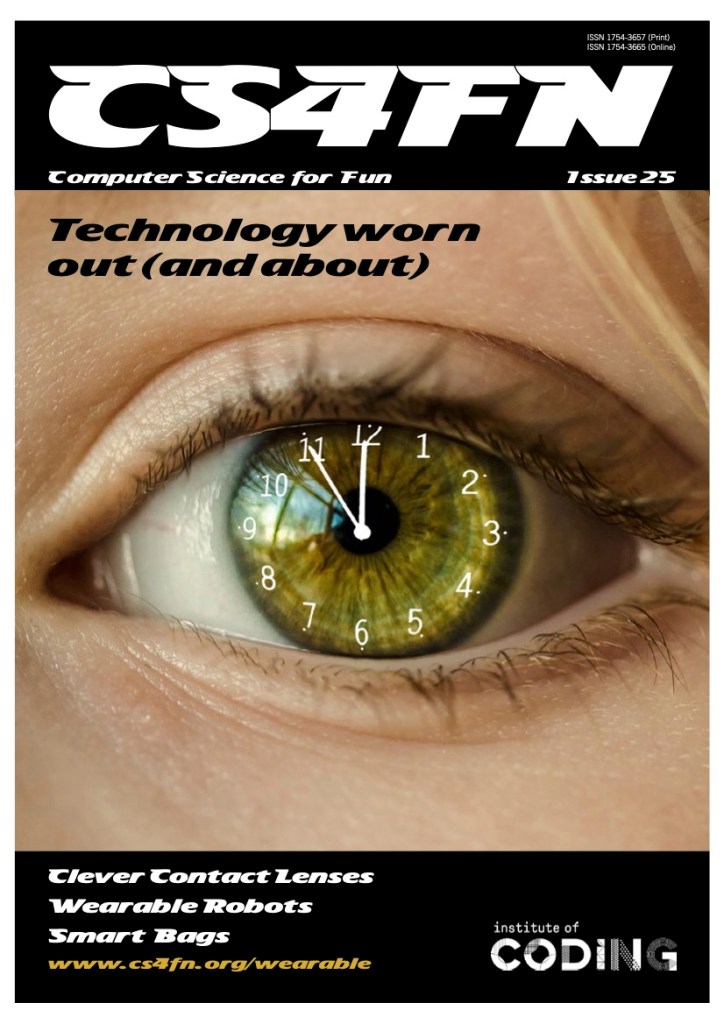
Download Issue 25 of the cs4fn magazine “Technology Worn Out (and about) on Wearable Computing here.