Skip to content

cs4fn

Computer Science for Fun

Category: Entertainment

Mood Gloves

A worried woman walking down steps in coat and hat. Film Noire.
Image by Roy Clarke from Pixabay
Image by Roy Clarke from Pixabay (cropped)

When we watch a film, it’s not just the pictures that make the experience, it’s the soundtrack too. The music and sound effects play a big part in setting the mood of a film. They matter. If you are to get the sinking feeling in your stomach or feel the shivers down your spine, it’s probably the music. QMUL’s Antonella Mazzoni wondered if other senses could contribute too … and designed a Mood Glove to find out.

Vibrations

We use touch as well as sight and sound to sense the world. This kind of ‘haptic feedback’ is used, for example, in phones that vibrate to tell us someone is calling. Antonella wondered if haptic feedback could heighten our mood while watching films in the way sounds do. To test her ideas she created a series of gloves. They had simple electronics built in to them that caused small pads to vibrate against the hand. She could control the order they vibrated and also the strength and frequency of the vibration. Early experiments showed it was best to make the pads vibrate on the back of the hand: when placed on the palm they tended to tickle too much. She also found that the positions of the vibrations did not make a big difference to moods, so she placed them in a simple circle.

Moods

Our moods and emotion can be broken into two parts: our levels of ‘arousal’ and of ‘valence’. Arousal is to do with the intensity of the mood. Being angry, delighted, alarmed and excited are all high arousal moods, whereas being bored, tired, sleepy and calm are low arousal ones. Valence is instead about the level of pleasure involved. High valence moods are pleasant and include being delighted, happy or calm, whereas low valence moods are unpleasant, such as being afraid, annoyed, depressed or bored. Together they give a standard way to rate mood.

Antonella next collected lots of film clips for use in her experiments. A series of volunteers watched the clips while wearing the glove and rated the experience in terms of their arousal and valence while watching them. Using these ratings as a baseline, she then ran experiments to explore if, and how, different kinds of vibration in the glove changed the wearer’s mood while watching the clips.

Suspense

In one experiment, she investigated suspense. Suspense is where the audience knows something about the plot that the characters don’t, leading to a gradual buildup of tension or expectation. Suspense can be linked to both positive and negative feelings so is not specifically about valence. It involves gradually increasing arousal. It is something that the score of a film can make a big difference to: transforming a clip with little suspense to one full of it. Antonella wondered if our sense of touch, through her Mood Glove, could deliver a similar enhancement? Perhaps, for example, a gradually building pattern of vibration on our hand could increase the build-up of arousal and so suspense. To find out, she chose 60 film clips that involved suspense. Volunteers rated them in terms of valence and arousal, and she used the 16 with most agreement. These final choices included clips from films like Inception, North by Northwest and Gravity.

Effects

Volunteers experienced
heightened levels of suspense

Next she designed some simple effects to test. In her ‘buildup’ effect there was a gradual increase of both the strength and frequency of the vibration. The ‘fade in’ effect just increased the strength of the vibrations, starting from nothing and building to a peak. She also created an illusion that the effect moved across the hand, using the different vibration pads. A new set of volunteers watched the chosen film clips while wearing the glove. It gave different vibration patterns in time to each film. They rated their mood while watching the clips and Antonella also interviewed them about the experience afterwards. She found that the volunteers did experience heightened levels of suspense from certain kinds of vibration patterns for some clips. What worked differed for different clips suggesting a need to design the effect to fit the film.

Jobs

New technology creates new jobs that didn’t previously exist. You can see this in the ever increasing lengths of the credits of films, as new kinds of special effects lead to new jobs. Perhaps in future there will be a new career to follow as a `haptic composer’ for films, just as there are currently jobs composing soundtracks.

Perhaps it could be the job for you!

– Paul Curzon, Queen Mary University of London (from the archive)

More on …

  • The women are still here [PORTAL]

Related Magazines …

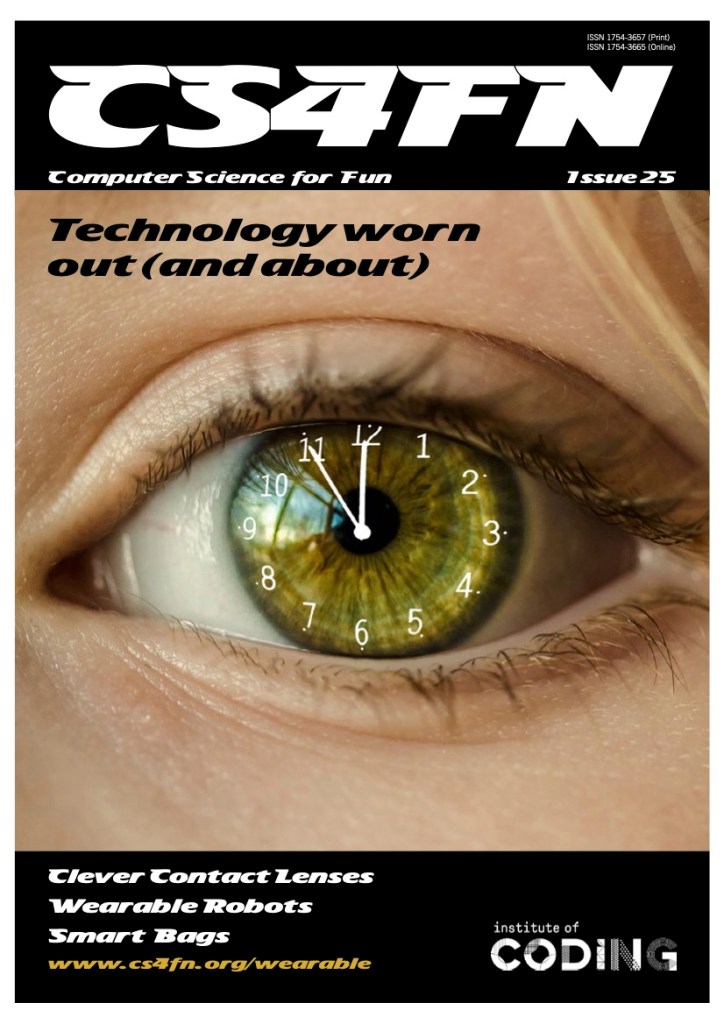
  • Technology worn out (and about)
  • The women are here
  • The women are (still) here

EPSRC supports this blog through research grant EP/W033615/1. 

Paul Curzon Creative Computing, Entertainment, Interaction Design, Media Arts Technology, Mobile Computing, Movies, Sensor Technology, Women in Computing Leave a comment March 27, 2023December 24, 2025 3 Minutes

Posts navigation

Newer posts

Click below to find out more…

Search our site

Image showing concentric luminous green circles and radial lines on a black background which converge into a central dip in the middle, to evoke a gravity well or black hole. Overlaid is white text saying Portals.
Adapted spacetime image by Johnson Martin from Pixabay
Find out about some of the rather surprising things computer scientists have got up to when they're in a playful mood.
Banner for LGBTQ+ Computer Science Greats with white text on the rainbow pride flag
LGBTQ+ Computer Science Greats portal

Click to read our Lego-themed series featuring pixel puzzles, compression algorithms, number representation, gray code, binary and computation.

Recent Posts

  • Music AI Kriss Kross Puzzle
  • How machines “hear” music
  • All the notes?
  • Musical Algorithms
  • The day the music didn’t die

All previous posts

Recent Comments

Unknown's avatarMusic AI Kriss Kross… on The day the music didn’t …
Unknown's avatarMusic AI Kriss Kross… on Separate your stems
Unknown's avatarMusical Algorithms… on You’ll be Bach! – create…
Unknown's avatarThe art of animatron… on I’m (not) a little …
Unknown's avatarThe Decline and Fall… on Victorian volunteers needed…

Archives

  • February 2026
  • January 2026
  • December 2025
  • November 2025
  • October 2025
  • September 2025
  • August 2025
  • July 2025
  • June 2025
  • May 2025
  • April 2025
  • March 2025
  • February 2025
  • January 2025
  • December 2024
  • November 2024
  • October 2024
  • September 2024
  • August 2024
  • July 2024
  • June 2024
  • May 2024
  • April 2024
  • March 2024
  • February 2024
  • January 2024
  • December 2023
  • November 2023
  • October 2023
  • September 2023
  • August 2023
  • July 2023
  • June 2023
  • May 2023
  • April 2023
  • March 2023
  • February 2023
  • January 2023
  • December 2022
  • November 2022
  • October 2022
  • September 2022
  • August 2022
  • July 2022
  • June 2022
  • May 2022
  • April 2022
  • March 2022
  • January 2022
  • December 2021
  • November 2021
  • October 2021
  • July 2021
  • June 2021
  • May 2021
  • April 2021
  • September 2017
  • June 2017
  • May 2017
  • April 2017

Categories

  • Advent Calendar
  • Algorithmic thinking
  • algorithms
  • Ancient History
  • Animal Welfare
  • Anthropology
  • April Fools & Tech Whimsy
  • Archeology
  • Art and Craft
  • Artificial Intelligence
  • Artificial Life
  • astronomy
  • Audio Engineering
  • Augmented Reality
  • Automata
  • Aviation & Aerospace
  • Bayesian Networks
  • Bias
  • Big Data
  • Biologically-inspired computing
  • Biology
  • Black History Month
  • Brain-computer interfaces
  • Careers
  • Cellular Automata
  • Cloud Computing
  • Complexity
  • Compression Algorithms
  • Computation
  • Computational Thinking
  • Computer Architecture
  • Computer Graphics
  • Computer History
  • Computer memory
  • Computer Science
  • Computer Science & Research
  • Computer Vision
  • Computers and Society
  • Creative Computing
  • cs4fn issues
    • annual 2
    • EE4FN – Issue 2
    • ee4fn1
    • issue 10 – Computing goes mobile
    • issue 11 – Computer animation proudly presents
    • Issue 12 – Computing on the Catwalk
    • issue 13 – Facing Up To Faces
    • issue 14 – Alan Turing – The Genius Who Gave Us The Future
    • issue 15 – Does your computer understand you?
    • issue 16 – Clean Up Your Language
    • issue 17 – Machines Making Medicine Safer
    • issue 18 – Machines That Are Creative
    • issue 19 – Touch it feel it hear it
    • Issue 2 – The Magic of Computer SCIENCE
    • issue 20 – Ada Lovelace
    • issue 21 – Computing Sounds Wild
    • issue 22 – Creative Computing
    • issue 23 – The Women are (still) here
    • issue 24 – Cyber Security
    • issue 25 – Wearable Technology
    • issue 26 – Serious Fun – Peter McOwan
    • issue 27 – Smart Health: Decisions decisions decisions…
    • Issue 28 – Cunning Computational Contraptions
    • issue 3 – Computer science and entertainment
    • issue 4 – Computer Science and BioLife
    • issue 5 – The Perception Deception
    • issue 6 – Computer science everywhere
    • issue 8 – Computer Science In Space
    • issue 9 – Programmed to save the world
  • Cyber security
  • Data Representation
  • Data Visualisation
  • Dependable Computing
  • Design for All
  • Digital Signal Processing
  • Diversity
    • disability
  • Education
  • Electronic Engineering
  • electronics
  • emotion
  • Encryption
  • English and Computing
  • Entertainment
  • Entrepreneurship
  • Fiction
  • Finance
  • Formal Verification
  • from around the web
  • games
  • Genetic Algorithms
  • Geography
  • Healthcare
  • History
  • Human-human communication
  • Humour
  • Image Representation
  • Information Retrieval
  • Interaction Design
  • Internet of Things
  • Issue 29 – Diversity
  • Law
  • Lego Computer Science
  • LGBTQ+
  • Linguistics
  • Logic and Proof
  • Machine Learning
  • magic
  • mathematics
  • Media Arts Technology
  • Microprocessor design
  • Mistakes and errors
  • Mobile Computing
  • Movies
  • Music
  • Natural Language Processing
  • nature
  • Networking and Communications
  • Networks
  • Neuroscience
  • Number Representation
  • Operating Systems
  • Optics
  • People
  • Philosophy
  • Physics
  • Privacy
  • Programming
  • Programming Languages
  • puzzles
  • Quantum computing
  • Regular Expressions
  • Robotics
  • Safety-critical systems
  • Science
  • Sensor Technology
  • Sentiment Analysis
  • Simulation
  • Social Networks
  • Sonification
  • Sound and acoustics
  • Space
  • Sport
    • Basketball
    • Football
    • Motor racing
  • Steganography
  • swarm intelligence
  • Theory
  • Time
  • Uncategorized
  • Verification and Validation
  • Veterinary Science
  • Wearable computing
  • weather
  • Women in Computing
  • zoology

Meta

  • Create account
  • Log in
  • Entries feed
  • Comments feed
  • WordPress.com

Blog Stats

  • 80,322 hits

Blog at WordPress.com.
  • Subscribe Subscribed
    • cs4fn
    • Join 133 other subscribers
    • Already have a WordPress.com account? Log in now.
    • cs4fn
    • Subscribe Subscribed
    • Sign up
    • Log in
    • Report this content
    • View site in Reader
    • Manage subscriptions
    • Collapse this bar
 

Loading Comments...