Flies are small, fast and rather cunning. Try to swat one and you will see just how efficient their brain is, even though it has so few brain cells that each one of them can be counted and given a number. A fly’s brain is a wonderful proof that, if you know what you’re doing, you can efficiently perform clever calculations with a minimum of hardware. The average household fly’s ability to detect movement in the surrounding environment, whether it’s a fly swat or your hand, is due to some cunning wiring in their brain.
Movement is measured by detecting something changing position over time. The ratio distance/time gives us the speed, and flies have built in speed detectors. In the fly’s eye, a wonderful piece of optical engineering in itself with hundreds of lenses forming the mosaic of the compound eye, each lens looks at a different part of the surrounding world, and so each registers if something is at a particular position in space.
All the lenses are also linked by a series of nerve cells. These nerve cells each have a different delay. That means a signal takes longer to pass along one nerve than another. When a lens spots an object in its part of the world, say position A, this causes a signal to fire into the nerve cells, and these signals spread out with different delays to the other lenses’ positions.
The separation between the different areas that the lenses view (distance) and the delays in the connecting nerve cells (time) are such that a whole range of possible speeds are coded in the nerve cells. The fly’s brain just has to match the speed of the passing object with one of the speeds that are encoded in the nerve cells. When the object moves from A to B, the fly knows the correct speed if the first delayed signal from position A arrives at the same time as the new signal at position B. The arrival of the two signals is correlated. That means they are linked by a well-defined relation, in this case the speed they are representing.
Do locusts like Star Wars?
Understanding the way that insects see gives us clever new ways to build things, and can also lead to some bizarre experiments. Researchers in Newcastle showed locusts edited highlights from the original movie Star Wars. Why you might ask? Do locusts enjoy a good Science Fiction movie? It turns out that the researchers were looking to see if locusts could detect collisions. There are plenty of those in the battles between X-wing fighters and Tie fighters. They also wanted to know if this collision detecting ability could be turned into a design for a computer chip. The work, part-funded by car-maker Volvo, used such a strange way to examine locust’s vision that it won an Ig Nobel award in 2005. Ig Noble awards are presented each year for weird and wonderful scientific experiments, and have the motto ‘Research that makes people laugh then think’. You can find out more at http://improbable.com
Car crash: who is to blame?
So what happens if we start to use these insect ‘eye’ detectors in cars, building
We now have smart cars with the artificial intelligence (AI) taking over from the driver completely or just to avoid hitting other things. An interesting question arises. When an accident does happen, who is to blame? Is it the car driver: are they in charge of the vehicle? Is it the AI to blame? Who is responsible for that: the AI itself (if one day we give machines human-like rights), the car manufacturer? Is it the computer scientists who wrote the program? If we do build cars with fly or locust like intelligence, which avoid accidents like flies avoid swatting or can spot possible collisions like locusts, is it the insect whose brain was copied that is to blame!?!What will insurance companies decide? What about the courts?
As computer science makes new things possible, society quickly needs to decide how to deal with them. Unlike the smart cars, these decisions aren’t something we can avoid.
Peter W McOwan, Queen Mary University of London(updated from the archive)
Kerstin Dautenhahn is a biologist with a mission: to help us make friends with robots. Kerstin was always fascinated by the natural world around her, so it was no surprise when she chose to study Biology at the University of Bielefeld in Germany. Afterwards she went on to study a Diploma in Biology where she did research on the leg reflexes in stick insects, a strange start it may seem for someone who would later become one of the world’s foremost robotics researchers. But it was through this fascinating bit of biology that Kerstin became interested in the ways that living things process information and control their body movements, an area scientists call biological cybernetics. This interest in trying to understand biology made her want to build things to test her understanding, these things would be based on ideas copied from biological animals but be run by computers, these things would be robots.
Follow that robot
From humble beginning building small robots that followed one another over a hilly landscape, she started to realise that biology was a great source of ideas for robotics, and in particular that the social intelligence that animals use to live and work with each other could be modelled and used to create sociable robots.
She started to ask fascinating questions like “What’s the best way for a robot to interrupt you if you are reading a newspaper – by gesturing with its arms, blinking its lights or making a sound?” and perhaps most importantly “When would a robot become your friend?” First at the University of Hertfordshire, now a Professor at the University of Waterloo she leads a world famous research group looking to try and build friendly robots with social intelligence.
Good robot / Bad robot – East vs West
Kerstin, like many other robotics researchers, is worried that most people tend to look on robots as being potentially evil. If we look at the way robots are portrayed in the movies that’s often how it seems: it makes a good story to have a mechanical baddie. But in reality robots can provide a real service to humans, from helping the disabled, assisting around the home and even becoming friends and companions. The baddie robot ideas tends to dominate in the west, but in Japan robots are very popular and robotics research is advancing at a phenomenal rate. There has been a long history in Japan of people finding mechanical things that mimic natural things interesting and attractive. It is partly this cultural difference that has made Japan a world leader in robot research. But Kerstin and others like her are trying to get those of us in the west to change our opinions by building friendly robots and looking at how we relate to them.
Polite Robots roam the room
When at the University of Hertfordshire, Kerstin decided that the best way to see how people would react to a robot around the house was to rent a flat near the university, and fill it with robots. Rather than examine how people interacted with robots in a laboratory, moving the experiments to a real home, with bookcases, biscuits, sofas and coffee tables, make it real. She and her team looked at how to give their robots social skills: what was the best way for a robot to approach a person, for example? At first they thought that the best approach would be straight from the front, but they found that humans felt this too aggressive, so the robots were trained to come up gently from the side. The people in the house were also given special ‘comfort buttons’, devices that let them indicate how they were feeling in the company of robots. Again interesting things happened, it turned out that not all, but quite a lot of people were on the whole happy for these robots to be close to themselves, closer in fact than they would normally let a human approach. Kerstin explains ‘This is because these people see the robot as a machine, not a person, and so are happy to be in close proximity. You are happy to move close to your microwave, and it’s the same for robots’. These are exciting first steps as we start to understand how to build robots with socially acceptable manners. But it turns out that robots need to have good looks as well as good manners if they are going to make it in human society.
Looks are everything for a robot?
This fall in acceptability is called the ‘uncanny valley’
How we interact with robots also depends on how the robots look. Researchers had found previously that if you make a robot look too much like a human being, people expect it to be a human being, with all the social and other skills that humans have. If it doesn’t have these, we find interaction very hard. It’s like working with a zombie, and it can be very frightening. This fall in acceptability of robots that look like, but aren’t quite, human is what researchers call the ‘uncanny valley’, so people prefer to encounter a robot that looks like a robot and acts like a robot. Kerstin’s group found this effect too, so they designed their robots to look and act they way we would expect robots to look and act, and things got much more sociable. But they are still looking at how we act with more human like robots and built KASPAR, a robot toddler, which has a very realistic rubber face capable of showing expressions and smiling, and video camera eyes that allow the robot to react to your behaviours. He possesses arms so can wave goodbye or greet you with a friendly gesture. Most recently he was extended with multi-modal technology that allowed several children to play with him at the same time, He’s very lifelike and their hope was hopefully as KASPAR’s programming grew, and his abilities improved he, or some descendent of him, would emerge from the uncanny valley to become someone’s friend, and in particular, children with autism.
Autism – mind blindness and robots
The fact that most robots at present look like and act like robots can give them a big advantage to help them support children with autism. Autism is a condition that prevents you from developing an understanding of how to interact socially with the world. A current theory to explain the condition is that those who are autistic cannot form a correct understanding of others intentions, it’s called mind blindness. For example, if I came into the room wearing a hideous hat and asked you ‘Do you like my lovely new hat?’ you would probably think, ‘I don’t like the hat, but he does, so I should say I like it so as not to hurt his feelings’, you have a mental model of my state of mind (that I like my hat). An autistic person is likely to respond ‘I don’t like your hat’, if this is what he feels. Autistic people cannot create this mental model so find it hard to make friends and generally interact with people, as they can’t predict what people are likely to say, do or expect.
Playing with Robot toys
It’s different with robots, many autistic children have an affinity with robots. Robots don’t do unexpected things. Their behaviour is much simpler, because they act like robots. Using robots Kerstin’s group examined how we can use this interaction with robot toys to help some autistic children to develop skills to allow them to interact better with other people. By controlling the robot’s behaviours some of the children can develop ways to mimic social skills, which may ultimately improve their quality of life. There were some promising results, and the work continues to be only one way to try and help those suffering with this socially isolating condition.
Future friendly
It’s only polite that the last word goes to Kerstin from her time at Hertfordshire:
‘I firmly believe that robots as assistants can potentially be very useful in many application areas. For me as a researcher, working in the field of human-robot interaction is exciting and great fun. In our team we have people from various disciplines working together on a daily basis, including computer scientists, engineers and psychologist. This collaboration, where people need to have an open mind towards other fields, as well as imagination and creativity, are necessary in order to make robots more social.’
In the future, when robots become our workmates, colleagues and companions it will be in part down to Kerstin and her team’s pioneering effort as they work towards making our robot future friendly.
Peter W McOwan, Queen Mary University of London(from the archive)
Laugh and the world laughs with you they say, but what if you’re a computer. Can a computer have a ‘sense of humour’?
Computer generated jokes can do more than give us a laugh. Human language in jokes can often be ambiguous: words can have two meanings. For example the word ‘bore’ can mean a person who is uninteresting or could be to do with drilling … and if spoken it could be about a male pig. It’s often this slip between the meaning of words that makes jokes work (work that joke out for yourself). To be able to understand how human based humour works, and build a computer program that can make us laugh will give us a better understanding of how the human mind works … and human minds are never boring.
Many researchers believe that jokes come from the unexpected. As humans we have a brain that can try to ‘predict the future’, for example when catching a fast ball our brains have a simple learned mathematical model of the physics so we can predict where the ball will be and catch it. Similarly in stories we have a feel for where it should be going, and when the story takes an unexpected turn, we often find this funny. The shaggy dog story is an example; it’s a long series of parts of a story that build our expectations, only to have the end prove us wrong. We laugh (or groan) when the unexpected twist occurs. It’s like the ball suddenly doing three loop-the-loops then stopping in mid-air. It’s not what we expect. It’s against the rules and we see that as funny.
Some artificial intelligence researchers who are interested in understanding how language works look at jokes as a way to understand how we use language. Graham Richie was one early such researcher, and funnily enough he presented his work at an April Fools’ Day Workshop on Computational Humour. Richie looked at puns: simple gags that work by a play on words, and created a computer program called JAPE that generates jokes.
How do we know if the computer has a sense of humour? Well how would we know a human comic had a sense of humour? We’d get them to tell a joke. Now suppose that we had a test where we had a set of jokes, some made by humans and some by computers, and suppose we couldn’t tell the difference? If you can’t tell which is computer generated and which is human generated then the argument goes that the computer program must, in some way, have captured the human ability. This is called a Turing Test after the computer scientist Alan Turing. The original idea was to use it as a test for intelligence but we can use the same idea as a test for an ability to be funny too.
So let’s finish with a joke (and test). Which of the following is a joke created by a computer program following Richie’s theory of puns, and which is a human’s attempt? Will humans or machines have the last laugh on this test?
Have your vote: which of these two jokes do you think was written by a computer and which by a human.
1) What’s fast and wiry?
… An aircraft hanger!
2) What’s green and bounces?
… A spring cabbage!
Make your choice before scrolling down to find the answer.
– Peter W. McOwan, Queen Mary University of London (from the archive)
Subscribe to be notified whenever we publish a new post to the CS4FN blog.
This blog is funded by EPSRC on research agreement EP/W033615/1.
The answers
Could you tell which of the two jokes was written by a human’s and which by a computer?
Lots of cs4fn readers voted over several years and the voting went:
58 % votes cast believed the aircraft hanger joke is computer generated
42 % votes cast believed the spring cabbage joke is computer generated
In fact …
The aircraft hanger joke was the work of a computer.
The spring cabbage joke was the human generated cracker.
If the voters were doing no better than guessing then the votes would be about 50-50: no better than tossing a coin to decide. Then the computer was doing as well at being funny as the human. A vote share of 58-42 suggests (on the basis of this one joke only) that the computer is getting there, but perhaps doesn’t quite have as good a sense of humour as the human who invented the spring cabbage joke. A real test would use lots more jokes, of course. If doing a real experiment it would also be important that they were not only generated by the human/computer but selected by them too (or possibly selected at random from ones they each picked out as their best). By using ones we selected our sense of humour could be getting in the way of a fair test.
When Pepper’s Ghost first appeared on the stage as part of one of Professor Pepper’s shows on Christmas Eve, 1862 it stunned the audiences. This was more than just magic: it was miraculous. It was so amazing that some spiritualists were convinced Pepper had discovered a way of really summoning spirits. A ghostly figure appeared on the stage out of thin air, interacted with the other characters on the stage and then disappeared in an instant. This was no dark seance where ghostly effects happen in a darkened room: who knows what tricks are then being pulled in the dark to cause the effects. Neither was it modern day special effects where it is all done on film or in the virtual world of a computer. This was on a brightly lit stage in front of everyone’s eyes…
Switch to the modern day and similar ghostly magic is now being used by fighter pilots. Have the military been funding X-files research? Well maybe, but there is nothing supernatural about Pepper’s Ghost. It is just an illusion. The show it first appeared in was a Science show, though it went on to amaze audiences as part of magic shows for years to come, and can still be found, for example in Disney Theme Parks, and onstage to make virtual band Gorillaz come to life.
Today’s “supernatural” often becomes tomorrow’s reality, thanks to technology. With Pepper’s ghost, 19th century magic has in fact become enormously useful 21st century hi-tech. 19th century magicians were more than just showmen, they were inventors, precision engineers and scientists, making use of the latest scientific results, frequently pushing technology forward themselves. People often think of magicians as being secretive, but they were also businessmen, often patenting the inventions behind their tricks, making them available for all to see but also ensuring their rivals could not use them without permission. The magic behind Pepper’s ghost was patented by Henry Dircks, a Liverpudlian engineer, in 1863 as a theatrical effect though it was probably originally invented much earlier – it was described in an Italian book back in 1558 by Baptista Porta.
Through the looking glass
So what was Pepper’s ghost? It’s a cliche to say that “it’s all done with mirrors”, but it is quite amazing what you can do with them if you both understand their physics and are innovative enough to think up extraordinary ways to use old ideas. Pepper’s ghost worked in a completely different way to the normal way mirrors are used in tricks though. It was done using a normal sheet of glass, not a silvered mirror at all. If you have ever looked at your image reflected in a window on a dark night you have seen a weak version of Pepper’s Ghost. The trick was to place a large, spotlessly clean sheet of glass at an angle in front of the stage between the actors and the audience. By using the stage lights in just the right way, it becomes a half mirror. Not only can the stage be seen through the glass, but so can anything placed at the right position off the stage where the glass is pointing. Better still, because of the physics of reflection, the reflected images don’t seem to be on the surface of the glass at all, but the same distance behind as the objects are in front. The actor playing the ghost would perform in a hidden black area so that he or she was the only thing that reflected light from that area. When the ghost was to appear a very strong light was shone on the actor. Suddenly the reflection would appear – and as long as they were standing the right distance from the mirror, they could appear anywhere desired on the stage. To make them disappear in an instant the light was just switched off.
Jump to the 21st century and a similar technique has reappeared. Now the ghosts are instrument panels. A problem with controlling a fighter plane is you don’t have time to look down. You really want the data you need to keep control of your plane wherever you are looking outside the plane. It needs not just to be in the right position on the screen but at the right depth so you don’t need to refocus your eyes. Most importantly you must also be able to see out of the plane in an unrestricted way…You need the Peppers Ghost effect. That is all “Head-up” displays display do, though the precise technology used varies.
Satnav systems in cars are very dangerous if you have to keep looking down to see where the thing atually means you to turn. “What? This left turn or the next one?” Use a Head-up display and the instructions can hover in front of you, out on the road where your eyes are focussed. Better still you can project a yellow line (say) as though it was on the road, showing you the way off into the distance: Follow the Yellow Brick Road … Oh and wasn’t the Wizard of Oz another great magician who used science and engineering rather than magic dust.
Paul Curzon, Queen Mary University of London (first published in 2007)
Sasha owns a new tour company and her first tours are to the Azores, a group of volcanic islands in the Atlantic Ocean, off the coast of Portugal. They are one of the best places in the world to see whales and dolphins, so lots of people are signing up to go.
Sasha’s tour as advertised is to visit all nine islands in the Azores: São Miguel, Terceira, Faial, Pico, São Jorge, Santa Maria, Graciosa, Flores and Corvo. The holidaymakers go whale watching as well as visiting the attractions on each island, like swimming in the lava pools. Sasha’s first problem, though, is to sort out the itinerary. She has to work out the best order to visit the islands so her customers spend as little time as possible travelling, leaving more for watching whales and visiting volcanos. She also doesn’t want the tour to go back to the same island twice – and she needs it to end up back at the starting island, São Miguel, for the return flight back home.
Trouble in paradise
It sounds like it should be easy, but it’s actually an example of a computer science problem that dates back at least to the 1800s. It’s known as ‘The Travelling Salesman Problem’ because it is the same problem a salesman has who wants to visit a series of cities and get back to base at the end of the trip. It is surprisingly difficult.
It’s not that hard to come up with any old answer (just join the dots!), but it’s much tougher to come up with the best answer. Of course a computer scientist doesn’t want to just solve one-off problems like Sasha’s but to come up with a way of solving any variant of the problem. Sasha, of course, agrees – once she’s sorted out the Azores itinerary, she then needs to solve similar problems, like the day trip round São Miguel. Her customers will visit the lakes, the tea factory, the hot spring-fed swimming pool in the botanic gardens and so on. Not only that, once Sasha’s done with the Azores, she then needs to plan a wildlife tour of Florida. Knowing a quick way to do it would help her a lot.
The long way round
No one has yet come up with a good way to solve the Travelling Salesman problem though and it is generally believed to be impossible. You can find the best solution in theory of course: just try all the alternatives. Sasha could first work out how long it is if you go São Miguel, Terceira, Faial, Pico, São Jorge, Santa Maria, Graciosa, Flores, Corvo and back to São Miguel, then work out the time for a different order, swapping Corvo and Flores, say. Then she could try a different route, and keep on till she knew the length of every variation. She would then just pick the best. Trouble is, that takes forever.
Even this small problem with only 9 islands has over 20 000 solutions to check. Go up to a tour of 15 destinations and you have 43 billion calculations to do. Add a few more and it would take centuries for a fast computer running flat out to solve it. Bigger still and you find the computer would have to run for longer than the time left before the end of the universe. Hmmm. It’s a problem then.
Be greedy
The solution is not to be such a perfectionist and accept that a good solution will have to be good enough even though it may not be the absolute best. One way to get a good solution is called using a ‘greedy’ algorithm. You start at São Miguel and just go from there to the nearest island, from there to the nearest island not yet visited, and so on till you have done them all. That would probably work well for the Azores as they are in groups, so visiting the close ones in each group together makes sense. It doesn’t guarantee the best answer in all cases though.
Or just go climb a hill
Another way is to use a version of ‘hill climbing’. Here you take any old route and then try and optimise it, by just making small changes – swapping pairs of legs over, say: instead of going Faial to Pico and later Corvo to Flores try substituting Pico to Flores and Faial to Corvo, with the rest the same but in the opposite order. If the change is an improvement keep it and make later changes to that. Otherwise stick with the original. Either way keep trying changes on the best solution you’ve found so far, until you run out of time.
So Sasha may want to run a great tour company but there may not be enough time in the universe for her tours to be guaranteed perfect…unless of course she keeps them very small. After all, just visiting São Miguel and Terceira makes a great holiday anyway.
NASA Langley was the birthplace of the U.S. space program where astronauts like Neil Armstrong learned to land on the moon. Everyone knows the names of astronauts, but behind the scenes a group of African-American women were vital to the space program: Katherine Johnson, Mary Jackson and Dorothy Vaughan. Before electronic computers were invented ‘computers’ were just people who did calculations and that’s where they started out, as part of a segregated team of mathematicians. Dorothy Vaughan became the first African-American woman to supervise staff there and helped make the transition from human to electronic computers by teaching herself and her staff how to program in the early programming language, FORTRAN.
The women switched from being the computers to programming them. These hidden women helped put the first American, John Glenn, in orbit, and over many years worked on calculations like the trajectories of spacecraft and their launch windows (the small period of time when a rocket must be launched if it is to get to its target). These complex calculations had to be correct. If they got them wrong, the mistakes could ruin a mission, putting the lives of the astronauts at risk. Get them right, as they did, and the result was a giant leap for humankind.
See the film ‘Hidden Figures’ for more of their story.
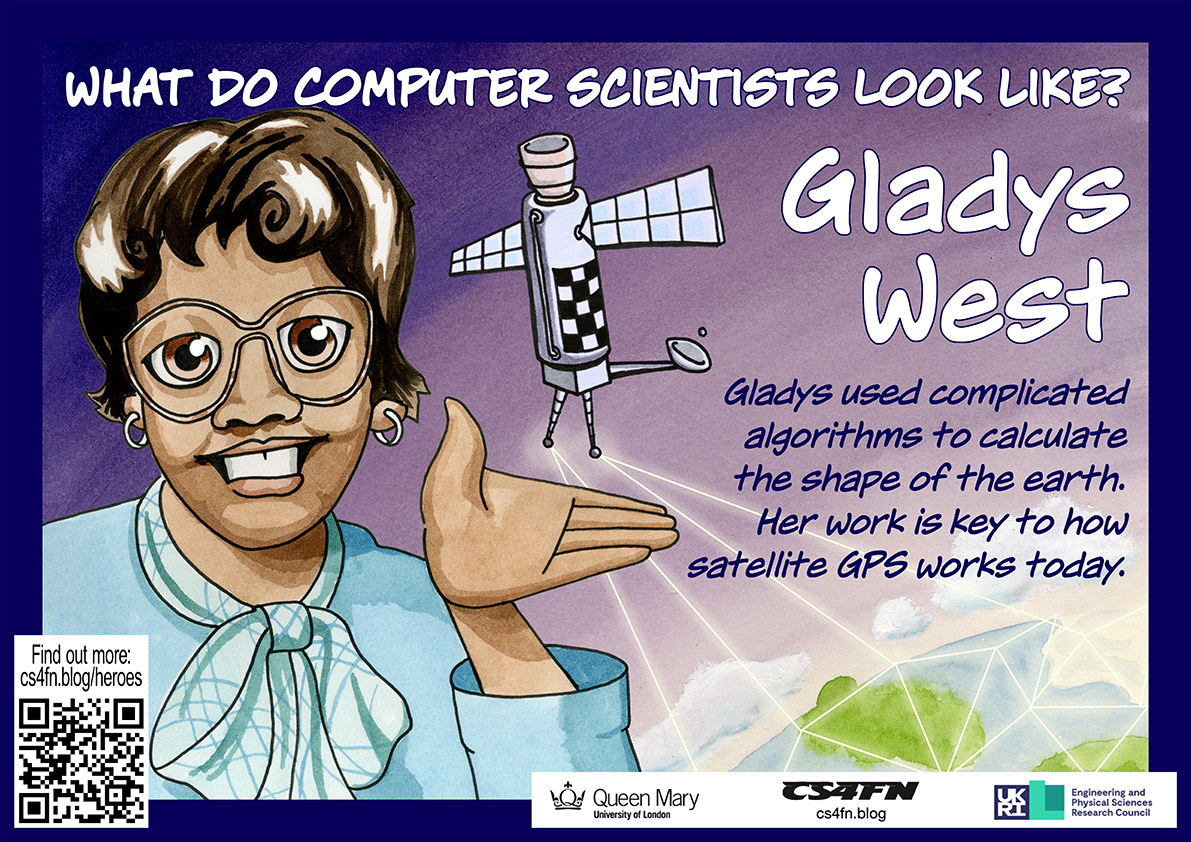
Satellites are critical to much modern technology, and especially GPS. It allows our smartphones, laptops and cars to work out their exact position on the surface of the earth. This is central to all mobile technology, wearable or not, that relies on knowing where you are, from plotting a route your nearest Indian restaurant to telling you where a person you might want to meet is. Many, many people were involved in creating GPS, but it was only in Black History Month of 2017 when the critical part Gladys West played became widely known.
Work hard, go far
As a child Gladys worked with her family in the fields of their farm in rural Virginia. That wasn’t the life she wanted, so she worked hard through school, leaving as the top student. She won a scholarship to university, and then landed a job as a mathematician at a US navy base.
There she solved the maths problems behind the positioning of satellites. She worked closely with the programmers to write the code to do calculations based on her maths. Nine times out of ten the results that came back weren’t exactly right so much of her time was spent working out what was going wrong with the programs, as it was vital the results were very accurate.
Seasat and Geosat
Her work on the Seasat satellite won her a commendation. It was a revolutionary satellite designed to remotely monitor the oceans. It collected data about things like temperature, wind speed and wind direction at the sea’s surface, the heights of waves, as well as sensing data about sea ice. This kind of remote sensing has since had a massive impact on our understanding of climate change. Gladys specifically worked on the satellite’s altimeter. It was a radar-based sensor that allowed Seasat to measure its precise distance from the surface of the ocean below. She continued this work on later remote sensing satellites too, including Geosat, a later earth observation satellite.
Gladys West and Sam Smith look over data from the Global Positioning System, which Gladys helped develop. Image: U.S. Navy, Public domain, via Wikimedia Commons US Navy, 1985,
GPS
Knowing the positions of satellites is the foundation for GPS. The way GPS works is that our mobile receivers pick up a timed signal from several different satellites. Calculating where we are can only be done if you first know very precisely where those satellites were when they sent the signal. That is what Gladys’ work provided.
GPS Watches
You can now buy, for example, buy GPS watches, allowing you to wear a watch that watches where you are. They can also be used by people with dementia, who have bad memory problems, allowing their carers to find them if they go out on their own but are then confused about where they are. They also allow parents to know where their kids are all the time. Do you think that’s a good use?
Since so much technology now relies on knowing exactly where we are, Gladys’ work has had a massive impact on all our lives.
To be a good computer scientist you have to enjoy problem solving. That is what it’s all about: working out the best way to do things. You also have to be able to think in a logical way: be a bit of a Vulcan. But what does that mean? It just means being able to think precisely, extracting all the knowledge possible from a situation just by pure reasoning. It’s about being able to say what is definitely the case given what is already known…and it’s fun to do. That’s why there is a Suduko craze going on as I write. Suduko are just pure logical thinking puzzles. Personally I like Kakuro better. They are similar to Soduko, but with a crossword format.
What is a Kakuro?
A Kakuro is a crossword-like grid, but where each square has to be filled in with a digit from 1-9 not a letter. Each horizontal or vertical block of digits must add up to the number given to the left or above, respectively. All the digits in each such block must be different. That part is similar to Soduko, though unlike Soduko, numbers can be repeated on a line as long as they are in different blocks. Also, unlike Soduko, you aren’t given any starting numbers, just a blank grid.
Where does logic come into it? Take the following fragment:
Part of a Kakuro Puzzle. Image by PC
There is a horizontal block of two cells that must add up to 16. Ways that could be done using digits 1-9 are 9+7, 8+8 or 7+9. But it can’t be 8+8 as that needs two 8s in a block which is not allowed so we are left with just two possibilities: 9+7 or 7+9. Now look at the vertical blocks. One of them consists of two cells that add up to 17. That can only be 9+8 or 8+9. That doesn’t seem to have got us very far as we still don’t know any numbers for sure. But now think about the top corner. We know from across that it is definiteley 9 or 7 and from down that it is definitely 9 or 8. That means it must be 9 as that is the only way to satisfy both restrictions.
A Kakuro for you to try
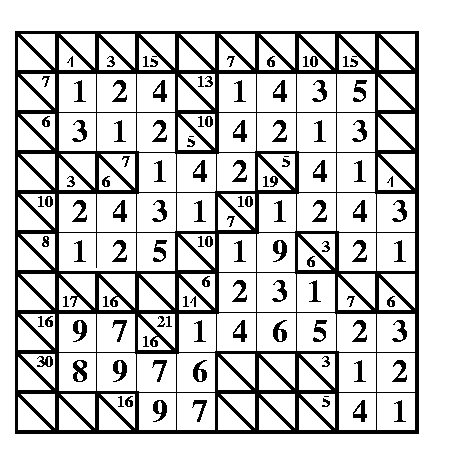
A Kakuro puzzle for you to try. Image by PC
Here is a full Kakuro to try. There is also a printer friendly pdf version. Check your answer at the very end of this post when you are done.
Being able to think logically is important because computer programming is about coming up with precise solutions that even a dumb computer can follow. To do that you have to make sure all the possibilities have been covered. Reasoning very much like in a Kakuro is needed to convince yourself and others that a program does do what it is supposed to.
A gentoo penguin slumps belly-first on a nest at Damoy, on the Antarctic Peninsula. Nearby some lichen grows across a rock, and schools of krill float through the Southern Ocean. Every one of these organisms is a part of life in the Antarctic, and scientitsts study each of them. But what happens to one species affects all the others too. To help make sure that they all survive, scientists have to understand how penguins, plants, krill and everything else in the Antarctic interact with one another. They need to figure out the rules of the ecosystem.
Working together
When you’re trying to understand a system that includes everything from plants to penguins, things get a bit complicated. Fortunately, ecology has a new tool to help, called complexity theory. Anje-Margriet Neutel is a Biosphere Complexity Analyst for the British Antarctic Survey. It’s her job to take a big puzzle like the Antarctic ecosystem, and work out where each plant and animal fits in. She explains that ‘complexity is sort of a new brand of science’. Lots of science is about isolating something – say, a particular chemical – from its surroundings so you can learn about it, but when you isolate all the parts of a system you miss how they work together. What complexity tries to do is build a model that can show all the important interactions in an ecosystem at the same time.
Energy hunt
So for a system as big as a continent full of species, where do you start? Anje’s got a sensible answer: you start with what you can measure. Energy’s a good candidate. After all, every organism needs energy to stay alive, and staying alive is pretty much the first thing any plant or animal needs to do. So if you can track energy and watch it move through the ecosystem, you’ll learn a lot about how things work. You’ll find out what comes into the system, what goes out and what gets recycled.
Playing with models
Once you’ve got an idea of how everything fits together you’ve got what scientists call a model. The really clever thing you can do with models is start to mess around with them. As an example Anje says, ‘What would happen if you took one group of organisms and put in twice as much of them?’ If you had a system with, say, twice as many penguins, the krill would have to be worried because more penguins are going to want to eat them. If they all run out what happens to the penguins? Or the seals that like eating krill too? It gets complicated pretty quickly, and those complicated reactions are just what scientists want to predict.
The language of nature
Figuring out how an ecosystem works is all about rules and structure. Ecosystems are huge complicated things, but they’re not random – whether they work or not depends on having the right organisms doing jobs in the right places, and on having the right connections between all the different parts. It’s like a computer program that way. Weirdly, it’s also a bit like language. In fact, Anje’s background is in studying linguistics, not ecology. Think of an ecosystem like a sentence – there are thousands of words in the English language but in order to make a sentence you have to put them together in the right way. If you don’t have the right grammar your sentence just won’t make sense, and if an ecosystem doesn’t have the right structure it’ll collapse. Anje says that’s what she wants to discover in the ecosystems she studies. ‘I’m interested in the grammar of it, in the grammar of nature.’
Surviving Antarctica
Since models can help you predict how an ecosystem reacts to strange conditions, Anje’s work could help Antarctica survive climate change. ‘The first thing is to understand how the models work, how the models behave, and then translate that back to the biology that it’s based on,’ she explains. ‘Then say OK, this means we expect there may be vulnerable areas or vulnerable climate regions where you can expect something to happen if you take the model seriously.’ If scientists like Anje can figure out how Antarctica’s ecosystems are set up to work, they’ll get clues about which areas of the continent are most at risk and what they can do to protect them.
Surviving on a continent where the temperature hardly ever gets above freezing is tough, and climate change is probably going to make it even tougher. If we can figure out how Antarctic ecosystems work, though, we’ll know what the essential elements for survival are, and we’ll have clues about how to make things better. Extracting the secret grammar of survival isn’t going to be a simple job, but that’s no surprise to the people working on it. After all, they’re not called complexity scientists for nothing.
How are you two doing together? You and your data, we mean. It’d be nice to have an update. Do you understand one another in that special OMG-we’ve-talked-all-night-and-now-the-sun’s-up kind of way? Is it more like you just kind of hang out together without really bothering to think about each other? Or maybe you’re just a bit baffled by the whole data scene. If your heart doesn’t beat with fervent love for the wild binary information all around you, that’s OK. In fact that’s pretty normal. It just so happens, though, that there’s a guy who wants to improve your data relationships. He’s called Andy Broomfield and he graduated as a designer from the Royal College of Art.
Andy’s worried that as we rely more and more on gadgets like mobiles and satnavs, a lot of us stop thinking about where the data comes from. “Increasingly we’re becoming dependent on the data,” says Andy. “We are just blindly fed it.” He tells the story of some councils that had to put up ‘Ignore Your Satnav’ signs after lorry drivers followed electronic directions down narrow lanes rather than believe their own eyes. He reckons that hapless users wouldn’t get quite so “data-lost” if we had a way to really connect with the pure information out there, being broadcast from satellites every second of the day. So he designed some gadgets of his own to help get our data relationships back on the rails.
Time to yourself
Ignore Sat Nav image by Dan Pope on Flickr, used under a CC BY-NC-SA 2.0 licence.
The first device lets you keep a personal time zone, and was inspired by a group of data-lovers who are sweet on measuring time. Time zones divide the globe into long tall ribbons based on longitude. Since GPS satellites can give each of us extremely accurate longitude readings all the time (the cs4fn offices are apparently at .042 degrees west), why not go even further and cut the ribbons up even more? That’s what Andy’s Longitude Time Piece does, to the point where you can uncover what Andy calls “your own local time zone”, right down to the second. Then you’d know that wherever you go, your timing would always be perfect.
Flooded with facts
Andy’s second invention is another GPS-flavoured one. Even though a lot of us can get lost really easily (even with maps and satellites to help), others love getting down and dirty with geographic data. This gadget’s good for both groups. People with a great sense of data direction can use the Geo Flood Browser to get info on the nearest river, wherever they are.
They can also share the love with others who get a bit data-lost, by leaving electronic tags around to let them know if the area gets flooded a lot. Then people nearby can use the tags using their own gadget to find out whether they ought to be stocking up on boats and snorkels before the next flood hits.
Spot a satellite
Finally Andy’s designed a gadget for your data relationships in space. Satellite spotters are kind of like backyard astronomers, except they love catching glimpses of the satellites that orbit the Earth. With Andy’s device anyone can tune into a satellite that’s above them and listen to it. You can either hear a voice tell you about the satellite, or you can actually listen into the bleeps of information coming from the satellite itself. That way, Andy says, you get “a connection to the pure data, the data that we’re dependent upon in the world.” It’s strange to think that this data is around us all the time – it’s just our phones and TVs that normally listen in, rather than us. If information is the lifeblood of our high-tech lives, the Satellite Scanner lets you listen to its heart.
Each of Andy’s devices uses information from the satellites whizzing, Cupid-like, around the Earth. The unusual thing is what they do with it – they’re not about being really useful so much as they are about actually experiencing the data that’s out there in the real world. That’s how he’s aiming to improve our data relationships. It’s like the way you can know someone for ages, but never see what they’re really about until you look from a different angle. Except this time it’s with satellites. Weird, eh? But good. A little like love.