Core rope memory

Earh rising over the surface of the moon from Apollo 8
Earthrise, taken on December 24, 1968, by Apollo 8 astronaut William Anders
Image via Wikimages (public domain)

Weaving, in the form of the Jacquard loom, with its swappable punch cards controlling the loom’s patterns inspired Charles Babbage. He intended to use the same kind of punch card to store programs in his Analytical Engine, which had it been built would have been the first computer. However, weaving had a much more direct use in computing history. Weaving helped get us to the Moon.

In the 1960s, NASA’s Apollo moon mission needed really dependable computers. It was vital that the programs wouldn’t be corrupted in space. The problem was solved using core rope memory.

Core rope memory was made of small ‘eyelets’ or beads of a metal called ferrite that can be magnetised and copper wire which was woven through some of the eyelets but not others. The ring-shaped magnets were known as magnetic cores. An electrical current passing through the wires made the whole thing work.

Representing binary

Both data and programs in computers are stored as binary: 1s and 0s. Those 1s and 0s can be represented by physical things in the world in lots of different ways. NASA used weaving. A wire that passed through an eyelet would be read as a binary 1 when the current was on but if it passed around the eyelet then it would be read as 0. This meant that a computer program, made up of sequences of 1s and 0s, could be permanently stored by the pattern that was woven. This gave read-only memory. Related techniques were used to create memory that the computer could change too, as the guidance computer needed both.

The memory was woven for NASA by women who were skilled textile workers. They worked in pairs using a special hollow needle to thread the copper wire through one magnetic core and then the other person would thread it back through a different one.

The program was first developed on a computer (the sort that took up a whole room back then) and then translated into instructions for a machine which told the weavers the correct positions for the wire threads. It was very difficult to undo a mistake so a great deal of care was taken to get things right the first time, especially as it could take up to two months to complete one block of memory. Some of the rope weavers were overseen by Margaret Hamilton, one of the women who developed the software used on board the spacecraft, and who went on to lead the Apollo software team.

The world’s first portable computer?

Several of these pre-programmed core rope memory units were combined and installed in the guidance computers of the Apollo mission spacecraft that had to fly astronauts safely to the Moon and back. NASA needed on-board guidance systems to control the spacecraft independently of Mission Control back on Earth. They needed something that didn’t take up too much room or weigh too much, that could survive the shaking and juddering of take-off and background radiation: core rope memory fitted the bill perfectly.

It packed a lot of information (well, not by modern standards! The guidance computer contained only around 70 kilobytes of memory) into a small space and was very robust as it could only break if a wire came loose or one of the ferrite eyelets was damaged (which didn’t happen). To make sure though, the guidance computer’s electronics were sealed from the atmosphere for extra protection. They survived and worked well, guiding the Landing Modules safely onto the Moon.

One small step for man perhaps, but the Moon landings were certainly a giant leap for computing.

Jo Brodie and Paul Curzon, Queen Mary University of London

More on …

Related Magazines …

Subscribe to be notified whenever we publish a new post to the CS4FN blog.


This blog is funded by EPSRC on research agreement EP/W033615/1.

QMUL CS4FN EPSRC logos

This article was funded by UKRI, through Professor Ursula Martin’s grant EP/K040251/2 and grant EP/W033615/1.
Dickens knitting in code

Charles Dickens is famous for his novels highlighting Victorian social injustice. Despite what people say, art and science really do mix, and Dickens certainly knew some computer science. In his classic novel about the French Revolution, A Tale of Two Cities, one of his characters relies on some computer science based knitting.

Dickens actually moved in the same social circles as Charles Babbage, the Victorian inventor of the first computer (which he designed but unfortunately never managed to build) and Ada Lovelace the mathematician who worked with him on those first computers. They went to the same dinner parties and Dickens will have seen Babbage demonstrate his prototype machines. An engineer in Dickens novel, Little Dorrit, is even believed to be partly based on Babbage. Dickens was probably the last non-family member to visit Ada before she died. She asked him to read to her, choosing a passage from his book Dombey and Son in which the son, Paul Dombey, dies. Like Ada, Paul Dombey had suffered from illness all his life.

So Charles Dickens had lots of opportunity to learn about algorithms! His novel ‘A Tale of Two Cities’ is all about the French Revolution, but lurking in the shadows is some computer science. One of the characters, a revolutionary called Madame Defarge takes the responsibility of keeping a register of all those people who are to be executed once the revolution comes to pass: the aristocrats and “enemies of the people”. Of course in the actual French Revolution lots of aristocrats were guillotined precisely for being enemies of the new state.

Now Madame Defarge could have just tried to memorize the names on her ‘register’ as she supposedly has a great memory, but the revolutionaries wanted a physical record. That raises the problem, though, of how to keep it secret, and that is where the computer science comes in. Madame Defarge knits all the time and so she decides to store the names in her knitting.

“Knitted, in her own stitches and her own symbols, it will always be as plain to her as the sun. Confide in Madame Defarge. It would be easier for the weakest poltroon that lives, to erase himself from existence, than to erase one letter of his name or crimes from the knitted register of Madame Defarge.”

Computer scientists call this Steganography: hiding information or messages in plain sight, so that no one suspects they are there at all. Modern forms of steganography include hiding messages in the digital representation of pictures and in the silences of a Skype conversation.

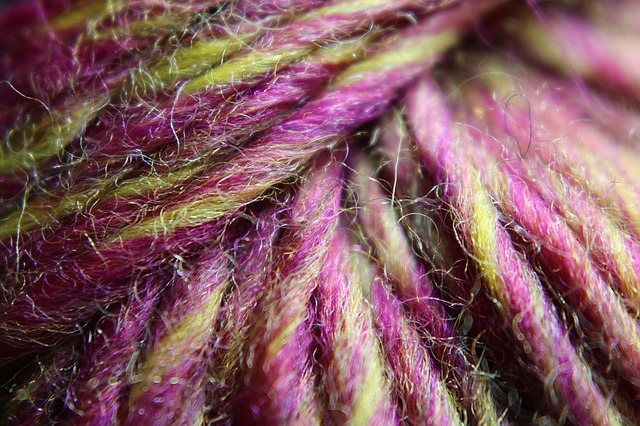
Madame Defarge didn’t of course just knit French words in the pattern like a victorian scarf version of a T-shirt message. It wouldn’t have been very secret if anyone looking at the resulting scarf could read the names. So how to do it? In fact, knitting has been used as a form of steganography for real. One way was for a person to take a ball of wool and mark messages down it in Morse Code dots and dashes. The wool was then knitted into a jumper or scarf. The message is hidden! To read it you unpick it all and read the morse code back off the wool.

The names were “Knitted, in her own stitches and her own symbols”

That wouldn’t have worked for Madame Defarge though. She wanted to add the names to the register in plain view of the person as they watched and without them knowing what she was doing. She therefore needed the knitting patterns themselves to hold the code. It was possible because she was both a fast knitter and sat knitting constantly so it raised no suspicion. The names were therefore, as Dickens writes “Knitted, in her own stitches and her own symbols”

She used a ‘cipher’ and that brings in another area of computer science: encryption. A cipher is just an algorithm – a set of rules to follow – that converts symbols in one alphabet (letters) into different symbols. In Madame Defarge’s case the new symbols were not written but knitted sequences of stitches. Only if you know the algorithm, and a secret ‘key’ that was used in the encryption, can you convert the knitted sequences back into the original message.

In fact both steganography and encryption date back thousands of years (computer science predates computers!), though Charles Dickens may have been the first to use knitting to do it in a novel. The Ancient Greeks used steganography. In the most famous case a message was written on a slave’s shaved head. They then let the hair grow back. The Romans knew about cryptographic algorithms too and one of the most famous ciphers is called the Caesar cipher as Julius Caesar used it when writing letters…even in Roman times people were worried about the spies reading their equivalent of emails.

Dickens didn’t actually describe the code that Madame Defarge was using so we can only guess…but why not see that as an opportunity and (if you can knit) why not invent a way yourself. If you can’t knit then learn to knit first and then invent one! Somehow you need a series of stitches to represent each letter of the alphabet. In doing so you are doing algorithmic thinking with knitting. You are knitting your way to being a computer scientist.

Paul Curzon, Queen Mary University of London (From the archive)


More on …

Related Magazines …


Subscribe to be notified whenever we publish a new post to the CS4FN blog.


This blog is funded by EPSRC on research agreement EP/W033615/1.

QMUL CS4FN EPSRC logos

EPSRC supported this article through research grants (EP/K040251/2 and EP/K040251/2 held by Professor Ursula Martin as well as grant EP/W033615/1).