Mark Dean: An Inspiration

This article is an edited version of one of the 2006 winning essays from the Queen Mary University of London, Department of Computer Science, first year essay competition.

May I ask you a question? When you think of the computer what names ring a bell? Bill Gates? Or for those more in touch with the history behind computers maybe Charles Babbage is a familiar name? May I ask you another question please? Do you know who Dr Mark Dean is? No, well you should. Do not worry yourself though, you are definitely not alone. I did not know of him either.

Allow me to enlighten you..

Mark Dean is in my opinion a very creative and inspirational black computer scientist. He is a vice-president at IBM and holds 3 of IBM’s first 9 patents on the personal computer. He has over 30 patents pending. He won the Black Engineer of the Year Presidents Award and was made an IBM fellow in 1995. An IBM fellow is IBM’s highest technical honor. Only 50 of IBM’s employee’s are fellows and Mark Dean was the first black one. Prior to joining IBM in 1980 he earned degrees in Electrical Engineering before going back to school to gain a PhD in the field from Stanford University. He was born in 1957 in Jefferson City, Tennessee and was one of the first black students to attend Jefferson City High School. He was an exceptional student and enjoyed athletics. Early manifestations of his desire to create were shown when he and his father built a tractor from scratch when he was just a boy.

Upon joining IBM Mark Dean and a partner led the team that developed the interior architecture (ISA systems bus) which allowed devices like the keyboard and printer to be connected to the motherboard making computers a part of our lives. It was that which earned him a spot in the National Inventors Hall of Fame. While at IBM he has been involved in numerous positions in computer system hardware architecture and design. He was responsible for IBM’s research laboratory in Austin, Texas where he focused on developing high performance microprocessors, software, systems and circuits. It is here where he made history by leading the team that built a gigahertz chip which did a billion calculations per second. In 2004, he was chosen as one of the 50 most important Blacks in Research Science.

I think that such a man should be well recognized in computer science, especially to black computer science students because from what I can see we are rare. We as a minority need an inspirational figure like Mark Dean. He inspires me, I wanted to share that with you. Before this small article it is very probable you had no knowledge of this man. So if there comes a time where you are asked about important names in the field of computers, I hope Dr Mark Dean springs to mind and rings a bell for you to hear loud and clear.

Dean Miller, Queen Mary University of London

More on …

Magazines …

Front cover of CS4FN issue 29 - Diversity in Computing


Subscribe to be notified whenever we publish a new post to the CS4FN blog.


This blog is funded by EPSRC on research agreement EP/W033615/1.

QMUL CS4FN EPSRC logos

Freddie Figgers – the abandoned baby who became a runaway telecom tech star

Freddie Figgers. Image by Freddie Figgers, CC BY 4.0 , via Wikimedia Commons

As a baby, born in the US in 1989, Freddie Figgers was abandoned by his biological parents but he was brought up with love and kindness by two much older adoptive parents who kindled his early enthusiasm for fixing things and inspired his work in smart health. He now runs the first Black-owned telecommunications company in the US.

When Freddie was 9 his father bought him an old (broken) computer from a charity shop to play around with. He’d previously enjoyed tinkering with his father’s collection of radios and alarm clocks and when he opened up the computer could see which of its components and soldering links were broken. He spotted that he could replace these with the same kinds of components from one of his dad’s old radios and, after several attempts, soon his computer was working again – Freddie was hooked, and he started to learn how to code.

When he was 12 he attended an after-school club and set to work fixing the school’s broken computers. His skill impressed the club’s leader, who also happened to be the local Mayor, and soon Freddie was being paid several dollars an hour to repair even more computers for the Mayor’s office (in the city of Quincy, Florida) and her staff. A few years later Quincy needed a new system to ensure that everyone’s water pressure was correct. A company offered to create software to monitor the water pressure gauges and said it would cost 600,000 dollars. Freddie, now 15 and still working with the Mayor, offered to create a low-cost program of his own and he saved the city thousands in doing so.

He was soon offered other contracts and used the money coming in to set up his own computing business. He heard about an insurance company in another US city whose offices had been badly damaged by a tornado and lost all of their customers’ records. That gave him the idea to set up a cloud computing service (which means that the data are stored in different places and if one is damaged the data can easily be recovered from the others).

His father, now quite elderly, had dementia and regularly wandered off and got lost. Freddie found an ingenious way to help him by rigging up one of his dad’s shoes with a GPS detector and two-way communication connected to his computer – he could talk to his dad through the shoe! If his dad was missing Freddie could talk to him, find out where he was and go and get him. Freddie later sold his shoe tracker for over 2 million dollars.

Living in a rural area he knew that mobile phone coverage and access to the internet was not as good as in larger cities. Big telecommunications companies are not keen to invest their money and equipment in areas with much smaller populations so instead Freddie decided to set up his own. It took him quite a few applications to the FCC (the US’ Federal Communications Commission who regulate internet and phone providers) but eventually, at 21, he was both the youngest and the first Black person in the US to own a telecoms company.

Most telecoms companies just provide a network service but his company also creates affordable smart phones which have ‘multi-user profiles’ (meaning that phones can be shared by several people in a family, each with their own profile). The death of his mother’s uncle, from a diabetic coma, also inspired him to create a networked blood glucose (sugar) meter that can link up wirelessly to any mobile phone. This not only lets someone share their blood glucose measurements with their healthcare team, but also with close family members who can help keep them safe while their glucose levels are too high.

Freddie has created many tools to help people in different ways through his work in health and communications – he’s even helping the next generation too. He’s also created a ‘Hidden Figgers’ scholarship to encourage young people in the US to take up tech careers, so perhaps we’ll see a few more fantastic folk like Freddie Figgers in the future.

Jo Brodie and Paul Curzon, Queen Mary University of London

More on …


This article was originally published on our sister website at Teaching London Computing (which has lots of free resources for computing teachers).

Further reading

See also

A ‘shoe tech’ device for people who have no sense of that direction – read about it in ‘Follow that Shoe’ on the last page of the wearable technology issue of CS4FN (‘Technology Worn Out (And About)’, issue 25).

Subscribe to be notified whenever we publish a new post to the CS4FN blog.


This blog is funded by EPSRC on research agreement EP/W033615/1.

QMUL CS4FN EPSRC logos

Gladys West: Where’s my satellite? Where’s my child?

Satellites are critical to much modern technology, and especially GPS. It allows our smartphones, laptops and cars to work out their exact position on the surface of the earth. This is central to all mobile technology, wearable or not, that relies on knowing where you are, from plotting a route your nearest Indian restaurant to telling you where a person you might want to meet is. Many, many people were involved in creating GPS, but it was only in Black History Month of 2017 when the critical part Gladys West played became widely known.

Work hard, go far

As a child Gladys worked with her family in the fields of their farm in rural Virginia. That wasn’t the life she wanted, so she worked hard through school, leaving as the top student. She won a scholarship to university, and then landed a job as a mathematician at a US navy base.

There she solved the maths problems behind the positioning of satellites. She worked closely with the programmers to write the code to do calculations based on her maths. Nine times out of ten the results that came back weren’t exactly right so much of her time was spent working out what was going wrong with the programs, as it was vital the results were very accurate.

Seasat and Geosat

Her work on the Seasat satellite won her a commendation. It was a revolutionary satellite designed to remotely monitor the oceans. It collected data about things like temperature, wind speed and wind direction at the sea’s surface, the heights of waves, as well as sensing data about sea ice. This kind of remote sensing has since had a massive impact on our understanding of climate change. Gladys specifically worked on the satellite’s altimeter. It was a radar-based sensor that allowed Seasat to measure its precise distance from the surface of the ocean below. She continued this work on later remote sensing satellites too, including Geosat, a later earth observation satellite.

Gladys West and Sam Smith look over data from the Global Positioning System,
which Gladys helped develop. Image: U.S. Navy, Public domain, via Wikimedia Commons US Navy, 1985,

GPS

Knowing the positions of satellites is the foundation for GPS. The way GPS works is that our mobile receivers pick up a timed signal from several different satellites. Calculating where we are can only be done if you first know very precisely where those satellites were when they sent the signal. That is what Gladys’ work provided.

GPS Watches

You can now buy, for example, buy GPS watches, allowing you to wear a watch that watches where you are. They can also be used by people with dementia, who have bad memory problems, allowing their carers to find them if they go out on their own but are then confused about where they are. They also allow parents to know where their kids are all the time. Do you think that’s a good use?

Since so much technology now relies on knowing exactly where we are, Gladys’ work has had a massive impact on all our lives.

Paul Curzon, Queen Mary University of London

Poster

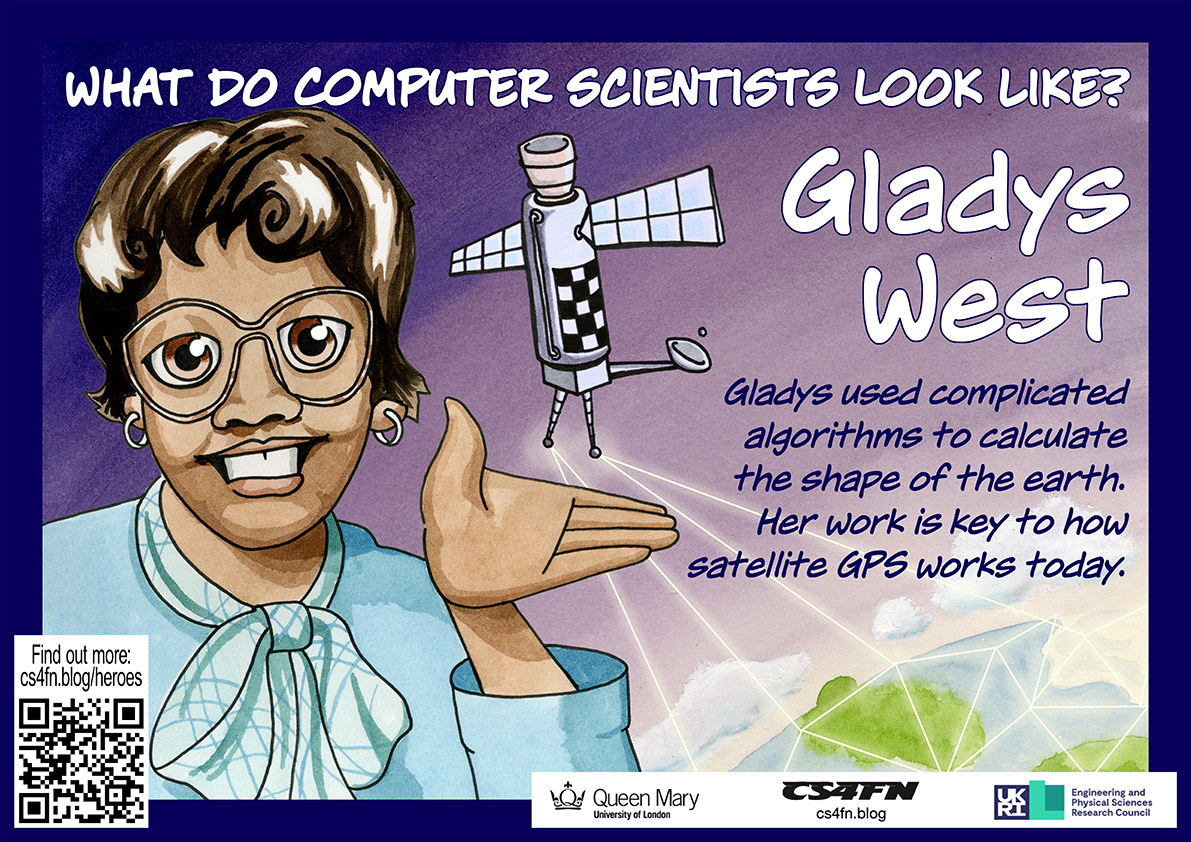
Poster of Gladys West
Poster by Richard Butterworth

More on …

This article is also republished during Black History Month and is part of our


Subscribe to be notified whenever we publish a new post to the CS4FN blog.


This blog is funded by EPSRC on research agreement EP/W033615/1.

QMUL CS4FN EPSRC logos