Graphic by Paul Curzon based on a graphical proof of Norman Fenton
If you take a test how do you work out how likely it is that you have the virus? Bayesian reasoning is one way (see “What are the chances of that”). Here is a graphical version of what that kind of reasoning is actually about.
If recent data shows that the virus currently affects one in 200 of the population, then it is reasonable to start with the assumption that the probability YOU have the virus is one in 200 (we call this the ‘prior probability’). Another way of saying that is that the prior probability is 0.5 per cent.
A better estimate
Suppose the probability a random person has the virus is 1 in 200 or 0.5 per cent. With no other evidence, your best guess that you have the virus is then also 0.5 per cent. You have also however taken a test and it was positive. However, for every 100 people taking the test, 2 will test positive when they actually do NOT have the virus. This means that the false positive rate is 2 per cent.
How? Bayes worked out a general equation for calculating this new, more accurate probability, called the ‘posterior’ probability (see page 8). It is based, here, on the probability of having the virus before testing (the original, prior probability) and any new evidence, which here is the test result.
A surprising result
How likely is it that you have the virus? With only this evidence, the probability you have the virus is still only 20 per cent.
Norman Fenton, Queen Mary University of London, Spring 2021
The hobby of a church minister over 250 years ago is helping computers make clever decisions.
Thomas Bayes was an English church minister who died in 1761. His hobby was a type of maths that today we call probability and statistics, though his writings were never really recognised during his own lifetime. So, how is the hobby of this 18th century church minister driving computers to become smarter than ever? His work is now being used in applications as varied as: helping to diagnose and treat various diseases; deciding whether a suspect’s DNA was at a crime scene; accurately recommending which books and films we will like; setting insurance premiums for rare events; filtering out spam emails; and more.
How likely is that?
Bayes was interested in calculating how likely things were to happen (their probability) and particularly things that cannot be observed directly. Suppose, for example, you want to know the probability that you have an infectious virus, something you can’t just tell by looking. Perhaps you’re going to a concert of your favourite band – one for which you’ve already paid a lot of money. So you need to know you are not infected. If recent data shows that the virus currently affects one in 200 of the population, then it is reasonable to start with the assumption that the probability YOU have the virus is one in 200 (we call this the ‘prior probability’). Another way of saying that is that the prior probability is 0.5 per cent.
A better estimate
However, you can get a much better estimate of how likely it is that you have the virus if you can gather more evidence of your personal situation. With a virus you can get tested. If the test was always correct, then you would know for certain. Tests are never perfect though. Let’s suppose that for every 100 people taking the test, two will test positive when they actually do NOT have the virus. Scientists call this the false positive rate: here two per cent. You take the test and it is positive. You can use this information to get a better idea of the likelihood you have the virus.
How? Bayes worked out a general equation for calculating this new, more accurate probability, called the ‘posterior’ probability. It is based, here, on the probability of having the virus before testing (the original, prior probability) and any new evidence, which here is the test result.
A surprising result
If we assume in our example that every person who does have the virus is certain to test positive then, plugging the numbers into Bayes’ theorem, tells us there is actually a surprisingly low, one in five (i.e., 20 per cent) chance you have the virus after testing positive. See A Graphical Explanation of Bayes’ theorem for why the answer is correct. Although this is much higher than the probability of having the virus without testing (two per cent), it still means you are unlikely to have the virus despite the positive test result!
If you understand Bayes theorem, you might feel it unfair if your doctor still insists that you have the virus and must miss the trip. In fact, many people find the result very surprising; generally, doctors who do not know Bayes’ theorem massively overestimate the likelihood that patients have a disease after a positive test result. But that is why Bayes’ theorem is so important.
To go or not to go
Of course, no one knows which are the five concert goers that are the ones infected. If all 25 ignore their doctor that means there are five people mingling in the crowd, passing on the virus, which would mean lots more people catch the virus who pass it on to lots more, who … (see Ping pong vaccination).
We have seen that, with a little extra information (such as a test result), we can work out a more accurate probability and so have better information upon which to make decisions. In practice, there are many different kinds of information that we can use to improve our estimate of the real probability. There are symptoms such as lack of taste/smell which are quite specific to the virus. Others, like a cough, are common in people with the virus but also in people with flu. There are also factors that can cause a person to have the virus in the first place such as close contact with an infected relative. So, instead of just inferring the probability of having the virus from one piece of information, like the test result, we can consider lots of interconnected data, each with its own prior probability. This is where computers come in: to do all the calculations for us.
We first need to tell the computer about what causes what. A convenient way to do this is to draw a diagram of the connections and probabilities called a ‘Bayesian network’ (see A Simple Bayesian Network – to come). Once a computer has been given the Bayesian network, it can not only work out more accurate probabilities, but it can also use them to start making decisions for us. This is where all those applications come in. Deciding whether a suspect’s DNA was at a crime scene, for example, needs the same kind of reasoning as deciding whether you have the virus.
Obviously, it is more complex to apply Bayes’ theorem in realistic situations and, until quite recently, even the fastest computers weren’t able to do the calculations. However, breakthroughs by computer scientists developing new algorithms mean that very complex Bayesian networks, with lots of inter-connected causes, can now be computed efficiently. Because of this, Bayesian networks can now be applied to a multitude of important problems that were previously impossible to solve. And that is why, perhaps surprisingly, the ideas of Thomas Bayes, from over 250 years ago, are showing us how to build machines that make smarter decisions when things are uncertain.
Norman Fenton, Queen Mary University of London, Spring 2021
Vaccination programmes work best when the majority of the population are vaccinated. One way scientists simulate the effects of disease and vaccination programmes is by using computer simulations. But what is a computer simulation?
You can visualise what a simulation is with ping pong balls bouncing around a crowd. Imagine having a large room full of people. A virus is represented by a ping pong ball, bouncing from person to person, infecting each person it touches. Each person who is hit by a ping pong ball and not already infected becomes infected. That means they toss that ping pong ball back into the crowd to infect more people, but they also toss an extra one too (and then they sit down: dead). Start with a few ping pong balls. Quickly the virus spreads everywhere and lots of people sit down (die). You have run a physical simulation of how a virus spreads!
Now start again but ‘vaccinate’ 80 per cent of the people first: give them a baseball cap to wear to show who is who. If those people get a ping pong ball, they just destroy it: they infect noone else. Start with the same number of ping pong balls. This time, the virus quickly dies out and only a few people sit down (die). Not only are the vaccinated people protected but they protect many of the un-protected people too who might have died.
Now (if you can program) you can write a program to do the same thing, and so simulate and explore the spread of infection, which is easier perhaps than getting a thousand people to chuck ping pong balls about. Create a grid (an array) of 1000 cells. Each represents a person. They can be infected or not. They can also be vaccinated or not. Start with five random cells (so people marked as infected). Run a series of rounds. After each round, a newly infected cell randomly chooses two others to infect. If not infected already and not vaccinated, then they become newly infected. If already infected or vaccinated, they do not pass the infection on.
You can run lots of different experiments with different conditions. For example, experiment with different proportions of people infected at the start or explore what percentage of people need to be vaccinated for the virus to quickly die out. Is 50 per cent enough? You could also change how many people one person infects, or for how long a person can infect others before dying. Perhaps they each keep causing new infections for three rounds before stopping instead of only one. In what situations does the virus infect lots of people and when does it die out quickly?
What you are doing here is computer modelling or simulating the effects of the virus in different scenarios, and that is essentially how computer scientists make the predictions that governments use to make decisions about lockdowns and mask wearing, if they are “following the science”. Of course, such models are only as good as the data that goes into them, such as how many other people does each person infect. In reality, this is data provided by surveys, experimental studies, and so on.
Paul Curzon, Queen Mary University of London, Spring 2021
The trouble with healthcare is that it’s becoming ever more expensive: new drugs, new treatments, more patients, the ever-increasing time needed with experts. Smart healthcare might be able to help.
We want everyone to get the care they need, but the costs are growing. Perhaps computer scientists can help? Research groups worldwide are exploring ways to create computing technology to improve healthcare, and intelligent programs that can support patients at home, helping monitor them and make decisions about what to do.
For example, say you are on powerful drugs to manage a long term illness: should you have the vaccine? Can you have a baby? Is a flare up of your disease about to hit you and how can you avoid it? Is that new ache a side effect of the drugs? Do you need to change medicines? Do you need to see a specialist?
If smart programs can help support patients then the doctors and nurses can spend more time with those who actually need it, hospitals can save on expensive drugs that aren’t working, and patients can have better lives. But what kind of technology can deliver this sort of service?
In the current issue of cs4fn magazine, we explore one particular way being developed on the EPSRC funded PAMBAYESIAN project at Queen Mary University of London, based on an area of computing called Bayesian networks, that might just be the answer. We also look at other ways computers can help deliver better healthcare for all and other uses of Bayesian networks.
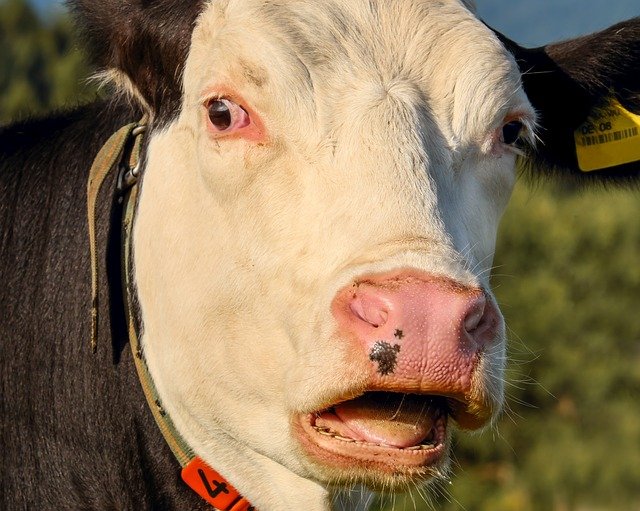
It has long been an aim of computer scientists to develop software that can work out how a person is feeling. Are you happy or sad, frustrated or lonely? If the software can tell then it can adapt to you moods, changing its behaviour or offering advice. Suresh Neethirajan from Wageningen University in the Netherlands has gone step further. He has developed a program that detects the emotions of farm animals.
Working out how someone is feeling is called “Sentiment Analysis” and there are lots of ways computer scientists have tried to do it. One way is based on looking at the words people speak or write. The way people speak, such as the tone of voice also gives information about emotions. Another way is based on our facial expressions and body language. A simple version of sentiment analysis involves working out whether someone is feeling a positive emotion (like being happy or excited) versus a negative emotions (such as being sad or angry) rather than trying to determine the precise emotion.
Applications range from deciding how a person might vote to predicting what they might buy. A more futuristic use is to help medics make healthcare decisions. When the patient says they are aren’t feeling too bad, are they actually fine or are they just being stoical, for example? And how much pain or stress are they actually suffering?
But why would you want to know the emotions of animals? One really important application is to know when an animal is, or is not, in distress. Knowing that can help a farmer look after that animal better, but also work out the best way to better look after animals more generally. It might help farmers design nicer living conditions, but also work out more humane ways to slaughter animals that involves the least suffering. Avoiding cruel conditions is reason on its own, but with happy farm animals you might also improve the yield of milk, quality of meat or how many offspring animals have in their lifetime. A farmer certainly shouldn’t want their animals to be so upset they start to self harm, which can be a problem when animals are kept in poor conditions. Not only is it cruel it can lead to infections which costs money to treat. It also spreads resistance to antibiotics. Having accurate ways to quickly and remotely detect how animals are feeling would be a big step forward for animal welfare.
But how to do it? While some scientists are actually working on understanding animal language, recognising body language is an easier first step to understand animal emotions. A lot is actually known about animal expressions and body language, and what they mean. If a dog is wagging its tail, then it is happy, for example. Suresh focussed on facial expressions in cows and pigs. What kind of expressions do they have? Cows, for example, are likely to be relaxed if their eyes are half-closed, and their ears are backwards or hung-down. If you can see the whites of their eyes, on the other hand then they are probably stressed. Pigs that are moving their ears around very quickly, by contrast, are likely to be stressed. If their ears are hanging and flipping in the direction of their eyes, though, then they are in a much more neutral state.
There are lots of steps to go through in creating a system to recognise emotions. The first for Suresh was to collect lots of pictures of cows and pigs from different farms. He collected almost 4000 images from farms in Canada, the USA and India. Each image was labelled by human experts according to whether it showed a positive, neutral and negative emotional state of the animal, based on what was already known about how animal expressions link to their emotions.
Sophisticated image processing software was then used to automatically pick out the animals’ faces as well as locate the individual features, such as eyes and ears. The orientation and other properties of those facial features, such as whether ears were hanging down or up is also determined. This processed data is then fed into a machine learning system to train it on this data. The fact that it was labelled meant the program knew what a human judged the different expressions to mean in terms of emotions, and so could then work out how patterns in the data that represented each animal state.
Once trained the system was then given new images without the labels to judge how accurate it was. It made a judgement and this was compared to the human judgement of the state. Human and machine agreed 86% of the time. More work is needed before such a system could be used on farms but it opens the possibility of using video cameras around a farm to raise the alarm when animals are suffering, for example.
Machine learning is helping humans in lots of ways. With systems like this machine learning could soon be helping animals live better lives too.
Paul Curzon, Queen Mary University of London, Spring 2021
Subscribe to be notified whenever we publish a new post to the CS4FN blog.
This blog is funded by EPSRC on research agreement EP/W033615/1.
‘How do robots eat pizza?’… ‘One byte at a time’. Computational Humour is real, but it’s not jokes about computers, it’s computers telling their own jokes.
Computers can create art, stories, slogans and even magic tricks. But can computers perform themselves? Can robots invent their own jokes? Can they tell jokes?
Combining Artificial Intelligence, computational linguistics and humour studies (yes you can study how to be funny!) a team of Scottish researchers made an early attempt at computerised standup comedy! They came up with Standup (System to Augment Non Speakers Dialogue Using Puns): a program that generates riddles for kids with language difficulties. Standup has a dictionary and joke-building mechanism, but does not perform, it just creates the jokes. You will have to judge for yourself as to whether the puns are funny. You can download the software from here. What makes a pun funny? It is a about the word having two meanings at exactly the same time in a sentence. It is also about generating an expectation that you then break: a key idea about what is at the core of creativity too.
A research team at Virginia Tech in the US created a system that started to learn about funny pictures. Having defined a ‘funniness score’ they created a computational model for humorous scenes, and trained it to predict funniness, perhaps with an eye to spotting pics for social media posting, or not.
But are there funny robots out there? Yes! RoboThespian programmed by researchers at Queen Mary University of London, and Data, created by researchers at Carnegie Mellon University are both robots programmed to do stand-up comedy. Data has a bank of jokes and responds to audience reaction. His developers don’t actually know what he will do when he performs, as he is learning all the time. At his first public gig, he got the crowd laughing, but his timing was poor. You can see his performance online, in a TED Talk.
RoboThespian did a gig at the London Barbican alongside human comedians. The performance was a live experiment to understand whether the robot could ‘work the audience’ as well as a human comedian. They found that even relatively small changes in the timing of delivery make a big difference to audience response.
What have these all got in common? Artificial Intelligence, machine learning and studies to understand what humour actually is, are being combined to make something that is funny. Comedy is perhaps the pinnacle of creativity. It’s certainly not easy for a human to write even one joke, so think how hard it is distill that skill into algorithms and train a computer to create loads of them.
You have to laugh!
Jane Waite, Queen Mary University of London, Summer 2017
Based on a 2016 talk by Sabine Hauert at the Royal Society
Sabine Hauert is a swarm engineer. She is fascinated by the idea of making use of swarms of robots. Watch a flock of birds and you see that they have both complex and beautiful behaviours. It helps them avoid predators very effectively, for example, so much so that many animals behave in a similar way. Predators struggle to fix on any one bird in all the chaotic swirling. Sabine’s team at the University of Bristol are exploring how we can solve our own engineering problems: from providing communication networks in a disaster zone to helping treat cancer, all based on the behaviours of swarms of animals.
Sabine realised that flocks of birds have properties that are really interesting to an engineer. Their ability to scale is one. It is often easy to come up with solutions to problems that work in a small ‘toy’ system, but when you want to use it for real, the size of the problem defeats you. With a flock, birds just keep arriving, and the flock keeps working, getting bigger and bigger. It is common to see thousands of Starlings behaving like this – around Brighton Pier most winter evenings, for example. Flocks can even be of millions of birds all swooping and swirling together, never colliding, always staying as a flock. It is an engineering solution that scales up to massive problems. If you can build a system to work like a flock, you will have a similar ability to scale.
Flocks of birds are also very robust. If one bird falls out of the sky, perhaps because it is caught by a predator, the flock itself doesn’t fail, it continues as if nothing happened. Compare that to most systems humans create. Remove one component from a car engine and it’s likely that you won’t be going anywhere. This kind of robustness from failure is often really important.
Swarms are an example of emergent behaviour. If you look at just one bird you can’t tell how the flock works as a whole. In fact, each is just following very simple rules. Each bird just tracks the positions of a few nearest neighbours using that information to make simple decisions about how to move. That is enough for the whole complex behaviour of the flock to emerge. Despite all that fast and furious movement, the birds never crash into each other. Fascinated, Sabine started to explore how swarms of robots might be used to solve problems for people.
Her first idea was to create swarms of flying robots to work as a communications network, providing wi-fi coverage in places it would otherwise be hard to set up a network. This might be a good solution in a disaster area, for example, where there is no other infrastructure, but communication is vital. You want it to scale over the whole disaster area quickly and easily, and it has to be robust. She set about creating a system to achieve this.
The robots she designed were very simple, fixed wing, propellor-powered model planes. Each had a compass so it knew which direction it was pointing and was able to talk to those nearest using wi-fi signals. It could also tell who its nearest neighbours were. The trick was to work out how to design the behaviour of one bird so that appropriate swarming behaviour emerged. At any time each had to decide how much to turn to avoid crashing into another but to maintain the flock, and coverage. You could try to work out the best rules by hand. Instead, Sabine turned to machine learning.
“Throwing those flying robots and seeing them flock was truly magical”
The idea of machine learning is that instead of trying to devise algorithms that solve problems yourself, you write an algorithm for how to learn. The program then learns for itself by trial and error the best solution. Sabine created a simple first program for her robots that gave them fairly random behaviour. The machine learning program then used a process modelled on evolution to gradually improve. After all evolution worked for animals! The way this is done is that variations on the initial behaviour are trialled in simulators and only the most successful are kept. Further random changes are made to those and the new versions trialled again. This is continued over thousands of generations, each generation getting that little bit better at flocking until eventually a behaviour of individual robots results that leads to them swarming together.
Sabine has now moved on to to thinking about a situation where swarms of trillions of individuals are needed: nanomedicine. She wants to create nanobots that are each smaller than the width of a strand of hair and can be injected into cancer patients. Once inside the body they will search out and stick themselves to tumour cells. The tumour cells gobble them up, at which point they deliver drugs directly inside the rogue cell. How do you make them behave in a way that gives the best cancer treatment though? For example, how do you stop them all just sticking to the same outer cancer cells? One way might be to give them a simple swarm behaviour that allows them to go to different depths and only then switch on their stickiness, allowing them to destroy all the cancer cells. This is the sort of thing Sabine’s team are experimenting with.
Swarm engineering has all sorts of other practical applications, and while Sabine is leading the way, some time soon we may need lots more swarm engineers, able to design swarm systems to solve specific problems. Might that be you?
Paul Curzon, Queen Mary University of London
Explore swarm behaviour using the Oxford Turtle system [EXTERNAL] (click the play button top centre) to see how to run a flocking simulation as well as program your own swarms.
Telepathy is the supposed Extra Sensory Perception ability to read someone else’s mind at a distance. Whilst humans do not have that ability, brain-computer interaction researchers at Stanford have just made the high tech version a virtual reality.
It has long been know that by using brain implants or electrodes on a person’s head it is possible to tell the difference between simple thoughts. Thinking about moving parts of the body gives particularly useful brain signals. Thinking about moving your right arm, generates different signals to thinking about moving your left leg, for example, even if you are paralysed so cannot actually move at all. Telling two different things apart is enough to communicate – it is the basis of binary and so how all computer-to-computer communication is done. This led to the idea of the brain-computer interface where people communicate with and control a computer with their mind alone.
Stanford researchers made a big step forward in 2017, when they demonstrated that paralysed people could move a cursor on a screen by thinking of moving their hands in the appropriate direction. This created a point and click interface – a mind mouse – for the paralysed. Impressively, the speed and accuracy was as good as for people using keyboard applications
Stanford researchers have now gone a step even further and used the same idea to turn mental handwriting into actual typing. The person just thinks of writing letters with an imagined pen on imagined paper, the brain-computer interface then picks up the thoughts of subtle movements and the computer converts them into actual letters. Again the speed and accuracy is as good as most people can type. The paralysed participant concerned could communicate 18 words a minute and made virtually no mistakes at all: when the system was combined with auto-correction software, as we now all can use to correct our typing mistakes, it got letters right 99% of the time.
The system has been made possible by advances in both neuroscience and computer science. Recognising the letters being mind-written involves distinguishing very subtle differences in patterns of neurons firing in the brain. Recognising patterns is however, exactly what Machine Learning algorithms do. They are trained on lots of data and pick out patterns of similar data. If told what letter the person was actually trying to communicate then they can link that letter to the pattern detected. Here each letter will not lead to exactly the same pattern of brain signals firing each time, but they will largely clump together,. Other letters will also group but with slightly different patterns of firings. Once trained, the system works by taking the pattern of brain signals just seen and matching it to the nearest clumping pattern. The computer then guesses that the nearest clumping is the letter being communicated. If the system is highly accurate, as this one was at 94% (before autocorrection), then it means the patterns of most letters are very distinct. A letter being mind-written rarely fell into a brain pattern gap, which would have meant that letter could as easily have been the pattern of one letter as the other.
So a computer based “telepathy” is possible. But don’t expect us all to be able to communicate by mind alone over the internet any time soon. The approach involves having implants surgically inserted into the brain: in this case two computer chips connecting to your brain via 100 electrodes. The operation is a massive risk to take, and while perhaps justifiable for someone with a problem as severe as total paralysis, it is less obvious it is a good idea for anyone else. However, this shows at least it is possible to communicate written messages by mind alone, and once developed further could make life far better for severely disabled people in the future.
Yet again science fiction is no longer fantasy, it is possible, just not in the way the science fiction writers perhaps originally imagined by the power of a person’s mind alone.
Paul Curzon, Queen Mary University of London, Spring 2021
New technology can have unforeseen effects. The Law in particular can sometimes struggle to keep up, but for the IT savvy lawyer that can mean opportunity. For example, one bunch of lawyers realised that the way money moves round the world electronically could give their clients the edge. Nanoseconds are all it takes. As a result, a bunch of New York nanoseconds gave Judges in the Southern district court of the city a real headache.
Different countries have different laws. That means lawyers will go out of their way to apply the law for their clients in the right country. It can make all the difference. Unlike some other countries US maritime law allows a person to freeze a person’s assets, even before a decision has been reached, when there is a maritime claim against them. For example, if a merchant hasn’t been paid for a shipload of cargo, or if a shipyard hasn’t been paid for ship repairs, then they can use this rule to freeze the defaulter’s money. Otherwise a win, when it comes, could be rather hollow, with the money long placed out of reach. The only trouble for the lawyers is that the money has to be in the US for the US law to apply.
Frozen money
That is where the technology comes in. Bankers don’t ship physical money from country to country, it’s all done electronically now… A consequence of the way the banking system was set up is that dollar transactions had to pass through the US banking centre in Manhattan as the money has to move from place to place. That’s an easy thing to require data to do in the age of the Internet. It only spends a fraction of a second in New York before it jumps on somewhere else. The law, of course, makes no distinction over shrinking timescales in which computers make things happen. A prepared lawyer can have the money frozen in that instant as just at that moment it is in the US.
That was great for people wanting to hold up money. It was a nightmare for the New York judges, though. Once the lawyers caught on about those nanoseconds the work started stacking up for the judges. All those fractions of a second added up to hours of the Judges’ time granting permission for the money to be seized. Every day the poor New York judges had to process hundreds and hundreds of requests, just in case some disputed money happened to pass through that day. To seize the money, it wasn’t enough just to put in a request and wait, ready to pounce when the money lands in Manhattan. Instead, just like a Spider re-spinning its web every morning, the trap had to be renewed daily. To do that the lawyers had to serve the bank daily with notice that if any money passed through that day it had to be stopped in its high speed tracks.
New technology constantly brings up new problems like this, when old laws or procedures are found to be wanting when technology changes the way things are done: changes things far beyond the imagination of those who drafted the laws. Just as technology never stands still, neither does the law…or the IT savvy lawyer.
Paul Curzon, Queen Mary University of London, Summer 2017, updated Spring 2021
Subscribe to be notified whenever we publish a new post to the CS4FN blog.
This blog is funded by EPSRC on research agreement EP/W033615/1.
The great Tudor and Stuart philosopher Sir Francis Bacon was a scientist, a statesman and an author. He was also a pretty decent computer scientist. He published* a new form of cipher, now called Bacon’s Cipher, invented when he was a teenager. Its core idea is the foundation for the way all messages are stored in computers today.
The Tudor and Stuart eras were a time of plot and intrigue. Perhaps the most famous is the 1605 Gunpowder plot where Guy Fawkes tried to assassinate King James I by blowing up the Houses of Parliament. Secrets mattered! In his youth Bacon had worked as a secret agent for Elizabeth I’s spy chief, Walsingham, so knew all about ciphers. Not content with using those that existed he invented his own. The one he is best remembered for was actually both a cipher and a form of steganography. While a cipher aims to make a message unreadable, steganography is the science of secret writing: disguising messages so no one but the recipient knows there is a message there at all.
A Cipher …
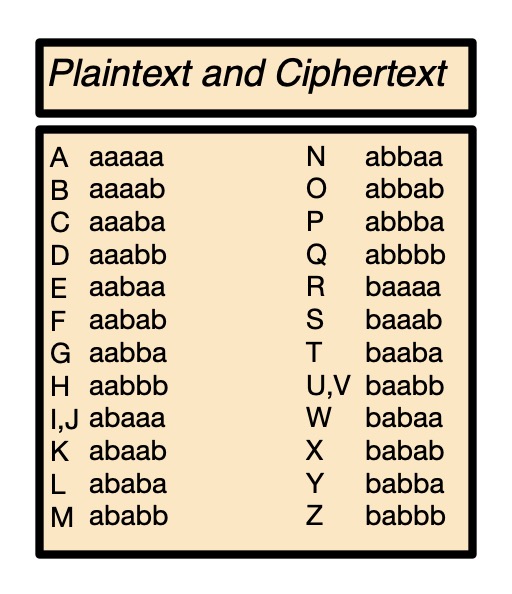
Bacon’s method came in two parts. The first was a substitution cipher, where different symbols are substituted for each letter of the alphabet in the message. This idea dates back to Roman times. Julius Caesar used a version, substituting each letter for a letter from a fixed number of places down the alphabet (so A becomes E, B becomes F, and so on). Bacon’s key idea was to replace each letter of the alphabet with, not a number or letter, but it’s own series of a’s and b’s (see the cipher table). The Elizabethan alphabet actually had only 24 letters so I and J have the same code as do U and V as they were interchangeable (J was the capital letter version of i and similarly for U and v).
In Bacon’s cipher everything is encoded in two symbols, so it is a binary encoding. The letters a and b are arbitrary. Today we would use 0 and 1. This is the first use of binary as a way to encode letters (in the West at least). Today all text stored in computers is represented in this way – though the codes are different – it is all Unicode is. It allocates each character in the alphabet with a binary pattern used to represent it in the computer. When the characters are to be displayed, the computer program just looks up which graphic pattern (the actual symbol as drawn) is linked to that binary pattern in the code being used. Unicode gives a binary pattern for every symbol in every human language (and some alien ones like Klingon).
Image by CS4FN
Steganography
The second part of Bacon’s cipher system was Steganography. Steganography dates back to at least the Greeks, who supposedly tattooed messages on the shaved heads of slaves, then let their hair grow back before sending them as both messenger and message. The binary encoding of Bacon’s cipher was vital to make his steganography algorithm possible. However, the message was not actually written as a’s and b’s. Bacon realised that two symbols could stand for any two things. If you could make the difference hard to spot, you could hide the messages. Bacon invented two ways of handwriting each letter of the alphabet – two fonts. An ‘a’ in the encoded message meant use one font and a ‘b’ meant use the other. The secret message could then be hidden inside an innocent one. The letters written were no longer the message, the message was in the font used. As Bacon noted, once you have the message in binary you could think of other ways to hide it. One way used was with capital and lower-case letters, though only using the first letter of words to make it less obvious.
Suppose you wanted to hide the message “no” in the innocuous message ‘hello world’. The message ‘no’ becomes ‘abbaa abbab’. So far this is just a substitution cipher. Next we hide it in, ‘hello world’. Two different kinds of fonts are those with curls on the tails of letters known as serif fonts and like this one and those without curls known as sans serif fonts and like this one. We can use a sans serif font to represent an ‘a’ in the coded message, and a serif font to represent ‘b’. We just alternate the fonts following the pattern of the a’s and b’s: ‘abbaa abbab’. The message becomes
Image by CS4FN
sans serif, serif, serif, sans serif, sans serif, sans serif, serif, serif, sans serif, serif.
Using those fonts for our message we get the final mixed font message to send:
Bacon the polymath
Bacon is perhaps best known as one of the principal advocates for rigorous science as a way of building up knowledge. He argued that scientists needed to do more than just come up with theories of how the world worked, and also guard against just seeing the results that matched their theories. He argued knowledge should be based on careful, repeated observation. This approach is the basis of the Scientific Method and one of the foundation stones of modern science.
Bacon was also a famous writer of the time, and one of many authors who has since been suggested as the person who wrote William Shakespeare’s plays. In his case it is because they claim to have found secret messages hidden in the plays in Bacon’s code. The idea that someone else wrote Shakespeare’s plays actually started just because some upper class folk with a lack of imagination couldn’t believe a person from a humble background could turn themselves into a genius. How wrong they were!
Paul Curzon, Queen Mary University of London, Autumn 2017
*Thanks to Pete Langman, whose PhD was on Francis Bacon, for pointing out a mistake in the original version of this blog where I suggested the cipher was published in, 1605, the year of the Gun Powder plot. It was actually first published in 1623 in De augmentis which was a translation/enlargement of his 1605 Advancement of Learning.
He also pointed out that Bacon conceived the idea while working with Elizabethan spymaster, Walsingham’s cipher expert at the time of the Babington plot to assasinate Elizabeth I, Thomas Phileppes, and Mary, Queen of Scots’ jailer, Amias Paulet. Bacon also claimed the cipher was never broken!
Subscribe to be notified whenever we publish a new post to the CS4FN blog.
This blog is funded by EPSRC on research agreement EP/W033615/1.