NASA Langley was the birthplace of the U.S. space program where astronauts like Neil Armstrong learned to land on the moon. Everyone knows the names of astronauts, but behind the scenes a group of African-American women were vital to the space program: Katherine Johnson, Mary Jackson and Dorothy Vaughan. Before electronic computers were invented ‘computers’ were just people who did calculations and that’s where they started out, as part of a segregated team of mathematicians. Dorothy Vaughan became the first African-American woman to supervise staff there and helped make the transition from human to electronic computers by teaching herself and her staff how to program in the early programming language, FORTRAN.
The women switched from being the computers to programming them. These hidden women helped put the first American, John Glenn, in orbit, and over many years worked on calculations like the trajectories of spacecraft and their launch windows (the small period of time when a rocket must be launched if it is to get to its target). These complex calculations had to be correct. If they got them wrong, the mistakes could ruin a mission, putting the lives of the astronauts at risk. Get them right, as they did, and the result was a giant leap for humankind.
See the film ‘Hidden Figures’ for more of their story.
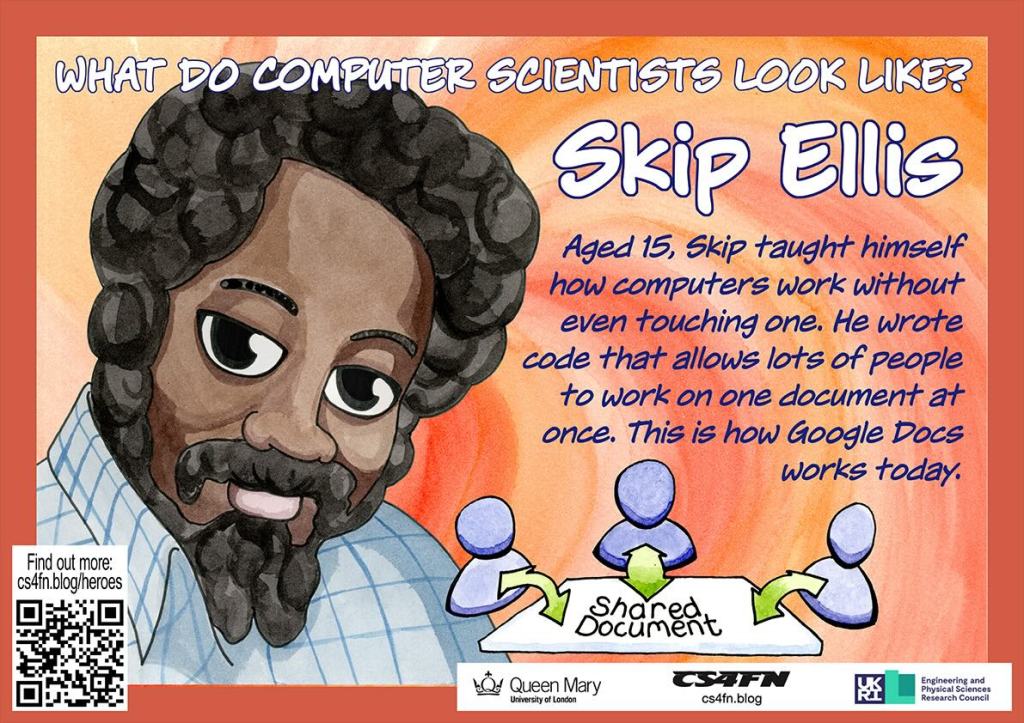
Back in 1956, Clarence Ellis started his career at the very bottom of the computer industry. He was given a job, at the age of 15, as a “computer operator” … because he was the only applicant. He was also told that under no circumstances should he touch the computer! Its lucky for all of us he got the job, though! He went on to develop ideas that have made computers easier for everyone to use. Working at a computer was once a lonely endeavour: one person, on one computer, doing one job. Clarence Ellis changed that. He pioneered ways for people to use computers together effectively.
The graveyard shift
The company Clarence first worked for had a new computer. Just like all computers back then, it was the size of a room. He worked the graveyard shift and his duties were more those of a nightwatchman than a computer operator. It could have been a dead-end job, but it gave him lots of spare time and, more importantly, access to all the computer’s manuals … so he read them … over and over again. He didn’t need to touch the computer to learn how to use it!
Saving the day
His studying paid dividends. Only a few months after he started, the company had a potential disaster on its hands. They ran out of punch cards. Back then punch cards were used to store both data. They used patterns of holes and non-holes as a way to store numbers as binary in a away a computer could read them. Without punchcards the computer could not work!
It had to though, because the payroll program had to run before the night was out. If it didn’t then no-one would be paid that month. Because he had studied the manuals in detail, and more so than anyone else, Clarence was the only person who could work out how to reuse old punch cards. The problem was that the computer used a system called ‘parity checking’ to spot mistakes. In its simplest form parity checking of a punch card involves adding an extra binary digit (an extra hole or no-hole) on the end of each number. This is done in a way that ensures that the number of holes is even. If there is an even number of holes already, the extra digit is left as a non-hole. If, on the other hand there is an odd number of holes, a hole is punched as the extra digit. That extra binary digit isn’t part of the number. It’s just there so the computer can check if the number has been corrupted. If a hole was accidentally or otherwise turned into a non-hole (or vice versa), then this would show up. It would mean there was now an odd number of holes. Special circuitry in the computer would spot this and spit out the card, rejecting it. Clarence knew how to switch that circuitry off. That meant they could change the numbers on the cards by adding new holes without them being rejected.
After that success he was allowed to become a real operator and was relied on to troubleshoot whenever there were problems. His career was up and running.
Clicking icons
He later worked at Xerox Parc, a massively influential research centre. He was part of the team that invented graphical user interfaces (GUIs). With GUIs Xerox Parc completely transformed the way we used computers. Instead of typing obscure and hard to remember commands, they introduced the now standard ideas, of windows, icons, dragging and dropping, using a mouse, and more. Clarence, himself, has been credited with inventing the idea of clicking on an icon to run a program.
As if that wasn’t enough of an impact, he went on to help make groupware a reality: software that supports people working together. His focus was on software that let people write a document together. With Simon Gibbs he developed a crucial algorithm called Operational Transformation. It allows people to edit the same document at the same time without it becoming hopelessly muddled. This is actually very challenging. You have to ensure that two (or more) people can change the text at exactly the same time, and even at the same place, without each ending up with a different version of the document.
The actual document sits on a server computer. It must make sure that its copy is always the same as the ones everyone is individually editing. When people type changes into their local copy, the master is sent messages informing it of the actions they performed. The trouble is the order that those messages arrive can change what happens. Clarence’s operational transformation algorithm solved this by changing the commands from each person into ones that work consistently whatever order they are applied. It is the transformed operation that is the one that is applied to the master. That master version is the version everyone then sees as their local copy. Ultimately everyone sees the same version. This algorithm is at the core of programs like Google Docs that have ensured collaborative editing of documents is now commonplace.
Clarence Ellis started his career with a lonely job. By the end of his career he had helped ensure that writing on a computer at least no longer needs to be a lonely affair.
One of the aims of our Diversity in Computing posters is to help a classroom of young people see the range of computer scientists which includes people who look like them and people who don’t look like them. You can download our posters free from the link above.
This article is an edited version of one of the 2006 winning essays from the Queen Mary University of London, Department of Computer Science, first year essay competition.
May I ask you a question? When you think of the computer what names ring a bell? Bill Gates? Or for those more in touch with the history behind computers maybe Charles Babbage is a familiar name? May I ask you another question please? Do you know who Dr Mark Dean is? No, well you should. Do not worry yourself though, you are definitely not alone. I did not know of him either.
Allow me to enlighten you..
Mark Dean is in my opinion a very creative and inspirational black computer scientist. He is a vice-president at IBM and holds 3 of IBM’s first 9 patents on the personal computer. He has over 30 patents pending. He won the Black Engineer of the Year Presidents Award and was made an IBM fellow in 1995. An IBM fellow is IBM’s highest technical honor. Only 50 of IBM’s employee’s are fellows and Mark Dean was the first black one. Prior to joining IBM in 1980 he earned degrees in Electrical Engineering before going back to school to gain a PhD in the field from Stanford University. He was born in 1957 in Jefferson City, Tennessee and was one of the first black students to attend Jefferson City High School. He was an exceptional student and enjoyed athletics. Early manifestations of his desire to create were shown when he and his father built a tractor from scratch when he was just a boy.
Upon joining IBM Mark Dean and a partner led the team that developed the interior architecture (ISA systems bus) which allowed devices like the keyboard and printer to be connected to the motherboard making computers a part of our lives. It was that which earned him a spot in the National Inventors Hall of Fame. While at IBM he has been involved in numerous positions in computer system hardware architecture and design. He was responsible for IBM’s research laboratory in Austin, Texas where he focused on developing high performance microprocessors, software, systems and circuits. It is here where he made history by leading the team that built a gigahertz chip which did a billion calculations per second. In 2004, he was chosen as one of the 50 most important Blacks in Research Science.
I think that such a man should be well recognized in computer science, especially to black computer science students because from what I can see we are rare. We as a minority need an inspirational figure like Mark Dean. He inspires me, I wanted to share that with you. Before this small article it is very probable you had no knowledge of this man. So if there comes a time where you are asked about important names in the field of computers, I hope Dr Mark Dean springs to mind and rings a bell for you to hear loud and clear.
Freddie Figgers. Image by Freddie Figgers, CC BY 4.0 , via Wikimedia Commons
As a baby, born in the US in 1989, Freddie Figgers was abandoned by his biological parents but he was brought up with love and kindness by two much older adoptive parents who kindled his early enthusiasm for fixing things and inspired his work in smart health. He now runs the first Black-owned telecommunications company in the US.
When Freddie was 9 his father bought him an old (broken) computer from a charity shop to play around with. He’d previously enjoyed tinkering with his father’s collection of radios and alarm clocks and when he opened up the computer could see which of its components and soldering links were broken. He spotted that he could replace these with the same kinds of components from one of his dad’s old radios and, after several attempts, soon his computer was working again – Freddie was hooked, and he started to learn how to code.
When he was 12 he attended an after-school club and set to work fixing the school’s broken computers. His skill impressed the club’s leader, who also happened to be the local Mayor, and soon Freddie was being paid several dollars an hour to repair even more computers for the Mayor’s office (in the city of Quincy, Florida) and her staff. A few years later Quincy needed a new system to ensure that everyone’s water pressure was correct. A company offered to create software to monitor the water pressure gauges and said it would cost 600,000 dollars. Freddie, now 15 and still working with the Mayor, offered to create a low-cost program of his own and he saved the city thousands in doing so.
He was soon offered other contracts and used the money coming in to set up his own computing business. He heard about an insurance company in another US city whose offices had been badly damaged by a tornado and lost all of their customers’ records. That gave him the idea to set up a cloud computing service (which means that the data are stored in different places and if one is damaged the data can easily be recovered from the others).
His father, now quite elderly, had dementia and regularly wandered off and got lost. Freddie found an ingenious way to help him by rigging up one of his dad’s shoes with a GPS detector and two-way communication connected to his computer – he could talk to his dad through the shoe! If his dad was missing Freddie could talk to him, find out where he was and go and get him. Freddie later sold his shoe tracker for over 2 million dollars.
Living in a rural area he knew that mobile phone coverage and access to the internet was not as good as in larger cities. Big telecommunications companies are not keen to invest their money and equipment in areas with much smaller populations so instead Freddie decided to set up his own. It took him quite a few applications to the FCC (the US’ Federal Communications Commission who regulate internet and phone providers) but eventually, at 21, he was both the youngest and the first Black person in the US to own a telecoms company.
Most telecoms companies just provide a network service but his company also creates affordable smart phones which have ‘multi-user profiles’ (meaning that phones can be shared by several people in a family, each with their own profile). The death of his mother’s uncle, from a diabetic coma, also inspired him to create a networked blood glucose (sugar) meter that can link up wirelessly to any mobile phone. This not only lets someone share their blood glucose measurements with their healthcare team, but also with close family members who can help keep them safe while their glucose levels are too high.
Freddie has created many tools to help people in different ways through his work in health and communications – he’s even helping the next generation too. He’s also created a ‘Hidden Figgers’ scholarship to encourage young people in the US to take up tech careers, so perhaps we’ll see a few more fantastic folk like Freddie Figgers in the future.
Jo Brodie and Paul Curzon, Queen Mary University of London
a European movement to make it easier for people to repair their devices, or even just change the battery in a smartphone themselves. See also the London-based Restart Project which is arguing for the same in the UK.
See also
A ‘shoe tech’ device for people who have no sense of that direction – read about it in ‘Follow that Shoe’ on the last page of the wearable technology issue of CS4FN (‘Technology Worn Out (And About)’, issue 25).
Subscribe to be notified whenever we publish a new post to the CS4FN blog.
This blog is funded by EPSRC on research agreement EP/W033615/1.
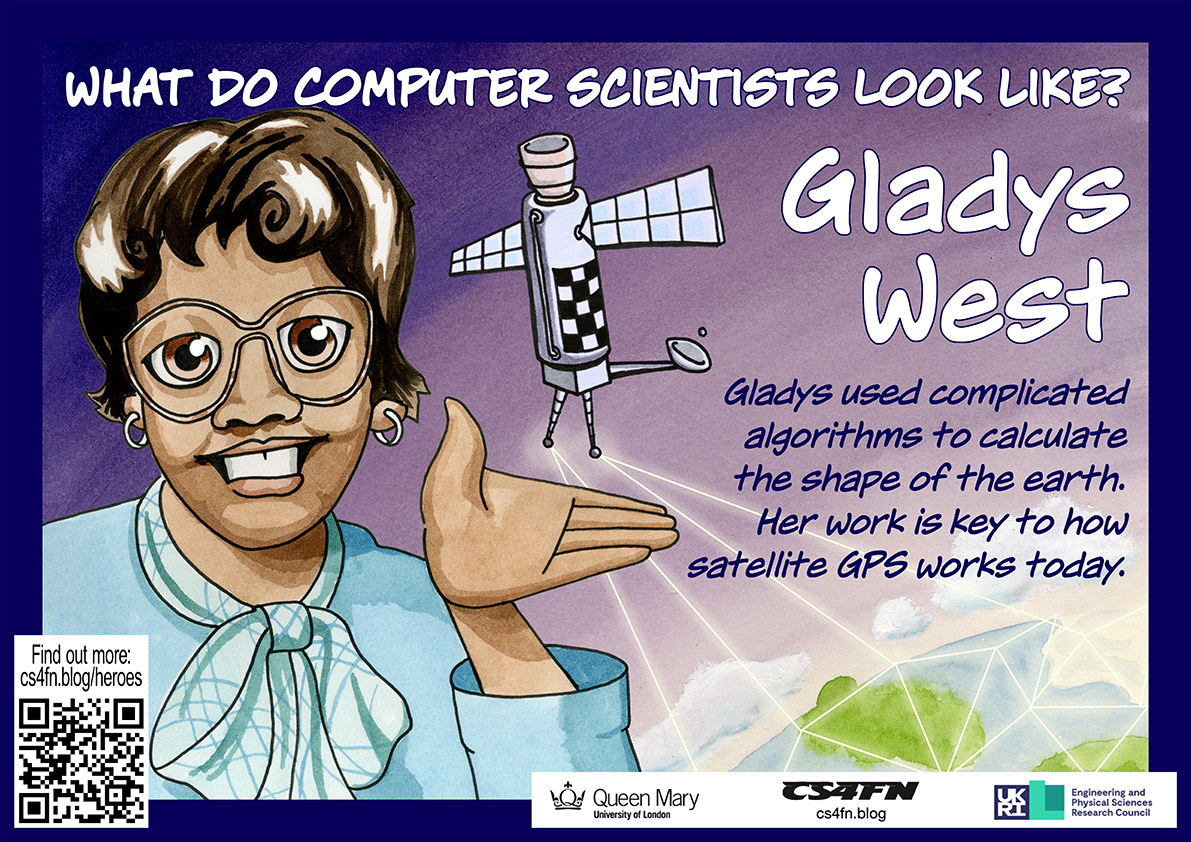
Satellites are critical to much modern technology, and especially GPS. It allows our smartphones, laptops and cars to work out their exact position on the surface of the earth. This is central to all mobile technology, wearable or not, that relies on knowing where you are, from plotting a route your nearest Indian restaurant to telling you where a person you might want to meet is. Many, many people were involved in creating GPS, but it was only in Black History Month of 2017 when the critical part Gladys West played became widely known.
Work hard, go far
As a child Gladys worked with her family in the fields of their farm in rural Virginia. That wasn’t the life she wanted, so she worked hard through school, leaving as the top student. She won a scholarship to university, and then landed a job as a mathematician at a US navy base.
There she solved the maths problems behind the positioning of satellites. She worked closely with the programmers to write the code to do calculations based on her maths. Nine times out of ten the results that came back weren’t exactly right so much of her time was spent working out what was going wrong with the programs, as it was vital the results were very accurate.
Seasat and Geosat
Her work on the Seasat satellite won her a commendation. It was a revolutionary satellite designed to remotely monitor the oceans. It collected data about things like temperature, wind speed and wind direction at the sea’s surface, the heights of waves, as well as sensing data about sea ice. This kind of remote sensing has since had a massive impact on our understanding of climate change. Gladys specifically worked on the satellite’s altimeter. It was a radar-based sensor that allowed Seasat to measure its precise distance from the surface of the ocean below. She continued this work on later remote sensing satellites too, including Geosat, a later earth observation satellite.
Gladys West and Sam Smith look over data from the Global Positioning System, which Gladys helped develop. Image: U.S. Navy, Public domain, via Wikimedia Commons US Navy, 1985,
GPS
Knowing the positions of satellites is the foundation for GPS. The way GPS works is that our mobile receivers pick up a timed signal from several different satellites. Calculating where we are can only be done if you first know very precisely where those satellites were when they sent the signal. That is what Gladys’ work provided.
GPS Watches
You can now buy, for example, buy GPS watches, allowing you to wear a watch that watches where you are. They can also be used by people with dementia, who have bad memory problems, allowing their carers to find them if they go out on their own but are then confused about where they are. They also allow parents to know where their kids are all the time. Do you think that’s a good use?
Since so much technology now relies on knowing exactly where we are, Gladys’ work has had a massive impact on all our lives.
To be a good computer scientist you have to enjoy problem solving. That is what it’s all about: working out the best way to do things. You also have to be able to think in a logical way: be a bit of a Vulcan. But what does that mean? It just means being able to think precisely, extracting all the knowledge possible from a situation just by pure reasoning. It’s about being able to say what is definitely the case given what is already known…and it’s fun to do. That’s why there is a Suduko craze going on as I write. Suduko are just pure logical thinking puzzles. Personally I like Kakuro better. They are similar to Soduko, but with a crossword format.
What is a Kakuro?
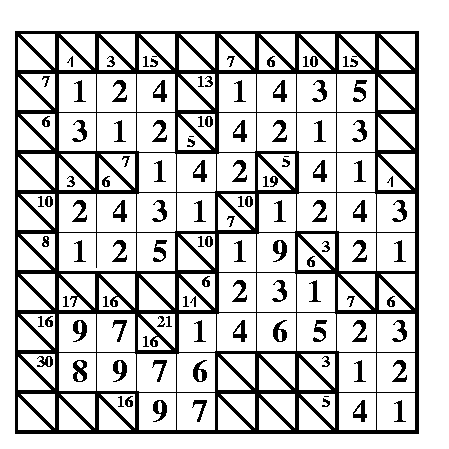
A Kakuro is a crossword-like grid, but where each square has to be filled in with a digit from 1-9 not a letter. Each horizontal or vertical block of digits must add up to the number given to the left or above, respectively. All the digits in each such block must be different. That part is similar to Soduko, though unlike Soduko, numbers can be repeated on a line as long as they are in different blocks. Also, unlike Soduko, you aren’t given any starting numbers, just a blank grid.
Where does logic come into it? Take the following fragment:
Part of a Kakuro Puzzle. Image by PC
There is a horizontal block of two cells that must add up to 16. Ways that could be done using digits 1-9 are 9+7, 8+8 or 7+9. But it can’t be 8+8 as that needs two 8s in a block which is not allowed so we are left with just two possibilities: 9+7 or 7+9. Now look at the vertical blocks. One of them consists of two cells that add up to 17. That can only be 9+8 or 8+9. That doesn’t seem to have got us very far as we still don’t know any numbers for sure. But now think about the top corner. We know from across that it is definiteley 9 or 7 and from down that it is definitely 9 or 8. That means it must be 9 as that is the only way to satisfy both restrictions.
A Kakuro for you to try
A Kakuro puzzle for you to try. Image by PC
Here is a full Kakuro to try. There is also a printer friendly pdf version. Check your answer at the very end of this post when you are done.
Being able to think logically is important because computer programming is about coming up with precise solutions that even a dumb computer can follow. To do that you have to make sure all the possibilities have been covered. Reasoning very much like in a Kakuro is needed to convince yourself and others that a program does do what it is supposed to.
A gentoo penguin slumps belly-first on a nest at Damoy, on the Antarctic Peninsula. Nearby some lichen grows across a rock, and schools of krill float through the Southern Ocean. Every one of these organisms is a part of life in the Antarctic, and scientitsts study each of them. But what happens to one species affects all the others too. To help make sure that they all survive, scientists have to understand how penguins, plants, krill and everything else in the Antarctic interact with one another. They need to figure out the rules of the ecosystem.
Working together
When you’re trying to understand a system that includes everything from plants to penguins, things get a bit complicated. Fortunately, ecology has a new tool to help, called complexity theory. Anje-Margriet Neutel is a Biosphere Complexity Analyst for the British Antarctic Survey. It’s her job to take a big puzzle like the Antarctic ecosystem, and work out where each plant and animal fits in. She explains that ‘complexity is sort of a new brand of science’. Lots of science is about isolating something – say, a particular chemical – from its surroundings so you can learn about it, but when you isolate all the parts of a system you miss how they work together. What complexity tries to do is build a model that can show all the important interactions in an ecosystem at the same time.
Energy hunt
So for a system as big as a continent full of species, where do you start? Anje’s got a sensible answer: you start with what you can measure. Energy’s a good candidate. After all, every organism needs energy to stay alive, and staying alive is pretty much the first thing any plant or animal needs to do. So if you can track energy and watch it move through the ecosystem, you’ll learn a lot about how things work. You’ll find out what comes into the system, what goes out and what gets recycled.
Playing with models
Once you’ve got an idea of how everything fits together you’ve got what scientists call a model. The really clever thing you can do with models is start to mess around with them. As an example Anje says, ‘What would happen if you took one group of organisms and put in twice as much of them?’ If you had a system with, say, twice as many penguins, the krill would have to be worried because more penguins are going to want to eat them. If they all run out what happens to the penguins? Or the seals that like eating krill too? It gets complicated pretty quickly, and those complicated reactions are just what scientists want to predict.
The language of nature
Figuring out how an ecosystem works is all about rules and structure. Ecosystems are huge complicated things, but they’re not random – whether they work or not depends on having the right organisms doing jobs in the right places, and on having the right connections between all the different parts. It’s like a computer program that way. Weirdly, it’s also a bit like language. In fact, Anje’s background is in studying linguistics, not ecology. Think of an ecosystem like a sentence – there are thousands of words in the English language but in order to make a sentence you have to put them together in the right way. If you don’t have the right grammar your sentence just won’t make sense, and if an ecosystem doesn’t have the right structure it’ll collapse. Anje says that’s what she wants to discover in the ecosystems she studies. ‘I’m interested in the grammar of it, in the grammar of nature.’
Surviving Antarctica
Since models can help you predict how an ecosystem reacts to strange conditions, Anje’s work could help Antarctica survive climate change. ‘The first thing is to understand how the models work, how the models behave, and then translate that back to the biology that it’s based on,’ she explains. ‘Then say OK, this means we expect there may be vulnerable areas or vulnerable climate regions where you can expect something to happen if you take the model seriously.’ If scientists like Anje can figure out how Antarctica’s ecosystems are set up to work, they’ll get clues about which areas of the continent are most at risk and what they can do to protect them.
Surviving on a continent where the temperature hardly ever gets above freezing is tough, and climate change is probably going to make it even tougher. If we can figure out how Antarctic ecosystems work, though, we’ll know what the essential elements for survival are, and we’ll have clues about how to make things better. Extracting the secret grammar of survival isn’t going to be a simple job, but that’s no surprise to the people working on it. After all, they’re not called complexity scientists for nothing.
How are you two doing together? You and your data, we mean. It’d be nice to have an update. Do you understand one another in that special OMG-we’ve-talked-all-night-and-now-the-sun’s-up kind of way? Is it more like you just kind of hang out together without really bothering to think about each other? Or maybe you’re just a bit baffled by the whole data scene. If your heart doesn’t beat with fervent love for the wild binary information all around you, that’s OK. In fact that’s pretty normal. It just so happens, though, that there’s a guy who wants to improve your data relationships. He’s called Andy Broomfield and he graduated as a designer from the Royal College of Art.
Andy’s worried that as we rely more and more on gadgets like mobiles and satnavs, a lot of us stop thinking about where the data comes from. “Increasingly we’re becoming dependent on the data,” says Andy. “We are just blindly fed it.” He tells the story of some councils that had to put up ‘Ignore Your Satnav’ signs after lorry drivers followed electronic directions down narrow lanes rather than believe their own eyes. He reckons that hapless users wouldn’t get quite so “data-lost” if we had a way to really connect with the pure information out there, being broadcast from satellites every second of the day. So he designed some gadgets of his own to help get our data relationships back on the rails.
Time to yourself
Ignore Sat Nav image by Dan Pope on Flickr, used under a CC BY-NC-SA 2.0 licence.
The first device lets you keep a personal time zone, and was inspired by a group of data-lovers who are sweet on measuring time. Time zones divide the globe into long tall ribbons based on longitude. Since GPS satellites can give each of us extremely accurate longitude readings all the time (the cs4fn offices are apparently at .042 degrees west), why not go even further and cut the ribbons up even more? That’s what Andy’s Longitude Time Piece does, to the point where you can uncover what Andy calls “your own local time zone”, right down to the second. Then you’d know that wherever you go, your timing would always be perfect.
Flooded with facts
Andy’s second invention is another GPS-flavoured one. Even though a lot of us can get lost really easily (even with maps and satellites to help), others love getting down and dirty with geographic data. This gadget’s good for both groups. People with a great sense of data direction can use the Geo Flood Browser to get info on the nearest river, wherever they are.
They can also share the love with others who get a bit data-lost, by leaving electronic tags around to let them know if the area gets flooded a lot. Then people nearby can use the tags using their own gadget to find out whether they ought to be stocking up on boats and snorkels before the next flood hits.
Spot a satellite
Finally Andy’s designed a gadget for your data relationships in space. Satellite spotters are kind of like backyard astronomers, except they love catching glimpses of the satellites that orbit the Earth. With Andy’s device anyone can tune into a satellite that’s above them and listen to it. You can either hear a voice tell you about the satellite, or you can actually listen into the bleeps of information coming from the satellite itself. That way, Andy says, you get “a connection to the pure data, the data that we’re dependent upon in the world.” It’s strange to think that this data is around us all the time – it’s just our phones and TVs that normally listen in, rather than us. If information is the lifeblood of our high-tech lives, the Satellite Scanner lets you listen to its heart.
Each of Andy’s devices uses information from the satellites whizzing, Cupid-like, around the Earth. The unusual thing is what they do with it – they’re not about being really useful so much as they are about actually experiencing the data that’s out there in the real world. That’s how he’s aiming to improve our data relationships. It’s like the way you can know someone for ages, but never see what they’re really about until you look from a different angle. Except this time it’s with satellites. Weird, eh? But good. A little like love.
Imagine being able to pick up an ordinary banana and use it as a phone. That’s part of the vision of ‘invoked computing’, which is being developed by Japanese researchers. A lot of the computers in our lives are camouflaged – smartphones are more like computers than phones, after all – but invoked computing would mean that computers would be everywhere and nowhere at the same time.
The idea is that in the future, computer systems could monitor an entire environment, watching your movements. Whenever you wanted to interact with a computer, you would just need to make a gesture. For example, if you picked up a banana and held one end to your ear and the other to your mouth, the computer would guess that you wanted to use the phone. It would then use a fancy speaker system to direct the sound, so you would even hear the phone call as though it were coming from the banana.
Sometimes you might find yourself needing a bit more computing power, though, right? Not to worry. You can make yourself a laptop if you just find an old pizza box. Lift the lid and the system will project the video and sound straight on to the box.
At the moment the banana phone and pizza box laptop are the only ways that you can use invoked computing in the researchers’ system, but they hope to expand it so that you can use other objects. Then, rather than having to learn how to use your computers, your computers will have to learn how you would like to use them. And when you are finished using your phone, you could eat it.
Computer Science isn’t just about using language, sometimes it’s about losing it. Sometimes people want to send messages so no one even knows they exist and a great place to lose language is inside a conversation.
Cryptography is the science of making messages unreadable. Spymasters have used it for a thousand years or more. Now it’s a part of everyday life. It’s used by the banks every time you use a cash point and by online shops when you buy something over the Internet. It’s used by businesses that don’t want their industrial secrets revealed and by celebrities who want to be sure that tabloid hackers can’t read their texts.
Cryptography stops messages being read, but sometimes just knowing that people are having a conversation can reveal more than they want even if you don’t know what was said. Knowing a football star is exchanging hundreds of texts with his team mate’s girlfriend suggests something is going on, for example. Similarly, CIA chief David Petraeus whose downfall made international news, might have kept his secret and his job if the emails from his lover had been hidden. David Bowie kept his 2013 comeback single ‘Where are we now?’ a surprise until the moment it was released. It might not have made him the front page news it did if a music journalist had just tracked who had been talking to who amongst the musicians involved in the months before.
That’s where steganography comes in – the science of hiding messages so no one even knows they exist. Invisible ink is one form of steganography used, for example, by the French resistance in World War II. More bizarre forms have been used over the years though – an Ancient Greek slave had a message tattooed on his shaven head warning of Persian invasion plans. Once his hair had grown back he delivered it with no one on the way the wiser.
Digital communication opens up new ways to hide messages. Computers store information using a code of 0s and 1s: bits. Steganography is then about finding places to hide those bits. A team of Polish researchers led by Wojciech Mazurczyk have now found a way to hide them in a video app (Skype) conversation.
Skype was one of the early popular video call applications, eventually replaced by Microsoft Teams. When you use Skype to make a phone call, the program converts the sounds you make to a long series of bits. They are sent over the Internet and converted back to sound at the other end. At the same time more sounds as bits stream back from the person you are talking to. Data transmitted over the Internet isn’t sent all in one go, though. It’s broken into packets: a bit like taking your conversation and tweeting it one line at a time.
Why? Imagine you run a crack team of commandos who have to reach a target in enemy territory to blow it up – a stately home where all the enemy’s Generals are having a party perhaps. If all the commandos travel together in one army truck and something goes wrong along the way probably no one will make it – a disaster. If on the other hand they each travel separately, rendezvousing once there, the mission is much more likely to be successful. If a few are killed on the way it doesn’t matter as the rest can still complete the mission.
The same applies to a video call. Each packet contains a little bit of the full conversation and each makes its own way to the destination across the Internet. On arriving there, they reform into the full message. To allow this to happen, each packet includes some extra data that says, for example, what conversation it is part of, how big it is and also where it fits in the sequence. If some don’t make it then the rest of the conversation can still be put back together without them. As long as too much isn’t missing, no one will notice.
Skype does something special with its packets. The size of the packets changes depending on how much data needs to be transmitted. If the person is talking, each packet carries a lot of information. If the person is listening then what is being transmitted is mainly silence. Skype then sends shorter packets. The Polish team realised they could exploit this for steganography. Their program, SkyDe, intercepts Skype packets looking for short ones. Any found are replaced with packets holding the data from the covert message. At the destination another copy of SkyDe intercepts them and extracts the hidden message and passes it on to the intended recipient. As far as Skype is concerned some packets just never arrive.
There are several properties that matter for a good steganographic technique. One is its bandwidth: how much data can be sent using the method. Because Skype calls contain a lot of silence SkyDe has a high bandwidth: there are lots of opportunities to hide messages. A second important property is obviously undetectability. The Polish team’s experiments have shown that SkyDe messages are very hard to detect. As only packets that contain silence are used and so lost, the people having the conversation won’t notice and the Skype receiver itself can’t easily tell because what is happening is no different to a typical unreliable network. Packets go missing all the time. Because both the Skype data and the hidden messages are encrypted, someone observing the packets travelling over the network won’t see a difference – they are all just random patterns of bits. Skype calls are now common so there are also lots of natural opportunities for sending messages this way – no one is going to get suspicious that lots of calls are suddenly being made.
All in all SkyDe provides an elegant new form of steganography. Invisible ink is so last century (and tattooing messages on your head so very last millennium). Now the sound of silence is all you need to have a hidden conversation.