The Digital Seabed: Data in Augmented Reality

A globe (North Atlantic visible) showing ocean depth information, with the path of HMS Challenger shown in red.
A globe (North Atlantic visible) showing ocean depth information, with the path of HMS Challenger shown in red. Image by Daniel Gill.

For many of us, the deep sea is a bit of a mystery. But an exciting interactive digital tool at the National Museum of the Royal Navy is bringing the seabed to life!

It turns out that the sea floor is just as interesting as the land where we spend most of our time (unless you’re a crab, of course, in which case you spend most of your time on the sea floor). I recently learnt about the sea floor at the National Museum of the Royal Navy in Portsmouth, in their “Worlds Beneath the Waves” exhibition, which documents 150-years of deep-sea exploration.

 One ship which revolutionised deep ocean study was HMS Challenger. It left London in 1858 and went on to make a 68,890 nautical-mile journey all over the earth’s oceans. One of its scientific goals was to measure the depth of the seabed as it circled the earth. To make these measurements, a long rope with a weight at one end was dropped into the water, which sank to the bottom. The length of the rope needed until the weight hit the floor was measured. It’s a simple process, but it worked! 

Thankfully, modern technology has caught up with bathymetry (the study of the sea floor). Now, sea floor depths are measured using sonar (so sound) and lidar (light) from ships or using special sensors on satellites. All of these methods send signals down to the seabed, and count how long it takes for a response. Knowing the speed of sound or light through air and water, you can calculate the distance to whatever reflected the signal.

You may be thinking, why do we need to know how deep the ocean is? Well, apart from the human desire to explore and mapour planet, it’s also useful for navigation and safety: in smaller waterways and ports, it’s very helpful to know whether there’s enough water below the boat to stay afloat!

It’s also useful to look at fault lines, the deep valleys (such as Challenger Deep, the deepest known point in the ocean, named after HMS Challenger), and underwater mountain ranges which separate continental plates. Studying these can help us to predict earthquakes and understand continental drift (read more about continental drift).
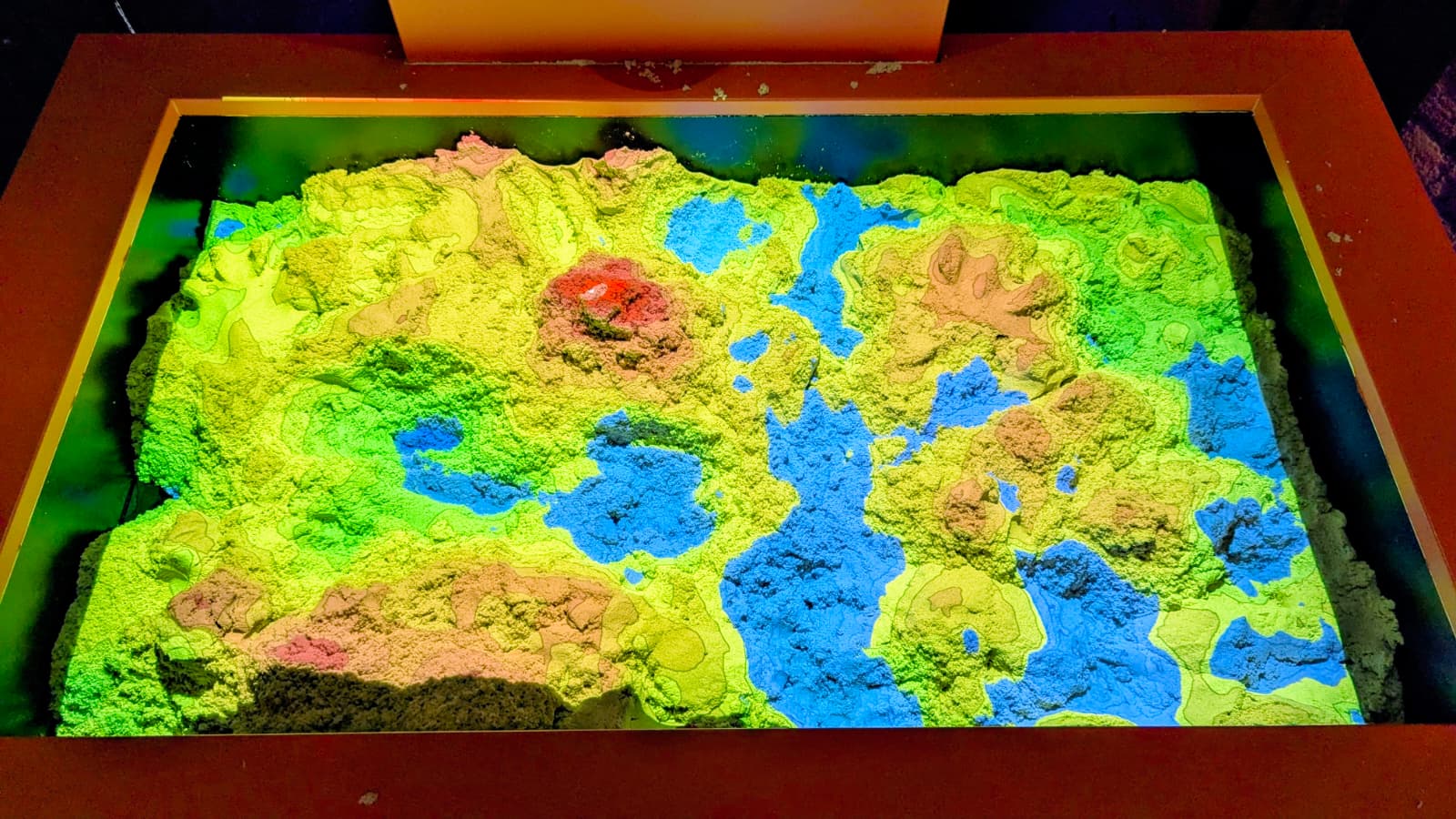
The sand table with colours projected onto it showing height.
The sand table with colours projected onto it showing height. Image by Daniel Gill.

We now have a much better understanding of the seabed, including detailed maps of sea floor topography around the world. So, we know what the ocean floor looks like at the moment, but how can we use this to understand the future of our waterways? This is where computers come in.

Near the end of the exhibition sits a table covered in sand, which has, projected onto it, the current topography of the sand. Where the sand is piled up higher is coloured red and orange, and lower in green and blue. Looking across the table you can see how sand at the same level, even far apart, is still within the same band of colour.
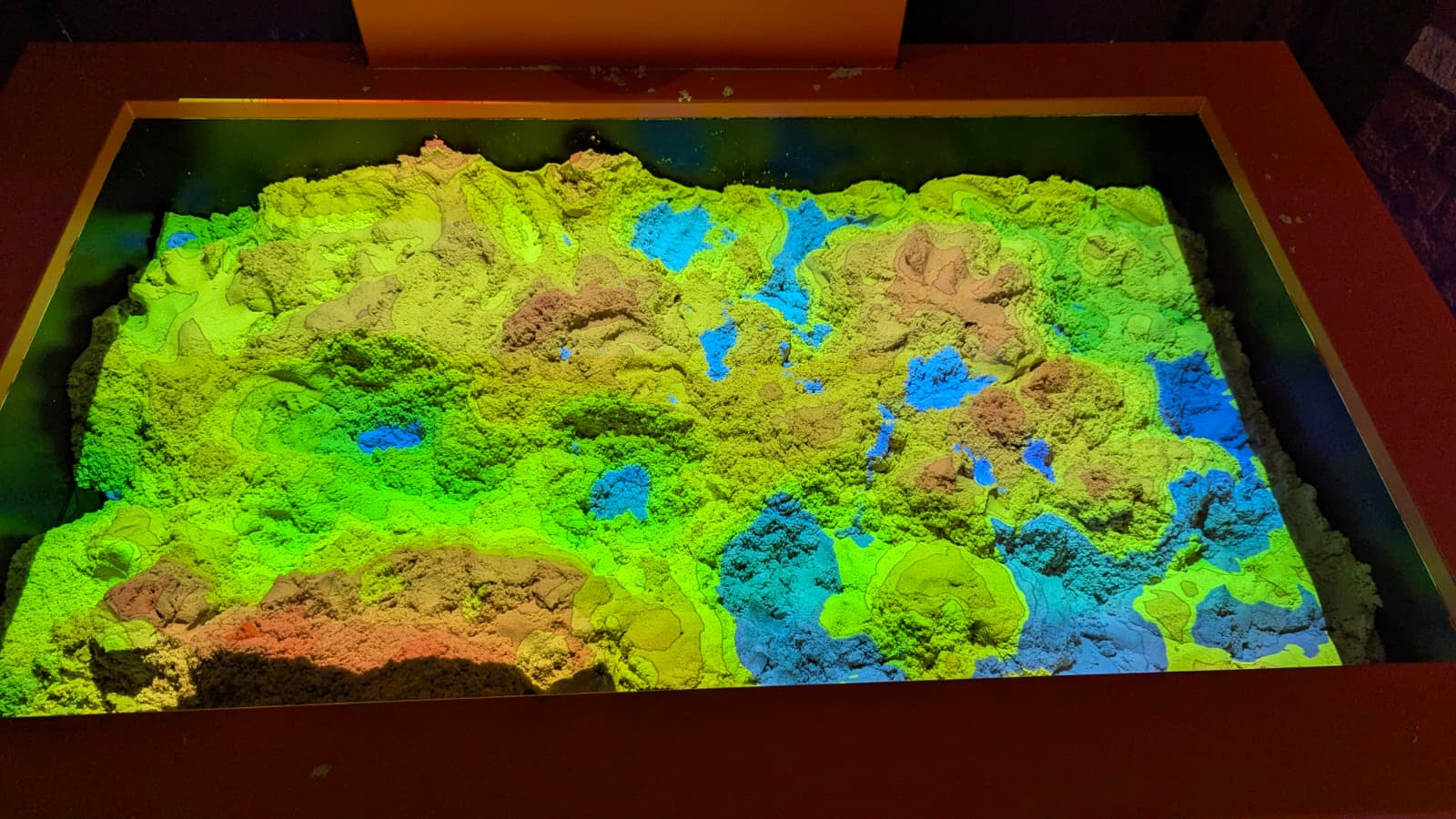
The projected image automatically adjusts (below) to the removal of the hill in red (above).
The projected image automatically adjusts (below) to the removal of the hill in red (above). Image by Daniel Gill.

But this isn’t even the coolest part! When you pick up and move sand around, the colours automatically adjust to the new sand topography, allowing you to shape the seabed at will. The sand itself, however, will flow and move depending on gravity, so an unrealistically tall tower will soon fall down and form a more rotund mound. 

 Want to know what will happen if a meteor impacts? Grab a handful of sand and drop it onto the table (without making a mess) and see how the topographical map changes with time!
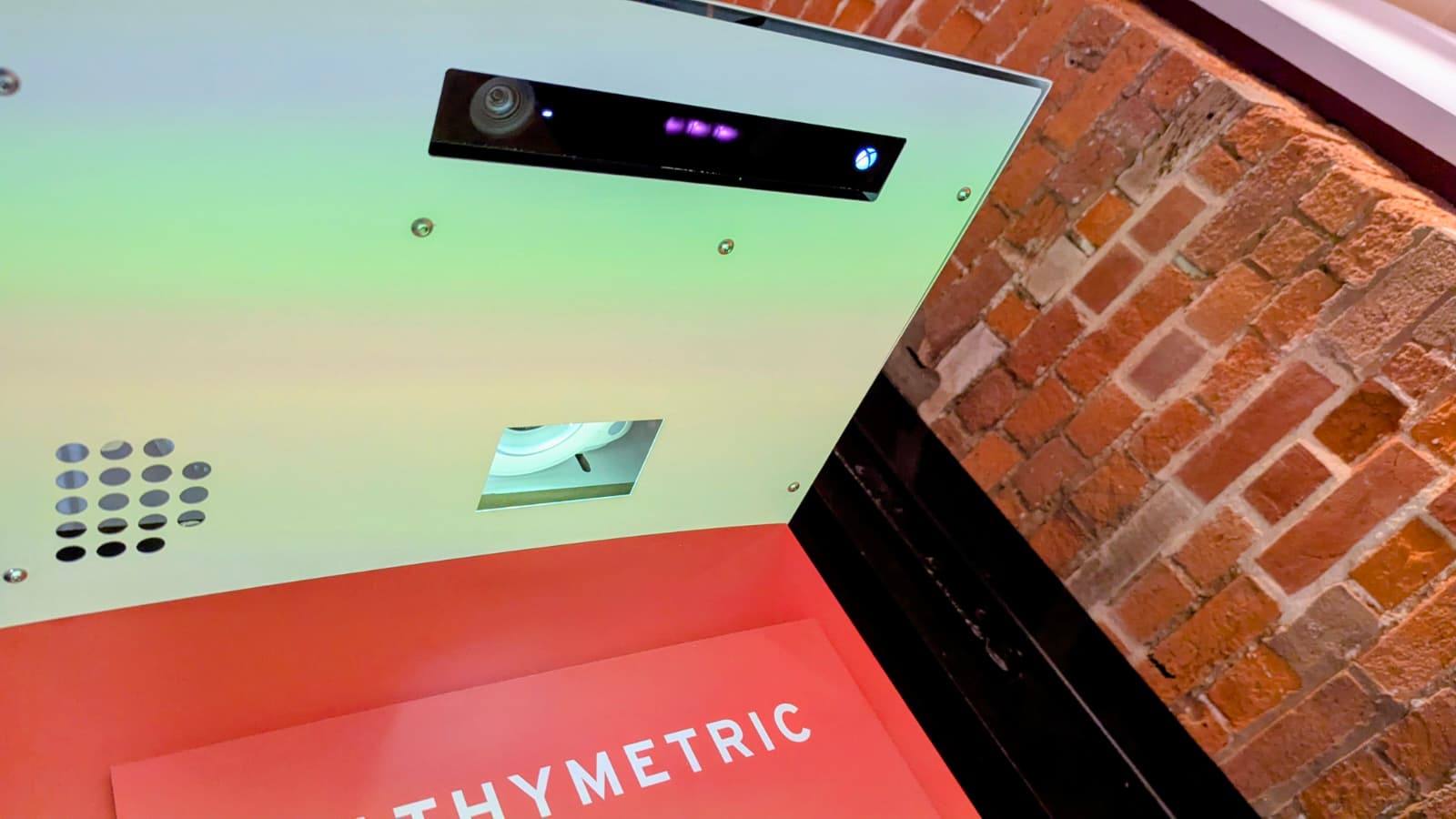
The technology above the table.
The technology above the table. Image by Daniel Gill.

So how does this work? Looking above the table, you can see an Xbox Kinect sensor, and a projector. The Kinect works much like the lidar systems installed on ships – it sends beams of infrared lights down onto the sand, which bounce off back to the sensor in a measured time. This creates a depth map, just like ships do, but on a much smaller scale. This map is turned into colours and projected back on to the sand. 

Virtual water fills the valleys.
Virtual water fills the valleys. Image by Daniel Gill.

This is not the only feature of this table, however: it can also run physics simulations! By placing your hand over the sand, you can add virtual water, which flows realistically into the lower areas of sand, and even responds to the movement of sand.

The mixing of physical and digital representations of data like this is an example of augmented, or mixed, reality. It can help visualise things that you might otherwise find difficult to imagine, perhaps by simulating the effects of building a new dam, for example. Models like this can help experts and students, and, indeed, museum visitors, to see a problem in a different and more interactive way.

– Daniel Gill, Queen Mary University of London

More on…

Subscribe to be notified whenever we publish a new post to the CS4FN blog.


This page is funded by EPSRC on research agreement EP/W033615/1.

QMUL CS4FN EPSRC logos

An experiment in buoyancy

Here is a little science experiment anyone can do to help understand the physics of marine animals and their buoyancy. It helps give insight into how animals such as ancient ammonites and now cuttlefish can move up and down at will just by changing the density of internal fluids.* (See Ammonite propulsion of underwater robots). It also shows how marine robots could do the same with a programmed ammonite brain.

First take a beaker of water and a biro pen top. Put a small piece of blu tack over the the top of the pen top (to cover the holes that are there to hopefully stop you suffocating if you were to swallow one – never chew pen tops!). Next, put a larger blob of blu tack round the bottom of the pen top. You will have to use trial and error to get the right amount. Your aim is to make the pen top float vertically upright in the water, with the smaller blu tack just floating above the surface. Try it, by carefully placing the pen top vertically into the water. If it doesn’t float like that, dry the blu tack then add or remove a bit more until it does float correctly.

It now has neutral buoyancy. The force of gravity pulling it down is the same as the buoyancy force (or upthrust) pushing it upwards, caused by the air trapped in the top of the lid… so it stays put, neither sinking nor rising.

Now fill a drink bottle with water all the way to the top. Then add a little more water so the water curves up above the top of the bottle (held in place by surface tension). Carefully, drop in the weighted pen top and screw on the top of the bottle tightly.

The pen top should now just float in the water at some depth. It is acting just like the swim bladder of a fish, with the air in the pen top preventing the weight of the blue tack pulling it down to the bottom.

Now, squeeze the side of the bottle. As you squeeze, the pen top should suddenly sink to the bottom! Let go and it rises back up. What is happening? The force of gravity is still pulling down the same as it was (the mass hasn’t changed), so if it is sinking the buoyancy force pushing up must be less that it was.

What is happening? We are increasing the pressure inside the bottle, so the water is now compressing the air in the pen top, reducing its volume and increasing its density. The more dense your little diving bell is, the less the buoyancy force pushing up, so it sinks.

That is essentially the trick that ammonites evolved, many, many millions of years ago, squeezing the gas inside their shell to suddenly sink to get away quickly when they sensed danger. It is what cuttlefish still do today squeezing the gas in their cuttlebone so the cuttlefish becomes denser.

So, if you were basing a marine robot on an ammonite (with movement also possible by undulating its arms, and by jet propulsion, perhaps) then your programming task for controlling its movement would involve it being able to internally squeeze an air space by just the right amount at the right time!

In fact, several groups of researchers have created marine robots based on ammonites. For example, a group at Utah have been doing so to better understand the real but extinct ammonites themselves, including how they did actually move. For example, the team have been testing different shell shapes to see if some shapes work better than others, and so just how efficient ammonite shell shapes actually were. By programming an ammonite robot brain, you could similarly, for example, better understand how they controlled their movement and how effective it really was in practice (not just in theory).

Science can now be done in a completely different way to the traditional version of just using discovery, observation and experiment. You can now do computer and robotic modelling too, running experiments on your creations. If you want to study marine biology, or even fancy being a Palaeontologist with a difference, understanding long extinct life, you can now do it through robotics and computer science, not just by watching animals or digging up fossils (but understanding some physics is still important to get you started).

– Paul Curzon, Queen Mary University of London

More on …

*Thanks to the Dorset Wildlife Trusts at the Chisel Beach Visitor Centre, Portland where I personally learnt about ammonite and cuttlefish propulsion in a really fun science talk on the physics of marine biology, including demonstrating this experiment.

Subscribe to be notified whenever we publish a new post to the CS4FN blog.


This page is funded by EPSRC on research agreement EP/W033615/1.

QMUL CS4FN EPSRC logos

Ammonite propulsion of underwater robots

Ammonite statue showing creature inside its shell
Image by M W from Pixabay

Intending to make a marine robot that will operate under the ocean? Time to start learning, not just engineering and computing, but the physics of marine biology! And, it turns out you can learn a lot from ammonites: marine creatures that ruled the ocean for millennia and died out while dinosaurs ruled the earth. Perhaps your robot needs a shell, not for protection, but to help it move efficiently.

If you set yourself the task of building an underwater robot, perhaps to work with divers in exploring wrecks or studying marine life, you immediately have to solve a problem that is different to traditional land-based robotics researchers. Most of the really cool videos of the latest robots tend to show how great they are at balancing on two legs, doing some martial art, perhaps, or even gymnastics. Or maybe they are hyping how good they are running through the forest like a wolf, now on four legs. Once you go underwater all that exciting stuff with legs becomes a bit pointless. Now its all about floating not balancing. So what do you do?

The obvious thing perhaps is to just look at boats, submarines and torpedoes and design a propulsion system with propellers, maybe using an AI to design the most efficient propellor shape, then write some fancy software to control it as efficiently as possible. Alternatively, you could look at what the fish do and copy them!

What do fish do? They don’t have propellors! The most obvious thing is they have tails and fins and wiggle a lot. Perhaps your marine robot could be streamlined like a fish and well, swim, its way through the sea. That involves the fish using its muscles to make waves ripple along its body pushing against the water. In exerting a force on the water, by Newton’s Laws, the water pushes back and the fish moves forward.

Of course, your robot is likely to be heavy so will sink. That raises the other problem. Unlike on land, in water you need to be able to move up (and down) too. Being heavy, moving down is easy. But then that is the same for fish. All that fishy muscle is heavier than water so sinks too. Unless they have evolved a way to solve the problem, fish sink to the bottom and have to actively swim upwards if they want to be anywhere else. Some live on the bottom so that is exactly what they want. Maybe your robot is to crawl about on the sea floor too, so that may be right for it too.

Many, many other fish don’t want to be at the bottom. They float without needing to expend any energy to do so. How? They evolved a swim bladder that uses the physics of buoyancy to make them naturally float, neither rising or sinking. They have what is called neutral buoyancy. Perhaps that would be good for your robot too, not least to preserve its batteries for more important things like moving forwards. How do swim bladders do it? They are basically bags of air that give the fish buoyancy – a bit like you wearing a life jacket. Get the amount of air right and the buoyancy, which provides an upward force, can exactly counteract the force of gravity that is pushing your robot down to the depths. The result is the robot just floats under the water where it is. It now has to actively swim if it wants to move down towards the sea floor. So, if you want your robot to do more than crawl around on the bottom, designing in a swim bladder is a good idea.

Perhaps, you can save more energy and simplify things even more though. Perhaps, your robot could learn from ammonites. These are long extinct, dying out with the dinosaurs and now found only as fossils, fearsome predators that evolved a really neat way to move up and down in the water. Ammonites were once believed to be curled up snakes turned to stone, but they were actually molluscs (like snails) and the distinctive spiral structure preserved in fossils was their shell. They didn’t live deep in the spiral though, just in the last chamber at the mouth of the spiral with their multi-armed octopus like body sticking out the end to catch prey. So what were the rest of the chambers for? Filled with liquid or gas, they would act exactly like a swim bladder providing buoyancy control. However, it is likely that, as with the similar modern day nautilus, the ammonite could squeeze the gas or liquid of its spiral shell into a smaller volume, changing its density. Doing that changes its buoyancy: with increased density the buoyancy is less, so gravity exerts a greater force than the lift the shell’s content is giving and it suddenly sinks. Decrease the density by letting the gas or liquid expand and it rises again.

You can see how it works with this simple experiment.

You don’t needs a shell of course, other creatures have evolved more sophisticated versions. A cuttlebone does the same job. It is an internal organ of the cuttlefish (which are not fish but cephalopods like octopus and squid, so related to ammonites). They are the white elongated disks that you find washed up on the beach (especially along the south and west coasts in the UK). They are really hard on one side but slightly softer on the other. They act like an adjustable swim bladder. The hard upper side prevents gas escaping (whilst also adding a layer of armour). The soft lower side is full of microscopic chambers that the cuttlefish can push gas into or pull gas out of at will with the same effect as that of the ammonites shell.

This whole mechanism is essentially how the buoyancy tanks of a submarine work. First used in the original practical submarine, the Nautilus of 1800, they are flooded and emptied to make a submarine sink and rise.

Build the idea of a cuttlebone or ammonite shell into your robot and it can rise and sink at will with minimal energy wasted. Cuttlefish, though, also have another method of propulsion (aside from undulating their body) that allows it to escape from danger in a hurry: jet propulsion. By ejecting water stored in their mantle through their syphon (a tube), they can suddenly give themselves lots of acceleration just like a jet engine gives a plane. That would normally be a very inefficient form of propulsion, using lots of energy. However, experiments show that when used with negative buoyancy such as provided by the cuttlebone, this jet propulsion is actually much more efficient than it would be. So the cuttlebone saves energy again. And a rare ammonite fossil with the preserved muscles of the actual animal suggests that ammonites had similar jet propulsion too. Given some ammonites grew as large as several metres across, that would have been an amazing sight to see!

To be a great robotics engineer, rather than inventing everything from scratch, you could do well to learn from biological physics. Some of the best solutions are already out there and may even be older than the dinosaurs, You might then find your programming task is to program the equivalent of the brain of an ammonite.

Paul Curzon, Queen Mary University of London

More on …

Thanks to the Dorset Wildlife Trusts at the Chisel Beach Visitor Centre, Portland where I personally learnt about ammonite and cuttlefish propulsion in a really fun science talk on the physics of marine biology.

Subscribe to be notified whenever we publish a new post to the CS4FN blog.


This page is funded by EPSRC on research agreement EP/W033615/1.

QMUL CS4FN EPSRC logos

Film Futures: The Lord of the Rings

Image by Ondřej Neduchal from Pixabay

What if there was Computer Science in Middle Earth?…Computer Scientists and digital artists are behind the fabulous special effects and computer generated imagery we see in today’s movies, but for a bit of fun, in this series, we look at how movie plots could change if they involved Computer Scientists. Here we look at an alternative version of the film series (and of course book trilogy): The Lord of the Rings.

***SPOILER ALERT***

The Lord of the Rings is an Oscar winning film series by Peter Jackson. It follows the story of Frodo as he tries to destroy the darkly magical, controlling One Ring of Power, by throwing it in to the fires of Mount Doom at Mordor. This involves a three film epic journey across Middle Earth where he and “the company of the Ring” are chased by the Nazgûl, the Ringwraiths of the evil Sauron. Their aim is to get to Mordor, without being killed and the Ring taken from them and returned to Sauron who created it, or it being stolen by Golem who once owned it.

The Lord of the Rings: with computer science

In our computer science film future version, Frodo discovers there is a better way than setting out on a long and dangerous quest. Aragorn, has been tinkering with drones in his spare time, and so builds a drone to carry the Ring to Mount Doom controlled remotely. Frodo pilots it from the safety of Rivendell. However, on its first test flight, its radio signal is jammed by the magic of Saruman from his tower. The drone crashes and is lost. It looks like a the company must set off on a quest after all.

However, the wise Elf, the Lady Galadriel suggests that they control the drone by impossible-to-jam fibre optic cable. The Elves are experts at creating such cables using them in their highly sophisticated communication networks that span Middle Earth (unknown to the other peoples of Middle Earth), sending messages encoded in light down the cables.

They create a huge spool containing the hundreds of miles needed. Having also learnt from their first attempt, they build a new drone that uses stealth technology devised by Gandalf to make it invisible to the magic of Wizards, bouncing magical signals off it in a way that means even the ever watchful Eye of Sauron does not detect it until it is too late. The new drone sets off trailing a fine strand of silk-like cable behind, with the One Ring within. At its destination, the drone is piloted into the lava of Mount Doom, destroying the ring forever. Sauron’s power collapses, and peace returns to Middle Earth. Frodo does not suffer from post-traumatic stress disorder, and lives happily ever after, though what becomes of Golem is unknown (he was last seen on Mount Doom through the Drones camera, chasing after it, as the drone was piloted into the crater).

In real life…

Drones are being touted for lots of roles, from delivering packages to people’s doors to helping in disaster emergency areas. They have most quickly found their place as a weapon, however. At regular intervals a new technology changes war forever, whether it is the long bow, the musket, the cannon, the tank, the plane… The most recent technology to change warfare on the battlefield has been the introduction of drone technology. It is essentially the use of robots in warfare, just remote controlled, flying ones rather than autonomous humanoid ones, Terminator style (but watch this space – the military are not ones to hold back on a ‘good’ idea). The vast majority of deaths in the Russia-Ukraine war on both sides have been caused by drone strikes. Now countries around the world are scrambling to update their battle readiness, adding drones into their defence plans.

The earliest drones to be used on the battlefield were remote controlled by radio, The trouble with anything controlled that way is it is very easy to jam – either sending your own signals at higher power to take over control, or more easily to just swamp the airwaves with signal so the one controlling the drone does not get through. The need to avoid weapons being jammed is not a new problem. In World War II, some early torpedoes were radio controlled to their target, but that became ineffectual as jamming technology was introduced. Movie star Hedy Lamar is famous for patenting a mechanism whereby a torpedo could be controlled by radio signals that jumped from frequency to frequency, making it harder to jam (without knowing the exact sequence and timing of the frequency jumps). In London, torpedo stations protecting the Thames from enemy shipping had torpedoes controlled by wire so they could be guided all the way to the target. Unfortunately though it was not a great success, the only time one was used in a test it blew up a harmless fishing boat passing by (luckily no-one died).

And that is the solution adopted by both sides in the Ukraine war to overcome jamming. Drones flying across the front lines are controlled by miles of fibre optic cable that is run out on spools (tens of miles rather than the hundreds we suggested above). The light signals controlling the drone, pass down the glass fibre so cannot be jammed or interfered with. As a result the front lines in the Ukraine are now criss-crossed with gossamer thin fibres, left behind once the drones hit their target or are taken out by the opposing side. It looks as though the war is being fought by robotic spiders (which one day may be the case but not yet). With this advent of fibre-optic drone control, the war has changed again and new defences against this new technology are needed. By the time they are effective, likely the technology will have morphed into something new once more.

– Paul Curzon, Queen Mary University of London

More on …

Subscribe to be notified whenever we publish a new post to the CS4FN blog.


This page is funded by EPSRC on research agreement EP/W033615/1.

QMUL CS4FN EPSRC logos

Why do we still have lighthouses?

Image by Tom from Pixabay

In an age of satellite navigation when all ships have high-tech navigation systems that can tell them exactly where they are to the metre, on accurate charts that show exactly where dangers lurk, why do we still bother to keep any working lighthouses?

Lighthouses were built around the Mediterranean from the earliest times, originally to help guide ships into ports rather than protect them from dangerous rocks or currents. The most famous ancient lighthouse was the great lighthouse of Pharos, at the entry to the port of Alexandria. Built by the Ancient Egyptians, it was one of the seven wonders of the ancient world.

In the UK Trinity House, the charitable trust that still runs all our lighthouses, was set up in Tudor Times by Henry VIII, originally to provide warnings for shipping in the Thames. The first offshore lighthouse built to protect shipping from dangerous rocks was built on Eddystone at the end of the 17th century, It only survived for 5 years, before it was washed away in a storm itself, along, sadly, with Henry Winstanley who built it. However, in the centuries since then Trinity House, has repeatedly improved the design of their lighthouses, turning them into a highly reliable warning system that has saved countless lives, across the centuries.

There are still several hundred lighthouses round the UK with over 60 still maintained by Trinity House. Each has a unique code spelled out in its flashing light that communicates to ships exactly where it is, and so what danger awaits them. But why are they still needed at all? They cost a lot of money to maintain, and the UK government doesn’t fund them. It is all done on donations and money they can raise. So why not just power them down and turn them into museums? Instead their old lamps have been modernised and upgraded with powerful LED lights, automated and networked. They switch on automatically based on light sensors, sounding foghorns automatically too. If the LED light fails, a second automatically switches on in its place, and the control centre, now hundreds of miles away is alerted. There are no plans to turn them all off and just leave shipping to look after itself. The reason is a lesson that we could learn from in many other areas where computer technology is replacing “old-fashioned” ways of doing things.

Yes, satellite navigation is a wonderful system that is a massive step forward for navigation. However, the problem is that it is not completely reliable for several reasons. GPS, for example, is a US system, developed originally for the military and ultimately they retain control. They can switch the public version off at any time, and will if they think it is in their interests to do so. Elon Musk switched off his Starlink system, which he aims to be a successor to GPS, to prevent Ukraine from using it in the war with Russia. It was done in the middle of a Ukranian military operation causing that operation to fail. In July 2025, the Starlink system also demonstrated it is not totally reliable anyway, as it went down for several hours showing that satellite navigation systems can fail for periods, even if not switched off intentionally, due to software bugs or other system issues. A third problem is that navigation systems can be intentionally jammed whether as an act of war or terrorism, or just high-tech vandalism. Finally, a more everyday problem is that people are over trusting of computer systems and they can give a false sense of security. Satellite navigation gives unprecedented accuracy and so are trusted to work to finer tolerances than people would without them. As a result it has been noticed that ships now often travel closer to dangerous rocks than they used to. However, the sea is capricious and treacherous. Sail too close to the rocks in a storm and you could suddenly find yourself tossed upon them, the back of your ship broken, just as has happened repeatedly through history.

Physical lighthouses may be old technology but they work as a very visible and dependable warning system, day or night. They can be used in parallel to satellite navigation, the red and white towers and powerful lights very clearly say: “there is danger here … be extra careful!” That extra very physical warning of the physical danger is worth having as a reminder not to take risks.The lighthouses are also still there, adding in redundancy, should the modern navigation systems go down just when a ship needs them, with nothing extra needing to be done, and so no delay.

It is not out of some sense of nostalgia that the lighthouses still work. Updated with modern technology of their own, they are still saving lives.

– Paul Curzon, Queen Mary University of London

More on …

Subscribe to be notified whenever we publish a new post to the CS4FN blog.


This page is funded by EPSRC on research agreement EP/W033615/1.
QMUL CS4FN EPSRC logos