by Paul Curzon, Milan Verma and Hamit Soyel, Queen Mary University of London

Try our spot the difference puzzles set by an Artificial Intelligence …
NOTE: this page contains slowly flashing images.
Queen Mary researcher, Milan Verma used his AI program that modelled the way human brains see the world (our ‘vision system’) to change the details of some pictures in places where the program predicted changes should be easy to spot. Other pictures were changed in places where the AI predicted we would struggle to see even when big areas were changed.
The images flash back and forth between the original and the changed version. How quickly can you see the difference between the two versions.
Spot the Difference: Challenge 1
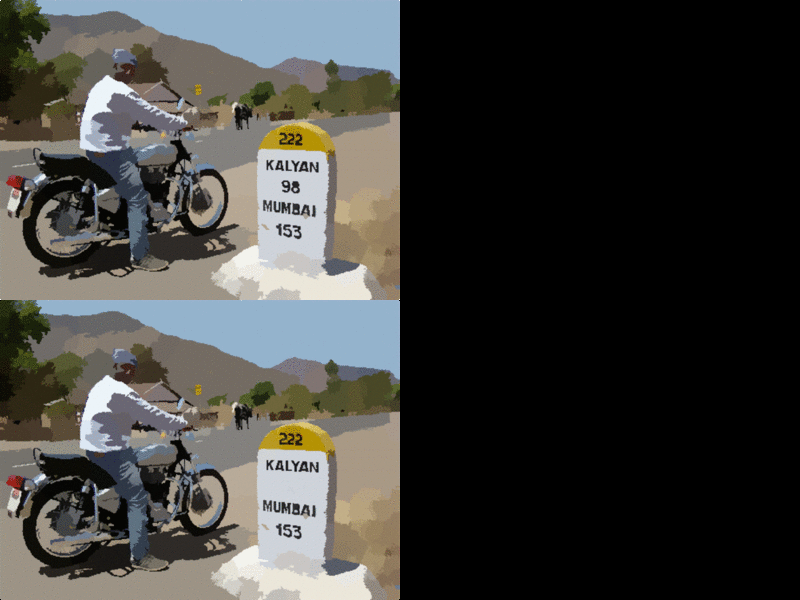
As this image flashes, something changes. This one is predicted by our AI to be quite hard to see. How quickly can you see the difference between the two versions?

Once you spot it (or give up) see both the answer (linked below) and the ‘saliency maps’ which show where the model predicts where your attention will be drawn to and away from.
You can also try our second challenge that is predicted to be easier.
Spot the Difference: Challenge 2
As this image flashes, something changes. This one is predicted by our AI to be easier to see. How quickly can you see the difference between the two versions?
Answers!
Once you’ve tried the two challenges above head over to our answer page to see how you did.
Further reading
This article was originally published on the CS4FN website.

EPSRC supports this blog through research grant EP/W033615/1.

 cs4fn
cs4fn 