“The thundering engines vibrate throughout your body”

The space shuttle lifting off
A space shuttle launch.
Image by WikiImages from Pixabay

Computer scientist Jason Cordes tells us what it was like to work for NASA on the International Space Station during the time of Space Shuttle launches. (From the archive)

Working for a space agency is brilliant. When I was younger, I often looked up at the stars and wondered what was out there. I visited Johnson Space Center in Houston, Texas and told myself that I wanted to work there someday. After completing my college degree in computer science, I had the great fortune to be asked to work at NASA’s Johnson Space Center as well as Kennedy Space Center.

Johnson Space Center is the home of the Mission Control Center (MCC). This is where NASA engineers direct in-orbit flights and track the position of the International Space Station (ISS) and the Space Shuttle when it is in orbit. Kennedy Space Center, situated at Cape Canaveral, Florida, is where the Space Shuttle and most other space-bound vehicles are launched. Once they achieve orbit, control is handed over to Johnson Space Center in Houston, which is why when you hear astronauts calling Earth, they talk to “Houston”.

Space City

Houston is a very busy city and you get that feeling when you are at Johnson. There are people everywhere and the Space Center looks like a small city unto itself. While I was there I worked on the computer control system for the International Space Station. The part I worked on was a series of laptop-based displays designed to give astronauts on the station a real-time view of the state of everything, from oxygen levels to the location of the robotic arm.

The interesting thing about developing this type of software is realising that the program is basically sending and receiving telemetry (essentially a long list of numbers) to the hardware, where the hardware is the space station itself. Once you think of it like that, the sheer simplicity of what is being done is really surprising. I certainly expected something more complex. All of the telemetry comes in over a wire and the software has to keep track of what telemetry belongs to what component since different components all broadcast over the same wire. Essentially the program routes the data based on what component it comes from and acts as an interpreter that takes the numbers that the space station is feeding and converting them into a graphical format that the astronauts can understand. The coolest part of working in Houston was interacting with astronauts and getting their feedback on how the software should work. It’s like working with celebrities.

Wild times

While at Kennedy Space Center, I was tasked with working on the Shuttle Launch Control System for the next generation of shuttles. The software is very similar to that used to control the ISS. The thing I remember most about working there was the environment.

Kennedy Space Center is about as opposite as you can get from the big city feeling at Johnson. It’s situated on what is essentially swampland on the eastern coast of Florida. The main gates to Johnson are right on major streets within Houston, but at Kennedy the gate is on a major highway, and even then, travel to the actual buildings of the Space Center is a leisurely 30 minute drive through orange groves and trees as well as bypassing causeways and creeks. Along the way you might spot an eagle’s nest in one of the trees, or a manatee poking its head from the waters. Kennedy is in the middle of a wildlife preserve with alligators, manatees, raccoons and every other kind of critter you can imagine. In fact, I was prevented from going home one evening by a gator that decided to warm itself up by my car.

The coolest thing about working at NASA, and specifically Kennedy Space Center, was being able to watch shuttle launches from less than 10 miles away. It’s an incredible experience. The thundering engines vibrate throughout your body like being next to the speakers at an entirely too loud rock concert. Night launches were the most amazing, with the fire from the engines lighting up the sky. It is very amazing to watch this machine and realise that you are the one who wrote the computer program that set it in motion. I’ve worked in a few development firms, but few of them gave me as much emotion when I saw it in action as this did.


More on …

Related Magazines …


Subscribe to be notified whenever we publish a new post to the CS4FN blog.


This blog is funded by EPSRC on research agreement EP/W033615/1.

QMUL CS4FN EPSRC logos

If the Beagle had landed…

A replica of Beagle 2 in the Science Museum with solar panels deployed.
Image by user:geni from Wikimedia CC BY-SA 4.0

A reason the Apollo Moon landings were manned was in-part because the astronauts were there to deal with things if they went wrong: landing on a planet or moon’s surface is perfectly possible to do automatically as long as things go to plan. It is when something unexpected happens that is always going to be the tricky bit.

Beagle 2 is a good example. It was a British-built space probe that was sent to explore Mars in 2003. Named after biologist Charles Darwin’s famous ship, Beagle 2, sadly it never made it. It was due to land on Christmas Day that year, but something went wrong and it vanished without a trace. Beagle 2’s disappearance was perhaps the inspiration behind the Guinevere One space probe in the 2005 Doctor Who episode ‘The Christmas Invasion’, but Beagle 2 was unlikely to have been stolen by the Sycorax.

Had Beagle 2 made it, the first thing we would have heard was its radio call sign, which was some digital music specially composed by Britpop group, Blur. It wasn’t the only part of the ill-fated Beagle 2 mission that had an artistic twist. Famous British artist Damien Hirst (the man who had previously pickled halved calves in formaldehyde tanks), had designed one of his famous spot paintings – rows of differently coloured spots – that was to be used as an instrument calibration chart. It would have been the first art on Mars, but it, instead, appeared to have become the first art all over Mars! However, if you shoot for the stars you have to expect things to fail sometimes. You learn and try again.

There was a twist to the story too, as eleven years later in 2015, the Beagle 2 was spotted by NASA’s Mars Reconnaissance Orbiter. Using sophisticated image reconstruction programs working with a series of different images, a picture of it was created that allowed the scientists to work out some of what had happened. It had landed successfully on Mars, but apparently its solar panels had then failed to fully open. One appeared to be blocking its communications antenna meaning it had no way to talk to Earth, and no way to repair itself either. It may well have collected data, but just couldn’t tell us about it (or play us some Blur). The data it collected (if it did) may be there, though, waiting for the day when it can be passed back to Earth.

While it may not have succeeded in helping us find out more about Mars, Beagle 2 has presumably become the first Martian Art Gallery, though, displaying the one and only work of art on the planet: a spot picture by Damien Hirst.

Peter W McOwan and Paul Curzon, Queen Mary University of London

(Updated from the archive)


More on …

  • Computer Science in Space
  • Read the full story of the trade-offs between human and machine control in Apollo in: Digital Apollo, David A Mindell, The MIT Press, 2011.

Related Magazines …


Subscribe to be notified whenever we publish a new post to the CS4FN blog.


This blog is funded by EPSRC on research agreement EP/W033615/1.

QMUL CS4FN EPSRC logos

Fencing the moon

Lunar module in landing configuration. Probes below each foot tell when the Lunar Module has almost landed.
Lunar module Eagle from the Apollo 11 moon landing getting ready to land (taken from the command module)
Image by NASA from Wikimedia (public domain)

The Apollo lunar modules that landed on the moon were guided by a complex mixture of computer program control and human control. Neil Armstrong and the other astronauts essentially operated an semi-automatic autopilot, switching on and off pre-programmed routines. One of the many problems the astronauts had to deal with was that the engines had to be shut down before the craft actually landed. Too soon and they would land too heavily with a crunch, too late and they could kick up the surface and the dust might cause the lunar module to explode. But how to know when?

They had ground sensing radar but would it be accurate enough? They needed to know when they were only feet above the surface. The solution was a cunning contraption: essentially a sensor button on the end of a long stick. These sensors dangled below each foot of the lunar module (see image). When they touched the surface the button pressed in, a light came on in the control panel and the astronaut knew to switch the engines off. Essentially, this sensor is the same as an epee: a fencing sword. In a fencing match the sword registers a hit on the opponent when the button on its tip is pressed against their body. Via a wire running down the sword and out behind the fencer, that switches on a light on the score board telling the referee who made the hit. So the Lunar Module effectively had a fencing bout with the moon…and won.

Paul Curzon, Queen Mary University of London

More on …

Related Magazines …


Subscribe to be notified whenever we publish a new post to the CS4FN blog.


This blog is funded by EPSRC on research agreement EP/W033615/1.

QMUL CS4FN EPSRC logos

Ada Lovelace in her own words

A jumble of letters
Image by CS4FN

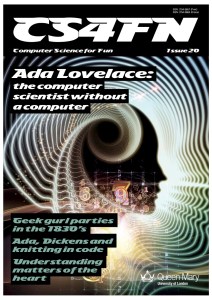
Charles Babbage invented wonderful computing machines. But he was not very good at explaining things. That’s where Ada Lovelace came in. She is famous for writing a paper in 1843 explaining how Charles Babbage’s Analytical Engine worked – including a big table of formulas which is often described as “the first computer program”.

Charles Babbage invented his mechanical computers to save everyone from the hard work of doing big mathematical calculations by hand. He only managed to build a few tiny working models of his first machine, his difference engine. It was finally built to Babbage’s designs in the 1990s and you can see it in the London Science Museum. It has 8,000 mechanical parts, and is the size of small car, but when the operator turns the big handle on the side it works perfectly, and prints out correct answers.

Babbage invented, but never built, a more ambitious machine, his Analytical Engine. In modern language, this was a general purpose computer, so it could have calculated anything a modern computer can – just a lot more slowly. It was entirely mechanical, but it had all the elements we recognize today – like memory, CPU, and loops.

Lovelace’s paper explains all the geeky details of how numbers are moved from memory to the CPU and back, and the way the machine would be programmed using punched cards.

But she doesn’t stop there – in quaint Victorian language she tells us about the challenges familiar to every programmer today! She understands how complicated programming is:

“There are frequently several distinct sets of effects going on simultaneously; all in a manner independent of each other, and yet to a greater or less degree exercising a mutual influence.”

the difficulty of getting things right:

“To adjust each to every other, and indeed even to perceive and trace them out with perfect correctness and success, entails difficulties whose nature partakes to a certain extent of those involved in every question where conditions are very numerous and inter-complicated.”

and the challenge of making things go faster:

“One essential object is to choose that arrangement which shall tend to reduce to a minimum the time necessary for completing the calculation.”

She explains how computing is about patterns:

“it weaves algebraical patterns just as the Jacquard-loom weaves flowers and leaves”.

and inventing new ideas

“We might even invent laws … in an arbitrary manner, and set the engine to work upon them, and thus deduce numerical results which we might not otherwise have thought of obtaining”.

and being creative. If we knew the laws for composing music:

“the engine might compose elaborate and scientific pieces of music of any degree of complexity or extent.”

Alan Turing famously asked if a machine can think – Ada Lovelace got there first:

“The Analytical Engine has no pretensions whatever to originate anything. It can do whatever we know how to order it to perform.”

Wow, pretty amazing, for someone born 200 years ago.

Ursula Martin, University of Oxford (From the archive)


More on …

Related Magazines …


Subscribe to be notified whenever we publish a new post to the CS4FN blog.


This blog is funded by EPSRC on research agreement EP/W033615/1.

QMUL CS4FN EPSRC logos

EPSRC supported this article through research grants (EP/K040251/2 and EP/K040251/2 held by Professor Ursula Martin as well as grant EP/W033615/1). 

Dickens knitting in code

Charles Dickens is famous for his novels highlighting Victorian social injustice. Despite what people say, art and science really do mix, and Dickens certainly knew some computer science. In his classic novel about the French Revolution, A Tale of Two Cities, one of his characters relies on some computer science based knitting.

Dickens actually moved in the same social circles as Charles Babbage, the Victorian inventor of the first computer (which he designed but unfortunately never managed to build) and Ada Lovelace the mathematician who worked with him on those first computers. They went to the same dinner parties and Dickens will have seen Babbage demonstrate his prototype machines. An engineer in Dickens novel, Little Dorrit, is even believed to be partly based on Babbage. Dickens was probably the last non-family member to visit Ada before she died. She asked him to read to her, choosing a passage from his book Dombey and Son in which the son, Paul Dombey, dies. Like Ada, Paul Dombey had suffered from illness all his life.

So Charles Dickens had lots of opportunity to learn about algorithms! His novel ‘A Tale of Two Cities’ is all about the French Revolution, but lurking in the shadows is some computer science. One of the characters, a revolutionary called Madame Defarge takes the responsibility of keeping a register of all those people who are to be executed once the revolution comes to pass: the aristocrats and “enemies of the people”. Of course in the actual French Revolution lots of aristocrats were guillotined precisely for being enemies of the new state.

Now Madame Defarge could have just tried to memorize the names on her ‘register’ as she supposedly has a great memory, but the revolutionaries wanted a physical record. That raises the problem, though, of how to keep it secret, and that is where the computer science comes in. Madame Defarge knits all the time and so she decides to store the names in her knitting.

“Knitted, in her own stitches and her own symbols, it will always be as plain to her as the sun. Confide in Madame Defarge. It would be easier for the weakest poltroon that lives, to erase himself from existence, than to erase one letter of his name or crimes from the knitted register of Madame Defarge.”

Computer scientists call this Steganography: hiding information or messages in plain sight, so that no one suspects they are there at all. Modern forms of steganography include hiding messages in the digital representation of pictures and in the silences of a Skype conversation.

Madame Defarge didn’t of course just knit French words in the pattern like a victorian scarf version of a T-shirt message. It wouldn’t have been very secret if anyone looking at the resulting scarf could read the names. So how to do it? In fact, knitting has been used as a form of steganography for real. One way was for a person to take a ball of wool and mark messages down it in Morse Code dots and dashes. The wool was then knitted into a jumper or scarf. The message is hidden! To read it you unpick it all and read the morse code back off the wool.

The names were “Knitted, in her own stitches and her own symbols”

That wouldn’t have worked for Madame Defarge though. She wanted to add the names to the register in plain view of the person as they watched and without them knowing what she was doing. She therefore needed the knitting patterns themselves to hold the code. It was possible because she was both a fast knitter and sat knitting constantly so it raised no suspicion. The names were therefore, as Dickens writes “Knitted, in her own stitches and her own symbols”

She used a ‘cipher’ and that brings in another area of computer science: encryption. A cipher is just an algorithm – a set of rules to follow – that converts symbols in one alphabet (letters) into different symbols. In Madame Defarge’s case the new symbols were not written but knitted sequences of stitches. Only if you know the algorithm, and a secret ‘key’ that was used in the encryption, can you convert the knitted sequences back into the original message.

In fact both steganography and encryption date back thousands of years (computer science predates computers!), though Charles Dickens may have been the first to use knitting to do it in a novel. The Ancient Greeks used steganography. In the most famous case a message was written on a slave’s shaved head. They then let the hair grow back. The Romans knew about cryptographic algorithms too and one of the most famous ciphers is called the Caesar cipher as Julius Caesar used it when writing letters…even in Roman times people were worried about the spies reading their equivalent of emails.

Dickens didn’t actually describe the code that Madame Defarge was using so we can only guess…but why not see that as an opportunity and (if you can knit) why not invent a way yourself. If you can’t knit then learn to knit first and then invent one! Somehow you need a series of stitches to represent each letter of the alphabet. In doing so you are doing algorithmic thinking with knitting. You are knitting your way to being a computer scientist.

Paul Curzon, Queen Mary University of London (From the archive)


More on …

Related Magazines …


Subscribe to be notified whenever we publish a new post to the CS4FN blog.


This blog is funded by EPSRC on research agreement EP/W033615/1.
QMUL CS4FN EPSRC logos

EPSRC supported this article through research grants (EP/K040251/2 and EP/K040251/2 held by Professor Ursula Martin as well as grant EP/W033615/1).