Click above to download the magazines ..Issue 28 and Issue 20
The computer revolution almost started in the Victorian age…
We think of the Victorians as iron, bridge, rail and ship builders – of a time when great civil and mechanical engineering projects came to fruition. It was an age of coal, of steam power, of cogs and girders. It was also an age where the foundations of the computer revolution were laid (both in the UK and elsewhere). Ideas and innovations flowed that would ultimately lead to the computer age. In the 19th century, the time wasn’t quite ripe for that yet, but computer science ideas were certainly flowing at the soirees, in fiction and in the labs. Here we look at just some of the people who laid that foundation and the interconnections of the ideas and the people.
Of course, those we look at are not all actually “Victorians” in the sense of not all British or even Empire. Apologies for the anglo-centric label covering stories of 19th century world-wide computing.
Download the magazines above or read the articles below
Dickens knitting in code
Charles Dickens is famous for his novels highlighting Victorian social injustice. Despite what people say, art and science really do mix, and Dickens certainly knew some computer science. In his classic novel about the French Revolution, A Tale of Two Cities, one of his characters relies on computer science based knitting. … (read on)
Letters from the Victorian Smog: Braille
We take for granted that computers use binary: to represent numbers, letters, music and pictures…any kind of information.That was something Ada Lovelace realised very early on. Binary wasn’t invented for computers though. Its first modern use as a way to represent letters was actually invented in the early 19th century. It is still used today: Braille. … (read on)
Ada Lovelace: Visionary
It is 1843, Queen Victoria is on the British throne. The industrial revolution has transformed the country. Steam, cogs and iron rule. The first computers won’t be successfully built for a hundred years. Through the noise and grime one woman sees the future. A digital future that is only just being realised…(read on)
The Logic Piano
Victorian, William Stanley Jevons was a famous economist in his day. He was the first economist to raise the issue of the ecological impact of economics. Jevons had other strings to his bow though and one of the strangest for the time if also incredibly forward thinking was his 1869 “logic piano”: a device that looked a little like a piano but that “played” logic. … (read on)
Babbage’s adders
Babbage’s Victorian computer was made of Victorian tech – metal, wheels and levers. It had a cunning contraption at its core that allowed it to store and add numbers. how did it work? … (read on)
Babbage’s triumph over brutal reality
Charles Babbage is famous for his amazing technical skills in designing a computer, but also infamous for his apparent spiky and obsessive personality, but his life was full of sorrow … (read on)
Ada Lovelace in her own words
Charles Babbage invented wonderful computing machines. But he was not very good at explaining things. That’s where Ada Lovelace came in. She is famous for writing a paper in 1843 explaining how Charles Babbage’s Analytical Engine worked – including a big table of formulas which is often described as “the first computer program”… (read on)
Nikola Tesla: the invisible genius
Nikola Tesla is an enigma wrapped in a mystery. Not bad going for an electronic engineer. Born, so the stories go, in the middle of a thunderstorm in Serbia, Tesla has left a fascinating legacy to the world today … (read on)
The taming of the screw
Babbage was obsessed with precision because if his machines were to work, they needed it. His demands for precision helped change the humble screw, becoming a standard that powered British industry. … (read on)
Ada and the music machine
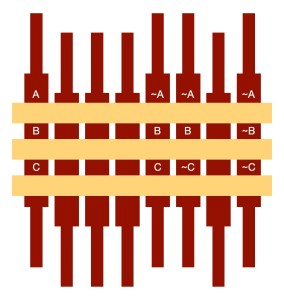
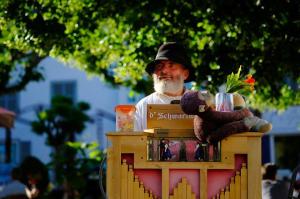
Charles Babbage found barrel organs so incredibly irritating that he waged a campaign to clear them from the streets, even trying to organise an act of parliament to have them banned. He hated the irritating noise preventing him from concentrating. His hatred, however, may have led to Ada Lovelace’s greatest idea … (read on)
Babbage’s barrels
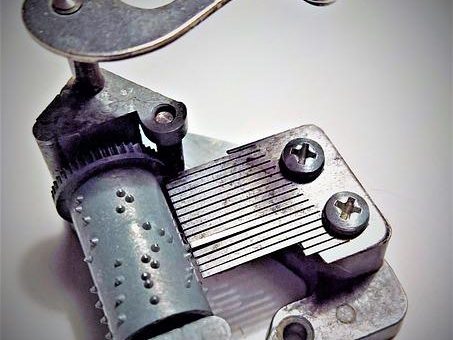
COMING SOON Despite his hatred of Barrel organs, Babbage used barrels with relocatable pins in his machines. They gave a way to program the instructions available to control the machine, something we would now call microcode… (read on)
Pass the screwdriver, Igor: Mary Shelley
Shortly after Ada Lovelace was born, and long before she made predictions about future “creative machines”, Mary Shelley, a friend of her father (Lord Byron), was writing a novel. In her book, Frankenstein, inanimate flesh is brought to life. Perhaps Shelley foresaw what is actually to come, what computer scientists might one day create: artificial life… (read on)
The Mummy in an AI world
Inspired by Mary Shelley’s Frankenstein, 17-year old Victorian orphan, Jane Webb secured her future by writing the first ever Mummy story. The 22nd century world in which her novel was set is perhaps the most amazing thing about the three volume book though. Her world included AIs there doing good as standard for the first time…. (read on)
A storm in a bell jar: Andrew Crosse
Ada Lovelace was close friends with John Crosse, and knew his father Andrew: the ‘real Frankenstein’. Andrew Crosse apparently created insect life from electricity, stone and water…leading to an early example of a social media-style storm, trolls and all… (read on)
Herman Hollerith: from punch cards to a special company
Herman Hollerith, the son of immigrants, struggled early on at school and then later in bookkeeping at college but it didn’t stop him inventing machines that used punch cards to store data. He founded a company to make and sell his machines. It turned into the company now called IBM, which of course helped propel us into the computer age. (read on)
The Wood Computer
Punch cards inspired Babbage as he invented the first Victorian computer, and were a way the first computers stored data a century later. Variations, called edge-notched cards, were used before the first working computers, providing an efficient way to find information. Oxford’s human-operated ‘wood computer’ was used in forests world-wide…. (read on)
Edge-notched cards and relational databases
Edge-notched cards implement a physical, but still powerful, version of a database: an organised way of storing data from cards with holes and notches in them … (read on)
Rebel with a cause: Florence Nightingale
Florence Nightingale is known for her nursing, in the Crimean War. She rebelled against convention to become a nurse when nursing was seen as a lowly job, not suitable for ‘ladies’. She broke convention in another less well-known, but much more significant way too. She was a mathematician and pioneered the use of pictures to present her statistical data about causes of war deaths and issues of sanitation and health: a Victorian version of the Big Data revolution … (read on)
This page was funded by UKRI, through grant EP/K040251/2 held by Professor Ursula Martin and forms part of a broader project on the development and impact of computing, as well as grant EP/W033615/1.







 cs4fn
cs4fn 