
The robots are here…
The robots have been coming for a long time. And now they are here. So what are we going to do with them? The aren’t all exactly what we may have thought though, not hard and metal but soft and squidgy, for example. Not humanoid and walking but swarms of flying insect-like machines…
Are they going to have lots of leisure time to do hobbies like paint, or are we going to work them into the ground.
Are they going to help us, work with us or replace us. That is up to us.
An ode to technology

People have always been fascinated by automata: robot-style contraptions allowing inanimate animal and human figures to move, long before computers could take the place of a brain as shown in an ode by an ancient greek Pindar… (read on)
Al-Jazari: the father of robotics

Science fiction films are full of humanoid robots acting as servants, workers, friends or colleagues. The first were created during the Islamic Golden Age, a thousand years ago… (read on)
Blade the emotional robot

Communicating with computers is clunky to say the least – we even have to go to IT classes to learn how to talk to them. It would be so much easier if they went to school to learn how to talk to us. If computers are to communicate more naturally with us we need to understand more about how humans interact with each other. Zabir explored this in his undergraduate project, creating Blade…. (read on)
Music-making mates for Mortimer
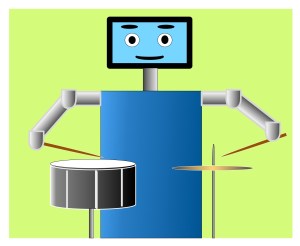
Robots are cool. Fact. But can they keep you interested for more than a short time? Over months? Years even? Louis McCallum of Queen Mary University of London tells us about his research using Mortimer a drumming robot.…. (read on).
Soft squidgy robots

Think of a robot and you probably think of something hard, metal, solid. Bang into one and it would hurt! But researchers are inventing soft robots, ones that are either completely squidgy or have squidgy skins.… (read on)
The wrong trousers? Not any more!

Inspired by the Wallace & Gromit film ‘The Wrong Trousers’, Johnathan Rossiter builds robotic trousers. We could all need them as we get older….. (read on)
Swallow a slugbot to catch a …

Imagine swallowing a slug (hint not only a yucky thought but also not a good idea as it could kill you)…now imagine swallowing a slug-bot … also yucky but in the future it might save your life…. (read on)
Sabine Hauert: Swarm engineer

Sabine Hauert is a swarm engineer. She is fascinated by the idea of making use of swarms of robots. Watch a flock of birds and you see that they have both complex and beautiful behaviours that help them evade predators, for example. Sabine’s team are exploring how we can solve our own engineering problems: from providing communication networks in a disaster zone to helping treat cancer, all based on the behaviours of swarms of animals … (read on)
The first law of humans

The first rule of humans when around robots is apparently that they should not do anything too unexpected… (read on)
Designing robots that care

Think of the perfect robot companion. A robot you can hang out with, chat to and who understands how you feel. Robots can already understand some of what we say and talk back. They can even respond to the emotions we express in the tone of our voice. But, what about body language? Could a robot use body language to show that it understands how we feel? Could a robot show empathy?… (read on)
Future Friendly: Focus on Kerstin Dautenhahn
Kerstin Dautenhahn is a biologist with a mission: to help us make friends with robots. She did research on the leg reflexes in stick insects and that led to an interest in biological cybernetics. This interest in trying to understand biology made her want to build things to test her understanding, based on ideas copied from biological animals but run by computers: robots. (read on)
Standup robots

‘How do robots eat pizza?’… ‘One byte at a time’. Computational Humour is real, but it’s not jokes about computers, it’s computers telling their own jokes... (read on)
How to get a head in robotics

If humans are ever to get to like and live with robots we need to understand each other. One way we do that is through the expressions on our faces. Can robots express feelings this way too? A group of researchers in Poland, at Wroclaw University of Technology, came up with a clever design for a robot head that could help a computer show its feelings. It’s inspired by the Teenage Mutant Ninja Turtles. (read on)
Punk robots learn to pogo

It’s the second of three punk gigs in a row for Neurotic and the PVCs, and tonight they’re sounding good. The audience seem to be enjoying it too. All around the room the people are clapping and cheering, and in the middle of the mosh pit the three robots are dancing.… (read on)
Robot runners

The first ever half marathon allowing humanoid robots to run against humans was held in Beijing this weekend (April 2025). 12,000 humans ran the event alongside 21 robots…and for now the humans definitely are the winners… (read on)
Understanding Ultron
Avengers: Age of Ultron is another film about robots trying to take over the world. AI is becoming ever present in our lives. But fears of AI’s potential negative impact on humanity remain as seen in its projection into characters like Ultron, a super-intelligence accidentally created by the Avengers..… (read on)
The naked robot
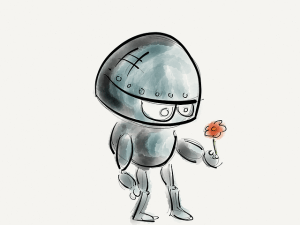
Why are so many film robots naked? We take it for granted that robots don’t wear clothes, and why should they?… (read on)
Dressing it up (why it might be good for robots to wear clothes)

Even though most robots still walk around naked, the Swedish Institute of Computer Science (SICS) in Stockholm explored how to produce fashion conscious robots… (read on)
Aaron and the art of art

Aaron is a successful American painter. Aaron’s delicate and colourful compositions on canvas sell well, and have been exhibited worldwide, in London’s Tate Modern gallery and the San Francisco Museum of Modern Art for example. Oh and by the way, Aaron is a robot!… (read on)
Ammonite propulsion of underwater robots

Intending to make a marine robot that will operate under the ocean? Time to start learning the physics of marine biology! It turns out you can learn a lot from ammonites: marine creatures that ruled the ocean for millennia and died out while dinosaurs ruled the earth. Perhaps your robot needs a shell, not for protection, but to help it move efficiently. (read on)
An experiment in buoyancy

Here is a little science experiment anyone can do to help understand the physics of marine animals and their buoyancy. It shows how animals such as ancient ammonites and now cuttlefish move up and down at will just by changing the density of internal fluids. It also shows how marine robots can be used to better understand ammonites from 350 million years ago (read on)
Film futures: Brassed off

Computer Scientists are behind the fabulous special effects we see in today’s movies, but for a bit of fun we look at how movie plots could change if they involved Computer Scientists. Here we look at an alternative version of the film Brassed Off exploring music and the effects of computers on society with a new robot character…. (read on)
Return of the killer robot? Evil scientist?! Helpless woman?!?

‘Geeky male computer scientist’ is just a stereotype, like ‘helpless female in need of rescue by male hunk’, ‘scientist as mad eccentric in white coat’, or ‘evil robot wanting to take over the world’. Where do false stereotypes come from? … (read on)
The Mummy in an AI world

Inspired by Mary Shelley’s Frankenstein, 17-year old Victorian orphan, Jane Webb secured her future by writing the first ever Mummy story. The 22nd century world in which her novel was set is perhaps the most amazing thing about the three volume book though … (read on)
Pass the screwdriver, Igor

Mary Shelley, Frankenstein’s monster & artificial life: Shortly after Ada Lovelace was born, so long before she made predictions about future “creative machines”, Mary Shelley, a friend of her father (Lord Byron), wrote a novel. In her book, Frankenstein, inanimate flesh is brought to life. Perhaps she foresaw what is actually to come, what computer scientists might one day create: artificial life. (read on)
The robot always wins

Find out about the robot that waits to see what it’s opponent does first before making the winning move. But it does it so fast it looks like it’s just really good at Rock Paper Scissors. Camera sensors, fast processing and motors helps it form the winning shape every time (you can also see it slowed down 50 times). Plus some other fun robot-themed and game-strategy-themed info. (read on)
Subscribe to be notified whenever we publish a new post to the CS4FN blog.
Click the Portals image below to uncover our other themed pages.

Subscribe to be notified whenever we publish a new post to the CS4FN blog.
This blog is funded by EPSRC on research agreement EP/W033615/1.

 cs4fn
cs4fn 