
Colour by Numbers
Learn about one way computers store images: what are called bit-mapped or raster images.
Create your own for your friends to do.
Find Puzzles and solutions below
Computers represent colours by numbers. Then by dividing an image into tiny squares called pixels, each represented by a colour, the whole picture can be stored as a grid of numbers.
Digital cameras have lots of sensors in a grid that sample the light levels at each point. These are converted directly into pixel values to be stored in the camera’s memory. Displays are also grids of lights (LEDs) that can be set to display a colour at that point, so the pixel representation links directly to the way an image is stored.
The first icons to be used with as part of window-based interfaces, like the dustbin icon for deleting things, were designed on 16×16 grids by Susan Kare.
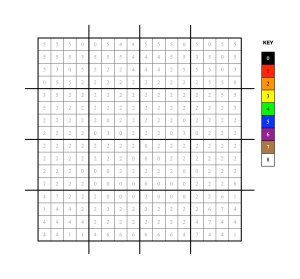
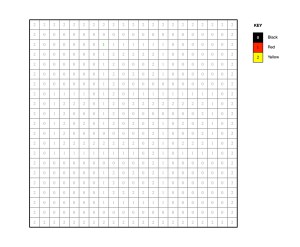
Colour in these pixel puzzles by using the key to tell you what colour each pixel should be.
What algorithm do you use to colour the picture?
Here are three different ways, three different algorithms:
- Work along the rows colouring each pixel in turn (changing pens as needed) before moving to the next row.
- Pick a colour then work along the rows, colouring pixels of only that colour. When you get to the end of the grid, pick the next colour and start again. Repeat this until you run out of colours.
- Pick an uncoloured square and colour it, then colour all pixels around it that are the same number, moving outwards until their are no more adjacent pixels with that number. Then pick a new uncoloured square and repeat until the whole picture is done.
The puzzles with solutions

Subscribe to be notified whenever we publish a new post to the CS4FN blog.
This blog is funded by EPSRC on grant EP/W033615/1.


 cs4fn
cs4fn 