
We’ll be at the Centre of the Cell “Celebrating Science” event on Thursday 29th August from 12 noon until 4pm. It’s free – come and say hello.

Centre of the Cell, Blizard Institute, 4 Newark Street, Whitechapel, London, E1 2AT.
Tel: 0207 882 2562
Find @CS4FN on social media Twitter / Mastodon / BlueSky
Blink! Guess The 5-Letter Word

Blink! is a game you can play with pen and paper and at least 2 people (or a bigger group). One person thinks of their own 5-letter word (or can choose one from our list*) – they are the word-knower. Everyone else has to guess what it is, they’re the guessers.
- The word-knower isn’t allowed to speak, they can only blink to indicate ‘YES’. If they don’t blink that’s a ‘NO’.
- The guessers can ask any yes/no question and wait for a blink.
One way to start is by going through the alphabet, letter by letter, and writing down the letter when the word-knower blinks. Gradually people might want to use their computational thinking skills to improve on this process, and develop a letter-searching strategy to save time. See Al-Kindi and Frequency Analysis below.
Note to teachers, home educators and parents: this isn’t charades and no-one needs to act out the word, only to spell it.
This game is based on our free booklet “Searching To Speak” about Jean-Dominique Bauby who became ill and was no longer able to speak. He wrote an entire book (‘The Diving Bell and the Butterfly’) just by blinking his dictation.
*List of five-letter words to blink, or make your own
We have a plain text file and one you can print onto labels (e.g. P21 or L7160) to attach to card.
Download a free PDF of “Searching To Speak”
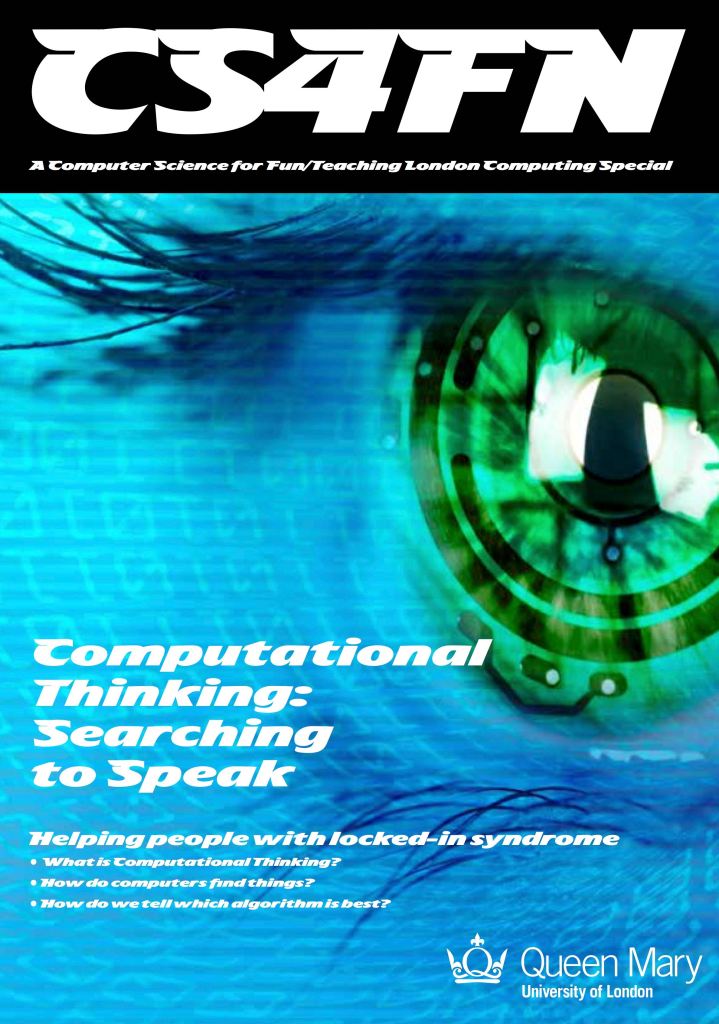
Explore the design of an algorithm to allow someone with locked-in syndrome to communicate. Locked-in syndrome is a condition resulting from a stroke where a person is totally paralysed. They can see, hear and think but cannot speak. How could a person with Locked-in syndrome write a book? How might they do it if they knew some computational thinking?
Download in English or a Dutch translation.
You can download all of our free magazines and booklets here.
Some articles on computer science and disability
Or click this link to read “T.V. Raman and his virtual guide dogs“.
Or click this link to read “Involving disabled people in the design of ICT tools and devices“.
Or click this link to read “Art Touch and Talk Tour Tech“.
We have even more articles on Neurodiversity and Disability in Computer Science in our portal linked below, and a magazine on Diversity in Computing.
Or click this link to read our “Neurodiversity and Disability in Computer Science” portal.

You can download a free PDF copy of Issue 29 of the CS4FN magazine all about diversity in computer science: “Diversity – Computing by all, working for all“.
al-Kindi and Frequency Analysis
It takes a long time to spell out a word by blinking YES for each letter, particularly if you start at A and go all the way through to Z to find the first letter of the word ‘zebra’. A way to speed things up is to consider the language of the word you’re guessing. In the English language the letter Q is almost always followed by the letter U, but the letter U is more common than Q because it can appear in words without a Q in them. The most common letter in English is the letter E, but many of our words start with C, P, D or S.
Not only can you use this as a potential strategy to spell a word more quickly, you can even use it to crack codes!
Or click this link to read “Frequency Analysis For Fun“.
Also on our stall
1. Colouring in
2. Magic books
Shortlink for this page: https://bit.ly/cs4fnfindingthewords.
Admin link to edit this page.
QR Code for this page:
Subscribe to be notified whenever we publish a new post to the CS4FN blog.
This blog is funded by EPSRC on research agreement EP/W033615/1.

 cs4fn
cs4fn 