
Recreate the drawing from the coordinates
One way computers store images is as a set of points (as coordinates) that make up lines and shapes.
This is the basis for the kind of computer graphics called Vector Graphics.
Here are some join-the-dot puzzles based on the idea. Can you recreate the original drawing? A coordinate conundrum is a Vector Image.
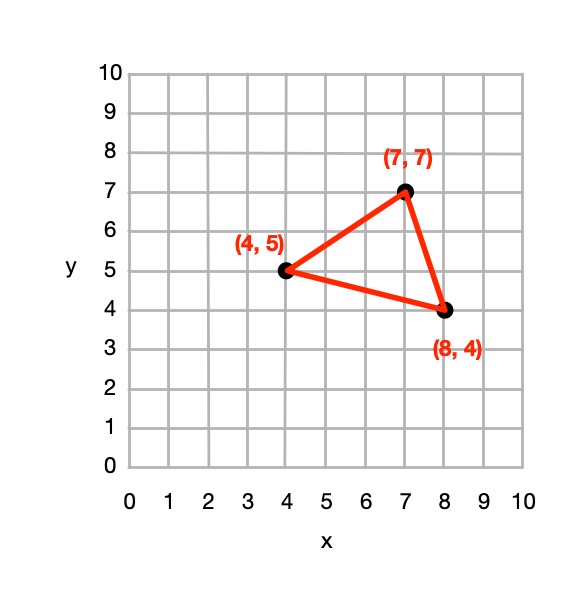
Points on a grid can be represented by pairs of numbers called coordinates. The first, x coordinate, says how far to go along horizontally. The second, y coordinate, says how far to go up, vertically. The numbers along the axes (along the bottom and up the side) of the grid give the distance in that direction. Draw the point at the place you end up at! So for example the coordinate (4,5) means go right from the origin 4 and up 5 and plot the point there.

You can join any two coordinates with lines. If a series of lines join back to the original one then it make a shape (a polygon), which can be coloured in. For example, if we plot the points (4,5), (7,7 and (8,4) drawing lines between them and back to (4,5) we make a triangle.
From 4 points we could define a square, rectangle or more general quadrilateral shape and so on.
So from a set of instructions telling you where to plot points, you can create a picture out of all the shapes and lines that make up the picture, giving colours for the lines or shapes.
This (and so these puzzles) is the basis of how programs in the language SVG (Scalable Vector Graphics) work to store a drawing as the instructions needed to recreate it. Drawing programs often store illustrations that the artists using them draw as an SVG program.
How to solve them
Each picture is made of shapes, each given by a colour and a list of the coordinates of its vertices (corners). For each shape:
1. Plot the list of (x,y) coordinates on the grid as dots.
2. Join the dots (which start and end at the same place) to make the shape.
3. Colour the shape you have made with the colour at the start of the list.
So, for example, if the first instruction starts: red (5,24) … that means plot the point 5 along and 24 up. It starts a new shape, coloured red, that ends at the same point.
If the series of points do not join back to the start then they represent coloured lines rather than a coloured shape,
Example: Semaphore flag
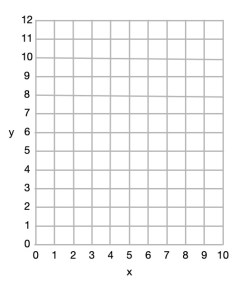
Here is a simple example to draw a red and yellow semaphore flag, given the shapes:
- red (0,10) (10,10) (10,0) and back to (0,10)
- yellow (0,10) (10,0) (0,0) and back to (0,10)
From this we can draw the picture.
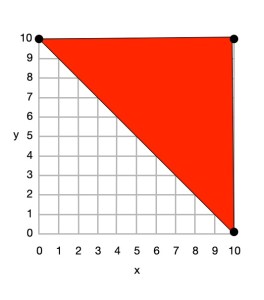
First we plot the points given for the red shape (a triangle), join the dots and colour it in.
- red (0,10) (10,10) (10,0) and back to (0,10)

Then we plot the points given for the yellow shape (another triangle), join the dots and colour it in.
- yellow (0,10) (10,0) (0,0) and back to (0,10)
Try the puzzles below either by printing off the puzzle sheet or drawing on squared paper. Find out more about Vector Graphics here.
Puzzles and Solutions
Puzzle 1: Knightly defence
This knightly picture needs a 10×12 grid. The shapes are:
red (5,5) (6,4) (5,1) (4,4) and join back to (5,5)
green (1,7) (2,8) (3,7) (2,6) and back to (1,7)
green (4,7) (5,8) (6,7) (5,6) and back to (4,7)
green (7,7) (8,8) (9,7) (8,6) and back to (7,7)
blue (1,11) (2,11) (2,10) (3,10) (3,11) (4,11) (4,9) (1,9) and back to(1,11)
blue (6,11) (7,11) (7,10) (8,10) (8,11) (9,11) (9,9) (6,9) and back to (6,11)
yellow (0,12) (10,12) (9,4) (8,2) (6,0) (4,0) (2,2) (1,4) and back to (0,12)
Download the:
Puzzle 2: Summer
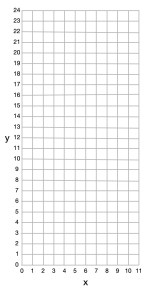
This summer picture needs a 11×24 grid. The shapes are:
red (5,24) (6,24) (7,23) (7,22) (4,22) (4,23) and join back to (5,24)
pink (8,22) (3,22) (1,20) (0,18) (1,15) (10,15) (11,18) (10,20) and back to (8,22)
orange (11,15)  (11,13) (0, 13) (0,15) and back to (11,15)
orange (10,13) (6,0) (5,0) (1,13) and back to (10,13)
Download the:
Puzzle 3: Minibeast
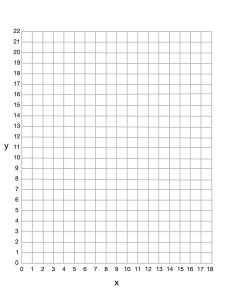
This mini-beast picture needs an 18×22 grid. The shapes and lines are:
yellow (3,17) (4,18) (5,18) (6,17) (6,16) (5,15) (4,15) (3,16) and join back to (3,17)
yellow (12,17) (13,18) (14,18) (15,17) (15,16) (14,15) (13,15) (12,16) and back to (12,17)
purple (4,7) (5,8) (6,8) (7,7) (7,6) (6,5) (5,5) (4,6) and back to (4,7)
purple (11,7) (12,8) (13,8) (14,7) (14,6) (13,5) (12,5) (11,6) and back to (11,7)
yellow (1,12) (3,11) (7,13) (8,9) (8,2) (7,1) (3,0) (1,3) (0,9) and back to (1,12)
yellow (10,2) (10,9) (11,13) (15,11) (17,12) (18,9) (17,3) (15,0) (11,1) and back to (10,2)
red (9,0) (8,2) (8,9) (7,13) (8,19) (9,20) (10,19) 11,13) (10,9) (10,2) and back to (9,0)
purple (0,13) (1,18) (2,20) (4,20) (8,19) (7,13) (3,11) (1,12) and back to (0,13)
purple (10,19) (14,20) (16,20) (17,18) (18,13) (17,12) (15,11) (11,13)  and back to (10,19)
LINES black (7,22) (9,20)
Download the:
Puzzle 4: Exotic bird
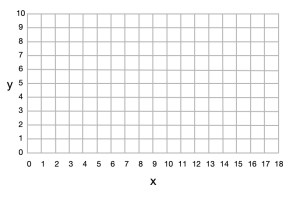
This avian picture needs an 18×10 grid. The shapes are:
green (0,2) (1,7) (3,10) (2,6) (2,4) and join back to (0,2)
red (0,1) (0,2) (2,3) (3,5) (4,6) (4,4) (5,3) (4,2) (5,0) (3,1) and back to (0,1)
yellow (8,3) (9,4) (10,4) and back to (8,3)
red (12,3) (14,8) (13,2) and back to (12,3)
yellow (14,1) (15,2) (18,1) and back to (14,1)
blue (4,2) (7,3 )(8,4) (9,4) (8,3) (10,4) (11,3) (14,9) (17,10) (15, 8) (14,3) (15,3) (15,2) (14,1) (18,1) (17,0) (12,1) (10,1) (8,2) and back to (4,2)
Download the:
Create your own
Now create your own puzzles. Draw a picture out of shapes on squared paper. Colour in the shapes, then work out the sequences of coordinates for each.
Subscribe to be notified whenever we publish a new post to the CS4FN blog.
This blog is funded by EPSRC on research agreement EP/W033615/1.

 cs4fn
cs4fn 